7. Principle of equivalence continued; parallel transport.
TL;DR
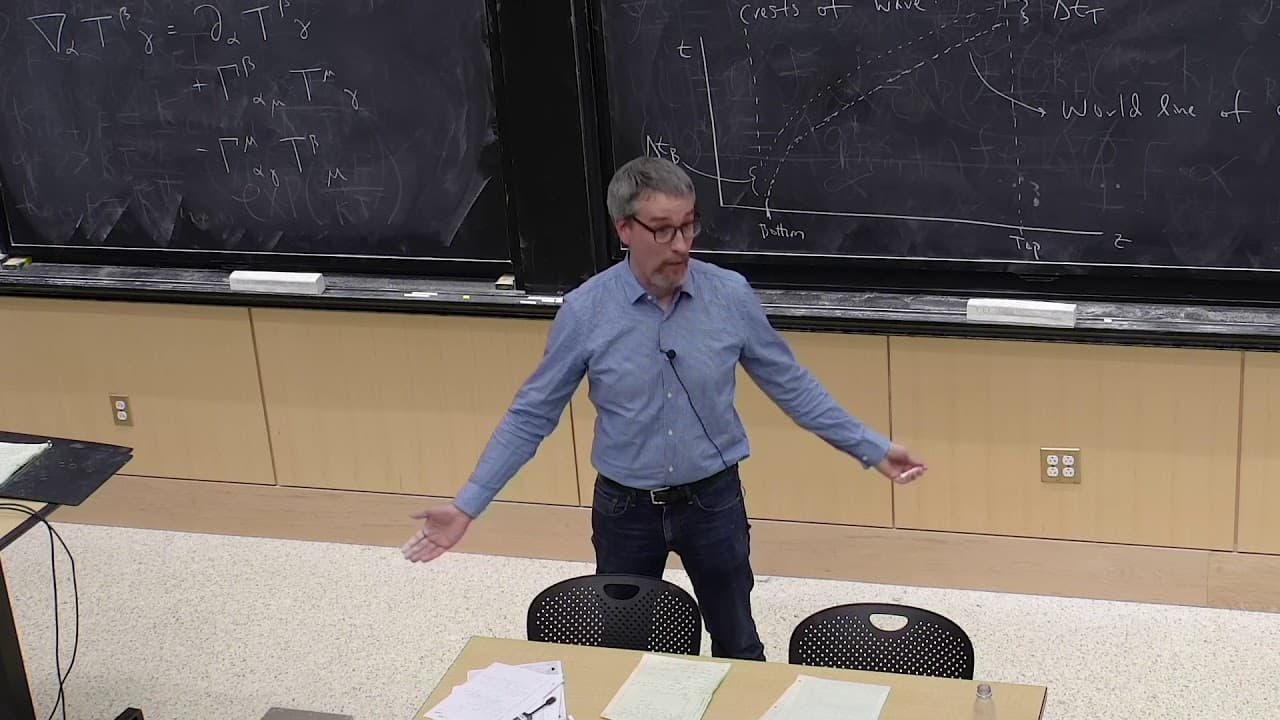
This lecture introduces the principle of equivalence and discusses the concept of curvature in general relativity.
Transcript
[SQUEAKING] [RUSTLING] [CLICKING] SCOTT HUGHES: All right, good afternoon. So today's lecture is a particularly important one. We are going to introduce the main physical principle that underlies general relativity. We'll be spending a bunch of time connecting that principle to the mathematics as the rest of the term unwinds. But today is where we'... Read More
Key Insights
- ❓ The principle of equivalence states that gravity and acceleration are equivalent.
- 🖼️ Local Lorentz frames are freely falling frames that experience no net acceleration and are the most natural generalization of inertial frames.
- 👀 Finding a coordinate system that makes the spacetime metric look like that of special relativity locally involves counting constraints and degrees of freedom in the coordinate transformation.
- ❓ Curvature in a curved manifold represents the deviation of initially parallel trajectories and affects the comparison and differentiation of vectors and tensors.
Install to Summarize YouTube Videos and Get Transcripts
Explore YouTube Video Summarizer or Get YouTube Transcript Extractor
Questions & Answers
Q: What is the principle of equivalence?
The principle of equivalence states that the motion of freely falling particles in a gravitational field cannot be distinguished from uniform acceleration. In other words, gravity and acceleration are equivalent.
Q: What are local Lorentz frames?
Local Lorentz frames are frames of reference that are freely falling and experience no net acceleration. They are considered the most natural generalization of inertial frames in general relativity.
Q: How can we find a coordinate system that makes the spacetime metric look like that of special relativity?
The calculation involves counting the number of constraints and degrees of freedom in the coordinate transformation. By comparing them, we can determine if there is enough freedom to make the spacetime metric look like that of special relativity.
Q: What is the significance of curvature in understanding vectors and tensors in curved spacetime?
Curvature represents the deviation of initially parallel trajectories in a curved manifold. In curved spacetime, vectors and tensors can only be compared and differentiated through parallel transport, which accounts for the changing tangent spaces along curves.
Summary & Key Takeaways
-
The lecture begins by introducing the principle of equivalence, which states that the motion of freely falling particles due to gravity cannot be distinguished from uniform acceleration.
-
The concept of local Lorentz frames is discussed, which are frames of reference that are freely falling and experience no net acceleration.
-
The lecture then explains how to find a coordinate system that makes the spacetime metric look like that of special relativity, but only locally.
-
The calculation involves counting the number of constraints and degrees of freedom in the coordinate transformation.
-
The lecture concludes by highlighting the importance of curvature in understanding the behavior of vectors and tensors in curved spacetime.
Read in Other Languages (beta)
Share This Summary 📚
Summarize YouTube Videos and Get Video Transcripts with 1-Click
Try YouTube Summary with ChatGPT & Claude or YouTube Transcript Generator
Explore More Summaries from MIT OpenCourseWare 📚


Summarize YouTube Videos and Get Video Transcripts with 1-Click
Try YouTube Summary with ChatGPT & Claude or YouTube Transcript Generator