What Is the Purpose of 'if __name__ == __main__' in Python?
TL;DR
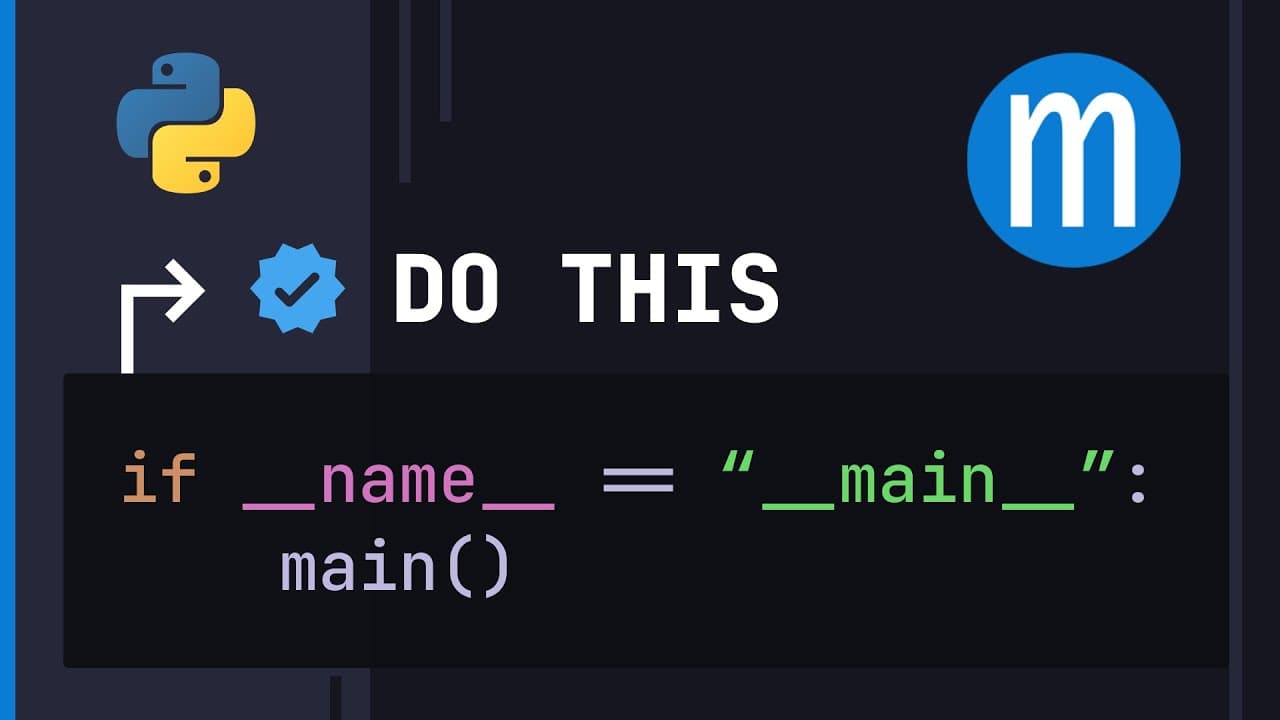
'if name == 'main'' signals that a Python script is intended to be executed directly rather than imported as a module. This idiom enhances code clarity by organizing the primary logic within a main function, preventing naming conflicts and unintended executions when importing. It also simplifies testing and improves code maintainability.
Transcript
hello and welcome i'm james murphy from mCoding and today we're going to be talking about the def main if name main idiom in python and why you should be using it in all of your scripts first off not every file is a script by a script i mean a file that you intend to run not a library so something like this that just defines a function th... Read More
Key Insights
- 💳 The "def main if name == 'main'" idiom provides clarity and signals the purpose of the Python script as a standalone executable.
- 🆘 It helps prevent naming conflicts and unintended side effects by encapsulating the main logic within a function.
- 🏃 Editors like PyCharm recognize the idiom and provide options to run scripts directly, improving the development experience.
- 👻 Using the idiom allows for better code organization and makes it explicit whether a file is meant to be run or imported as a library.
- 🥺 Without the idiom, importing a script file can lead to unexpected code execution and make testing more challenging.
- 😥 The idiom also allows for the creation of an entry point to a program that can be called from other scripts without spawning new processes.
- 😒 With the use of the idiom, code readability and maintainability are improved, making it easier for other developers to understand the intended usage of a file.
Install to Summarize YouTube Videos and Get Transcripts
Explore YouTube Video Summarizer or Get YouTube Transcript Extractor
Questions & Answers
Q: What is the purpose of using the "def main if name == 'main'" idiom in Python scripts?
The idiom is used to signal that a Python script is meant to be run as a standalone program and not just imported as a library. It improves code organization and prevents confusion for other programmers.
Q: What is the significance of the "name" variable when using this idiom?
The "name" variable holds the name of the current module. When running a script directly, the "name" value is set to "main", indicating that the script is the main entry point.
Q: Why is it recommended to define the main logic of a script within a "main()" function?
Defining the main logic within a "main()" function instead of the "if name == 'main'" block allows for better code encapsulation and reduces the risk of unintended side effects or global variable conflicts.
Q: How does using the "def main if name == 'main'" idiom improve code testing?
Without the idiom, importing the script file automatically runs the code, making it difficult to test the script in isolation. With the idiom, the main logic can be encapsulated in the "main()" function, allowing for easier testing without side effects.
Key Insights:
- The "def main if name == 'main'" idiom provides clarity and signals the purpose of the Python script as a standalone executable.
- It helps prevent naming conflicts and unintended side effects by encapsulating the main logic within a function.
- Editors like PyCharm recognize the idiom and provide options to run scripts directly, improving the development experience.
- Using the idiom allows for better code organization and makes it explicit whether a file is meant to be run or imported as a library.
- Without the idiom, importing a script file can lead to unexpected code execution and make testing more challenging.
- The idiom also allows for the creation of an entry point to a program that can be called from other scripts without spawning new processes.
- With the use of the idiom, code readability and maintainability are improved, making it easier for other developers to understand the intended usage of a file.
- Although the idiom requires a small amount of extra typing, the benefits it provides in terms of organization and clarity outweigh the minimal effort required to implement it.
Summary & Key Takeaways
-
The "def main if name == 'main'" idiom is used to distinguish Python scripts meant to be run from files meant to be imported as libraries.
-
It allows for clearer code organization and helps prevent naming conflicts and unintended side effects.
-
Using this idiom improves code readability and provides clarity for other programmers on how the file should be used.
Read in Other Languages (beta)
Share This Summary 📚
Summarize YouTube Videos and Get Video Transcripts with 1-Click
Try YouTube Summary with ChatGPT & Claude or YouTube Transcript Generator
Explore More Summaries from mCoding 📚


Summarize YouTube Videos and Get Video Transcripts with 1-Click
Try YouTube Summary with ChatGPT & Claude or YouTube Transcript Generator