L21.1 General computation of the phase shifts
TL;DR
This content discusses scattering and phase shifts in quantum mechanics and explains how to compute phase shifts using the radial Schrodinger equation.
Transcript
PROFESSOR: Today, we continue with scattering. And we begin by reviewing what were the main ideas that have already been explored. And here they are. I've summarized the main results on the blackboard. And we begin with an expansion of our solutions for the case of central potentials. This psi effect represents a solution away from the scattering c... Read More
Key Insights
- 🦾 Scattering in quantum mechanics involves understanding the behavior of particles encountering a potential region known as the scattering center.
- 🖐️ Phase shifts play a crucial role in describing the scattering process and can be calculated using the radial Schrodinger equation.
- 👻 Matching the solutions inside and outside the scattering region allows for the determination of the phase shifts.
Install to Summarize YouTube Videos and Get Transcripts
Explore YouTube Video Summarizer or Get YouTube Transcript Extractor
Questions & Answers
Q: What is the significance of the scattering center in the context of scattering in quantum mechanics?
The scattering center is the region where particles encounter a potential. It plays a crucial role in determining the behavior of scattered particles and influences the phase shifts observed in the scattering process.
Q: How are phase shifts related to the scattering solution and the ratio of coefficients Bl over Al?
The phase shifts are determined by the tangent of the phase shift angle, which is given by the ratio of the coefficients Bl over Al. These coefficients are obtained from the solutions of the radial Schrodinger equation and provide information about the scattering process.
Q: What is the role of the scattering amplitude in relation to the phase shift?
The scattering amplitude, denoted as f of k, is related to the phase shift and represents the scattering solution far away from the scattering source. It contributes to the cross-section of the scattering process, and each phase shift contributes to the total cross-section.
Q: How can phase shifts be computed using the radial Schrodinger equation?
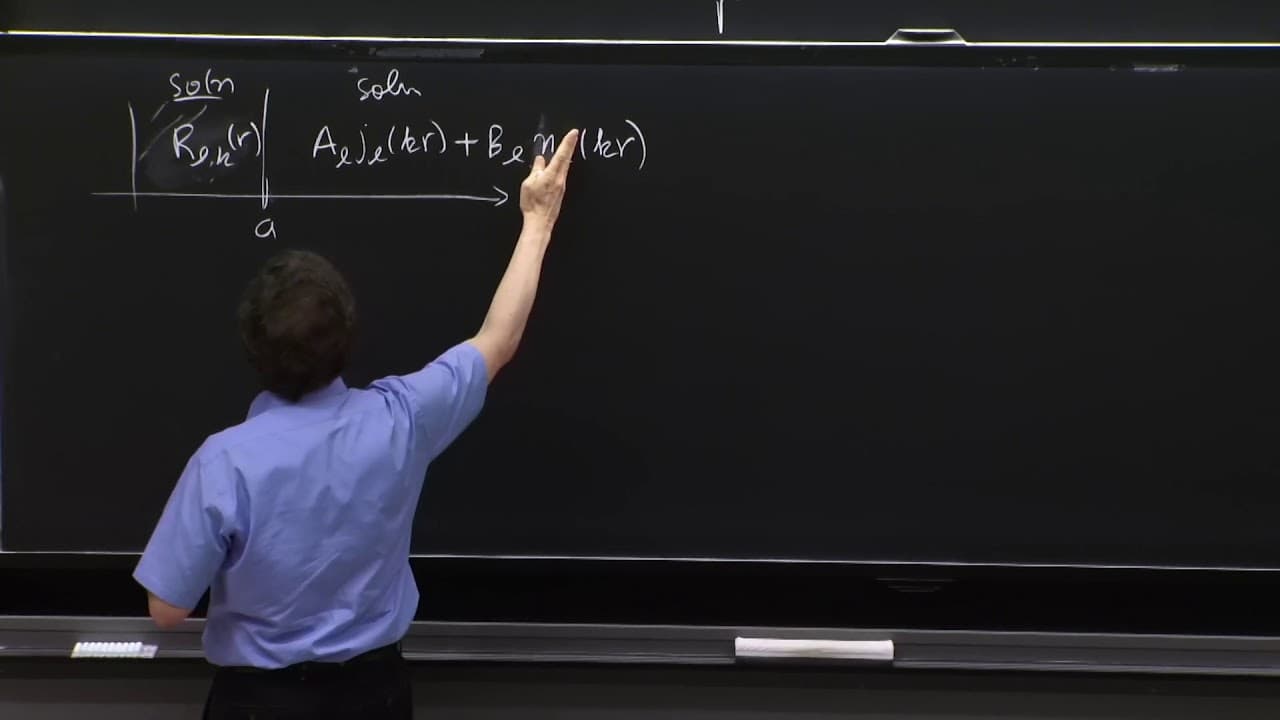
To compute phase shifts, the radial Schrodinger equation needs to be solved for the region inside the scattering potential. The solutions for this region are then matched to the solutions outside the potential. By dividing the derivatives of the solutions and solving for tangent delta, the phase shifts can be determined.
Summary & Key Takeaways
-
The content reviews the main ideas of scattering and introduces the concept of phase shifts in the context of central potentials.
-
The radial Schrodinger equation is presented as the equation that needs to be solved to compute phase shifts.
-
The process of matching the solutions inside and outside the scattering region is explained, and the algorithm for calculating phase shifts is provided.
Read in Other Languages (beta)
Share This Summary 📚
Summarize YouTube Videos and Get Video Transcripts with 1-Click
Try YouTube Summary with ChatGPT & Claude or YouTube Transcript Generator
Explore More Summaries from MIT OpenCourseWare 📚



Summarize YouTube Videos and Get Video Transcripts with 1-Click
Try YouTube Summary with ChatGPT & Claude or YouTube Transcript Generator