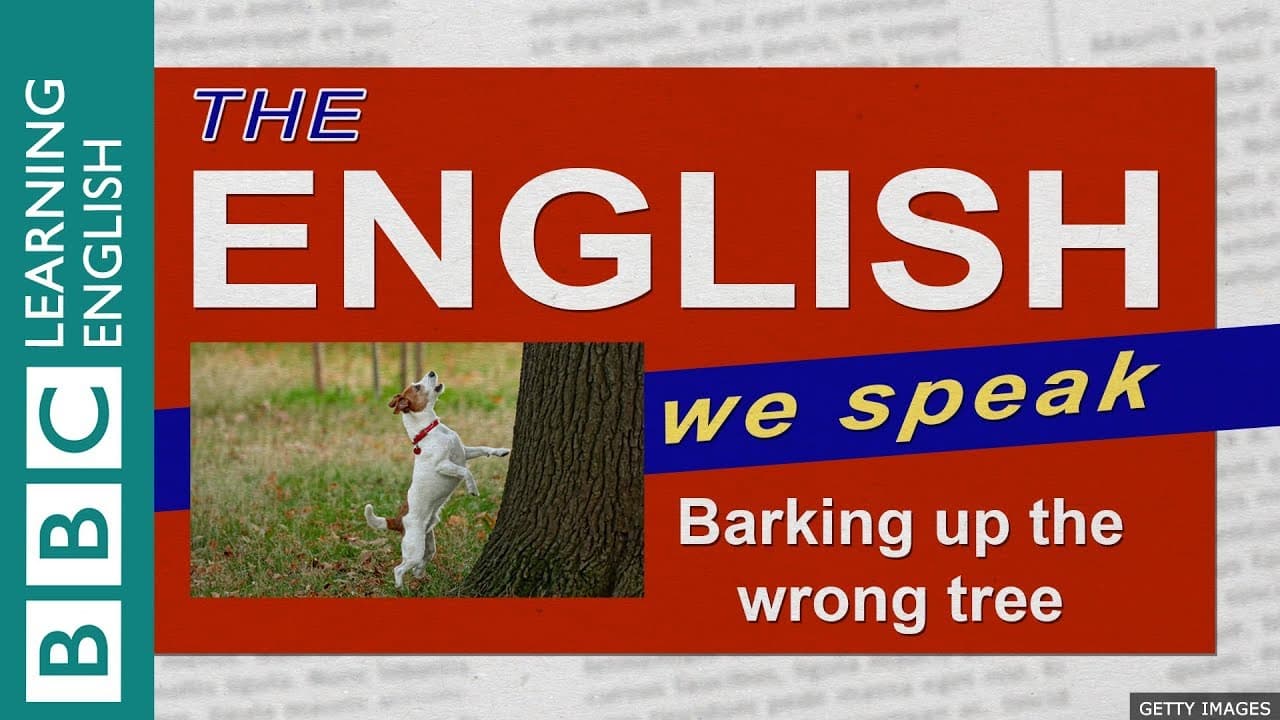
Barking up the wrong tree: The English We Speak
TL;DR
Feifei learns the meaning of 'barking up the wrong tree'.
Transcript
Feifei: Hello and welcome to The English We Speak. I'm Feifei... Rob: And I'm Rob. Hello. Errr, Feifei, you're looking a bit angry. Feifei: Me, angry! I am angry. Rob: Oh no, what's the problem? Feifei: I think you know Rob. Somebody told the boss that I spilt coffee over his computer yesterday - and now he's angry with me. Rob: Oh no. What kind of... Read More
Key Insights
- The phrase 'barking up the wrong tree' is used when someone makes a wrong assumption about a situation or person.
- Rob clarifies to Feifei that he did not inform the boss about the coffee spill incident.
- Feifei apologizes to Rob after realizing she wrongly accused him of telling the boss.
- The expression can also refer to doing something in a way that is ineffective or unproductive.
- Examples provided include not having enough money, not being the source of a rumor, and not lending a car.
- The show aims to teach English phrases in a conversational and relatable context.
- The English We Speak is part of a series offering various English learning content throughout the week.
- The program encourages viewer engagement and comments to enhance learning experiences.
Install to Summarize YouTube Videos and Get Transcripts
Explore YouTube Video Summarizer or Get YouTube Transcript Extractor
Questions & Answers
Q: What does 'barking up the wrong tree' mean?
The phrase 'barking up the wrong tree' is used when someone makes a wrong assumption about a situation or a person. It suggests that the person is directing their efforts or accusations in the wrong direction, much like a dog barking at the wrong tree.
Q: Why was Feifei angry in the episode?
Feifei was angry because someone informed the boss about her accidentally spilling coffee on his computer. She assumed Rob was the one who told the boss, which led to her frustration and confrontation with him during the episode.
Q: How did Rob respond to Feifei's accusation?
Rob responded to Feifei's accusation by using the phrase 'barking up the wrong tree' to indicate that she was mistaken. He clarified that he was not the one who informed the boss and explained the meaning of the phrase to help Feifei understand her error.
Q: What examples were used to illustrate the phrase?
Examples used to illustrate the phrase included scenarios where someone wrongly assumes another person has enough money to pay for a holiday, wrongly believes someone spread a rumor, or mistakenly thinks someone will lend them a car despite their driving habits.
Q: What is the purpose of The English We Speak series?
The English We Speak series aims to teach English phrases and expressions in a conversational and relatable context. By presenting these phrases through everyday scenarios, the series helps learners understand and use them effectively in real-life conversations.
Q: What other content does BBC Learning English offer?
BBC Learning English offers a wide range of content, including grammar lessons, news reviews, workplace English, language hacks, and short English lessons. The content is designed to help learners improve various aspects of their English skills, including vocabulary and pronunciation.
Q: How does the show engage with its audience?
The show engages with its audience by encouraging viewers to leave comments and participate in discussions. This interaction helps learners practice their English skills, share their thoughts, and receive feedback, creating a more interactive and supportive learning environment.
Q: What is the format of the episode discussed?
The format of the episode involves a dialogue between the hosts, Feifei and Rob, who discuss the phrase 'barking up the wrong tree' through a relatable scenario. The episode includes explanations, examples, and a resolution, making it an effective tool for language learning.
Summary & Key Takeaways
-
In this episode of The English We Speak, Feifei accuses Rob of telling the boss about a coffee spill. Rob denies the accusation, explaining the phrase 'barking up the wrong tree', which means making a wrong assumption. Feifei apologizes, understanding the phrase's meaning.
-
The phrase 'barking up the wrong tree' is explored through various examples, illustrating its use in everyday situations. It implies making a wrong assumption or pursuing an ineffective approach. The discussion is part of a broader series aimed at improving English language skills.
-
The English We Speak is a segment within a larger series of educational videos produced by BBC Learning English. The series covers different aspects of the English language, including grammar, vocabulary, and pronunciation, and encourages audience interaction through comments.
Read in Other Languages (beta)
Share This Summary 📚
Summarize YouTube Videos and Get Video Transcripts with 1-Click
Try YouTube Summary with ChatGPT & Claude or YouTube Transcript Generator
Explore More Summaries from BBC Learning English 📚
Summarize YouTube Videos and Get Video Transcripts with 1-Click
Try YouTube Summary with ChatGPT & Claude or YouTube Transcript Generator