Data Types in Java Reference
TL;DR
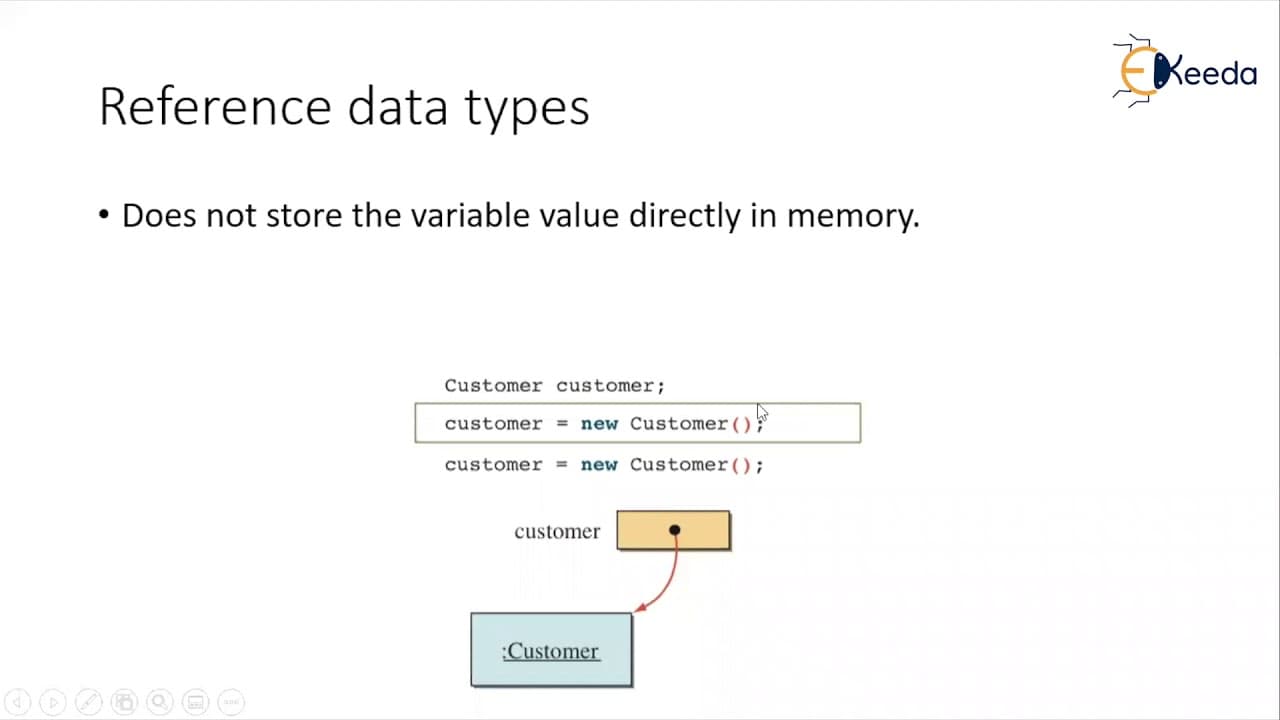
This session discusses the storage and types of reference data in Java, including class, array, and interface types.
Transcript
hello everyone welcome to the next session of portion in this session we are going to discuss about one more data type of Java which is reference data so we will discuss about what our references are types and how we can have reference data types stored into memory so first of all let's understand what is a reference data we have already discussed ... Read More
Key Insights
- 🏪 Reference data types in Java store the address of dynamically created objects.
- 🅰️ There are three types of reference data: class, array, and interface types.
- 🅰️ Reference variables can refer to objects of the declared type or any compatible object.
- 🥹 Reference data members do not hold values themselves but point to the location of the value in memory.
- ❓ The default value of a reference variable is null until it is initialized with an object.
- 🏪 Objects are stored on the heap, and the reference to the object is stored on the stack.
- 🏪 Arrays are also considered reference data members, with the reference stored on the stack and the values stored in the heap.
Install to Summarize YouTube Videos and Get Transcripts
Explore YouTube Video Summarizer or Get YouTube Transcript Extractor
Questions & Answers
Q: What are reference data types in Java?
Reference data types in Java hold the address of dynamically created objects. They are also known as non-primitive data types.
Q: How are reference data members stored in memory?
Reference data members do not hold the values themselves. Instead, they point to the location where the value is stored in memory. The actual object is stored on the heap, and the reference to the object is stored on the stack.
Q: Can a reference variable refer to any compatible object?
Yes, a reference variable can refer to an object of the declared type or any compatible object. For example, if a class implements an interface, the reference variable can also refer to an object of that interface type.
Q: What is the default value of a reference variable?
The default value of a reference variable is always null until it is initialized with an object. Null signifies that the reference variable does not currently point to any object.
Summary & Key Takeaways
-
Reference data types in Java hold the address of dynamically created objects.
-
Three main types of reference data in Java are class, array, and interface types.
-
When creating a reference variable, the default value is always null until it is initialized with an object.
Read in Other Languages (beta)
Share This Summary 📚
Summarize YouTube Videos and Get Video Transcripts with 1-Click
Try YouTube Summary with ChatGPT & Claude or YouTube Transcript Generator
Explore More Summaries from Ekeeda 📚




Summarize YouTube Videos and Get Video Transcripts with 1-Click
Try YouTube Summary with ChatGPT & Claude or YouTube Transcript Generator