How to Use the Ratio Test for Series Convergence
TL;DR
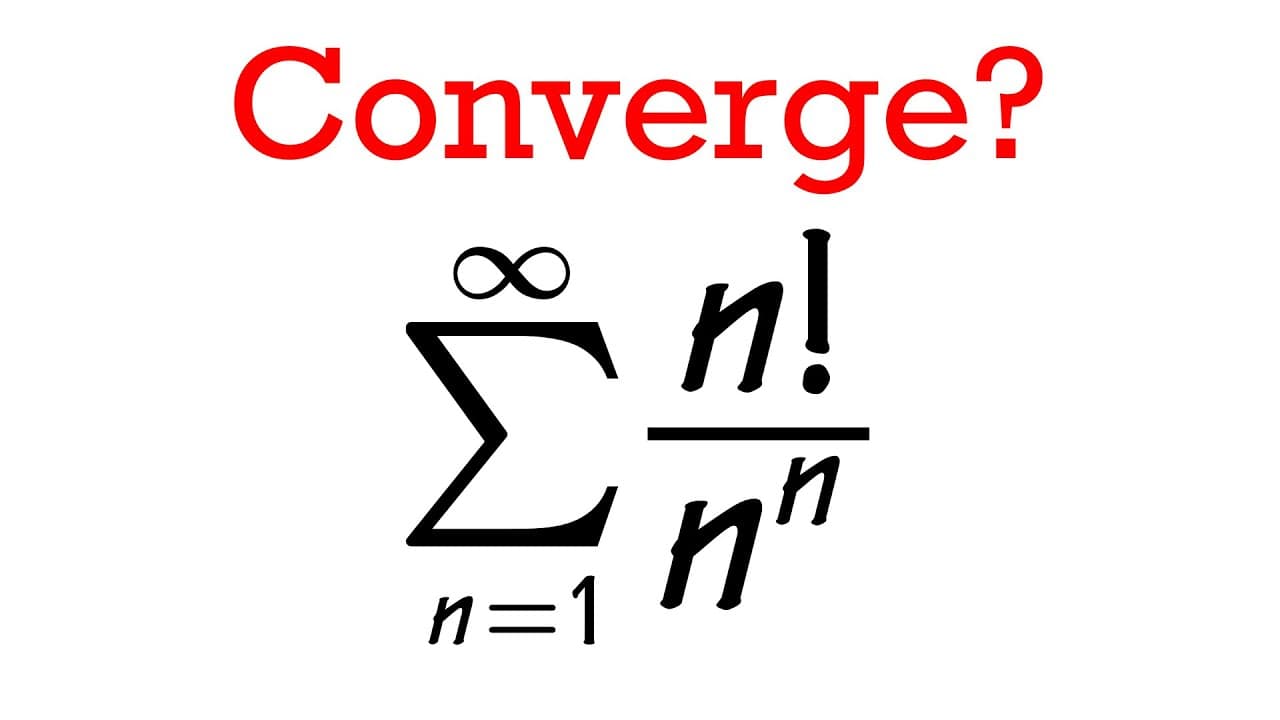
To use the ratio test for series convergence, find the limit of the absolute value of a(n+1)/a(n) as n approaches infinity. For the series in question, this limit simplifies to 1/e, which is less than 1, indicating that the series converges.
Transcript
converge or diverge we have the series 4 M goes from 1 to infinity and factorial over N to the nth power and we see that because we have the factorial and also the ending the exponent this right here is a great simple to use the ratio test right so let's write it down we'll be utilizing the ratio test and as we know to do the ratio test we have to ... Read More
Key Insights
- 😒 The video demonstrates the use of the ratio test to analyze series convergence or divergence.
- 😑 By simplifying the expressions and taking the limit as N approaches infinity, a conclusion is drawn about the behavior of the series.
- 🥳 The value 1/e plays a significant role in determining convergence, as it is the limit obtained when applying the ratio test.
- 🥳 The ratio test is a powerful tool for analyzing series, but its effectiveness depends on the nature of the series being evaluated.
- 🥳 The video emphasizes the importance of understanding factorial and exponentiation simplification when using the ratio test.
- 🙅 The analysis shows that the series in question converges, meaning it approaches a finite limit as N approaches infinity.
- 🥳 The ratio test helps determine whether a series is oscillatory, divergent, or convergent based on the limit obtained.
Install to Summarize YouTube Videos and Get Transcripts
Explore YouTube Video Summarizer or Get YouTube Transcript Extractor
Questions & Answers
Q: What is the purpose of using the ratio test in analyzing series convergence or divergence?
The ratio test is a tool that helps determine whether a series converges or diverges. By comparing the absolute values of a(M+1)/a(M) and taking the limit as N approaches infinity, we can make conclusions about the behavior of the series.
Q: How is the factorial term simplified when applying the ratio test?
To simplify the factorial term, we break down n+1 factorial into the original factorial term multiplied by (n+1) and (n+1) raised to the power of n. This simplification allows for cancellation of terms and easier computation.
Q: What is the significance of the value 1/e in the analysis of the series?
The value 1/e, where e is approximately 2.71828, is the limit obtained when applying the ratio test to the series 4M/(N^n!). Since 1/e is less than 1, this indicates that the series converges.
Q: Can the ratio test be applied to any series to determine convergence or divergence?
The ratio test is applicable to series with terms that involve factorial and exponentiation. It helps determine convergence or divergence by comparing the ratios of consecutive terms. However, it may not be effective for all series, and other methods may need to be used in some cases.
Summary & Key Takeaways
-
The video discusses using the ratio test to analyze the series 4M/(N^n!) to determine convergence or divergence.
-
The ratio test involves taking the limit as N approaches infinity and comparing the absolute values of a(M+1)/a(M).
-
The video simplifies the expression for a(M+1) and breaks down the factorial and exponent terms.
-
By applying the ratio test and simplifying the expression, it is determined that the series converges to 1/e.
Read in Other Languages (beta)
Share This Summary 📚
Summarize YouTube Videos and Get Video Transcripts with 1-Click
Try YouTube Summary with ChatGPT & Claude or YouTube Transcript Generator
Explore More Summaries from blackpenredpen 📚

Summarize YouTube Videos and Get Video Transcripts with 1-Click
Try YouTube Summary with ChatGPT & Claude or YouTube Transcript Generator