12.2 Constraint Condition
TL;DR
The video explains how to find the constraint condition in a system of objects using coordinate functions, allowing for the solution of the system of equations.
Transcript
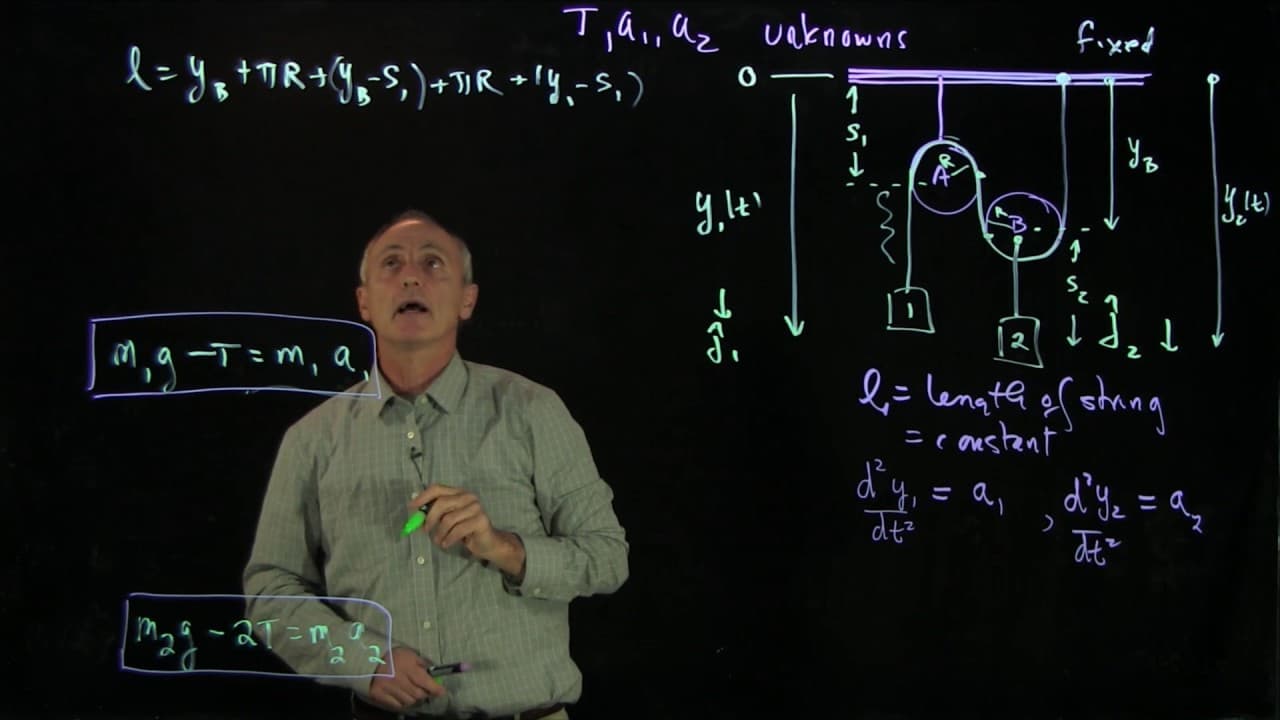
So when we analyzed Newton's Second Law-- applied to this compound system-- we had two equations for Object 1 and Object 2. And what we found is that we had three unknowns-- the tension in the string and the accelerations of the two objects. Now, how do we solve this system? Well, we're missing one condition, which is a constraint condition. Which ... Read More
Key Insights
- ❓ Newton's Second Law applied to a compound system requires the introduction of a constraint condition.
- 😑 Coordinate functions and constants help express the constraint condition and provide additional information for the solution.
- ❓ Two constraint conditions involve the lengths of the strings and the accelerations of the objects.
Install to Summarize YouTube Videos and Get Transcripts
Explore YouTube Video Summarizer or Get YouTube Transcript Extractor
Questions & Answers
Q: What is the purpose of the constraint condition in Newton's Second Law?
The constraint condition ensures that objects in a system move in a specific relationship together, aiding in the solution of the system of equations by providing additional information about the variables involved.
Q: How are coordinate functions introduced in the analysis?
Coordinate functions are introduced for each object in the system, where the derivatives of these functions represent the accelerations of the objects. This allows for a clear understanding of the motion and relationships between the objects.
Q: How do the length of the strings relate to the constraint condition?
The lengths of the strings are constant and can be expressed in terms of the coordinate functions. By analyzing these lengths and their derivatives, relationships between the accelerations of the objects can be determined.
Q: What is the significance of the derived equation a1 = -2a2?
The derived equation shows that the acceleration of Object 1 is equal to negative twice the acceleration of Object 2. This relationship, along with other equations, helps in solving the system of equations.
Summary & Key Takeaways
-
The video discusses the need for a constraint condition when solving a system of objects in Newton's Second Law.
-
The introduction of coordinate functions and constants help express the constraint condition.
-
Two constraint conditions are presented, involving the lengths of the strings and the accelerations of the objects.
-
By analyzing these constraints, the system of equations can be solved.
Read in Other Languages (beta)
Share This Summary 📚
Summarize YouTube Videos and Get Video Transcripts with 1-Click
Try YouTube Summary with ChatGPT & Claude or YouTube Transcript Generator
Explore More Summaries from MIT OpenCourseWare 📚



Summarize YouTube Videos and Get Video Transcripts with 1-Click
Try YouTube Summary with ChatGPT & Claude or YouTube Transcript Generator