How to Pronounce All English Consonant Sounds
TL;DR
To pronounce English consonant sounds correctly, practice pairs like 'p' and 'b' or 't' and 'd', which differ in force but share mouth positioning. Additionally, review single consonants such as 'h', 'l', 'm', and 'n', focusing on how to shape your mouth for each sound. Consistent practice of light and heavy consonants will significantly improve your pronunciation.
Transcript
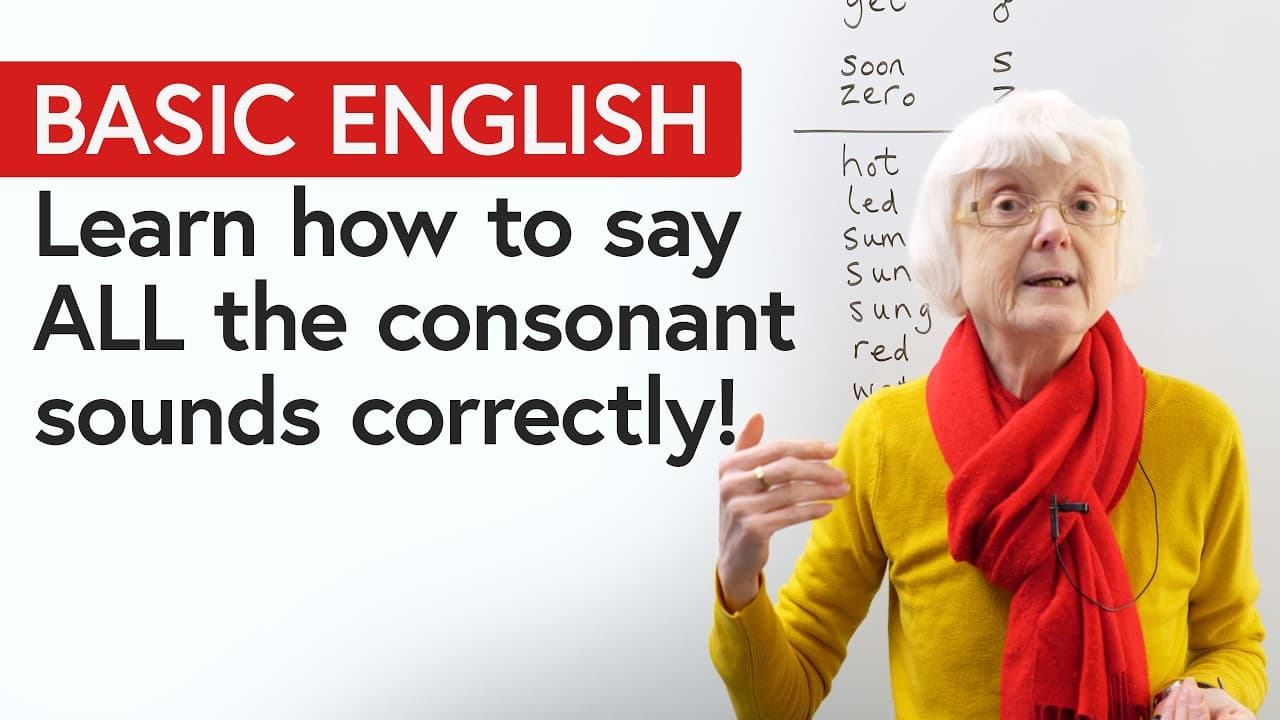
Hello. I'm Gill at engVid, and today's lesson is on consonants in English. Okay? So all the consonant sounds, not the vowel sounds, but the consonant sounds. So, just to explain that the way I've got them written up on the board here is this column here, and then down in this column down to the line, they are pairs of consonants because they are fo... Read More
Key Insights
- 👂 English consonant sounds are divided into pairs and single consonants, each formed in a specific manner.
- 🙂 Light and heavy consonant sounds are distinguished by the force applied and vocal cord engagement.
- 🤑 Understanding how to shape the mouth for consonant sounds is crucial for accurate pronunciation.
- 🔑 Gill provides demonstrations and example words for learners to practice pronunciation effectively.
- 😊 Differentiating between similar sounds like "p" and "b", "t" and "d", helps improve English pronunciation.
- 🤬 The inclusion of phonetic symbols aids learners familiar with this notation in distinguishing different consonant sounds.
- 👂 Consistent practice and repetition of consonant sounds contribute to mastering English pronunciation skills.
Install to Summarize YouTube Videos and Get Transcripts
Explore YouTube Video Summarizer or Get YouTube Transcript Extractor
Questions & Answers
Q: How are English consonant sounds categorized, according to Gill?
English consonant sounds are categorized into pairs, formed similarly but with varying force, and single consonants that do not belong in pairs. Gill demonstrates how to pronounce each pair and single consonant in the lesson.
Q: What is the difference between light and heavy consonant sounds in English?
Light consonant sounds require less force, while heavy consonant sounds require more vocal cord engagement when pronounced in English. This distinction is evident in pairs like "p" and "b", "t" and "d", and "ch" and "j".
Q: Why does Gill include phonetic symbols in the lesson on English consonant sounds?
Gill includes phonetic symbols to showcase the distinct sound each consonant makes, aiding those familiar with phonetic symbols. However, she emphasizes that knowing how to pronounce the sounds is more important than memorizing the symbols.
Q: How does Gill explain the pronunciation of the "r" sound in English?
Gill explains the English "r" sound by instructing learners to curl their tongue back into their mouth, differentiating it from the French "r" sound. She suggests watching another video for further practice on pronouncing the English "r" sound.
Summary & Key Takeaways
-
Gill explains English consonant pairs, formed the same way with differing force, and single consonants.
-
Demonstrates pronunciation of pairs like "p" and "b", "t" and "d", "ch" and "j", amongst others.
-
Touches on single consonant sounds like "h", "l", "m", "n", "r", "w", and "y".
Read in Other Languages (beta)
Share This Summary 📚
Summarize YouTube Videos and Get Video Transcripts with 1-Click
Try YouTube Summary with ChatGPT & Claude or YouTube Transcript Generator
Explore More Summaries from Learn English with Gill · engVid 📚




Summarize YouTube Videos and Get Video Transcripts with 1-Click
Try YouTube Summary with ChatGPT & Claude or YouTube Transcript Generator