Spectrum analyzer | Types | Electrical Instruments ( EIM ) | Lec - 25
TL;DR
Spectrum analyzers display signals by frequency and amplitude for precise analysis.
Transcript
hi everyone in this video we will learn about Spectrum analyzer so Spectrum analyzer is nothing but it is also a display unit it is also a display device like your cro what is the purpose of cro it displays the signal time versus amplitude any type of waveform whether it is a sine square or triangular any type of a bond that is going to be displaye... Read More
Key Insights
- ⌛ A spectrum analyzer converts time-domain signals into the frequency domain, representing them visually for easier analysis.
- 📶 The display of frequency versus amplitude enables users to clearly identify signal strength across various frequencies, which is vital in communications.
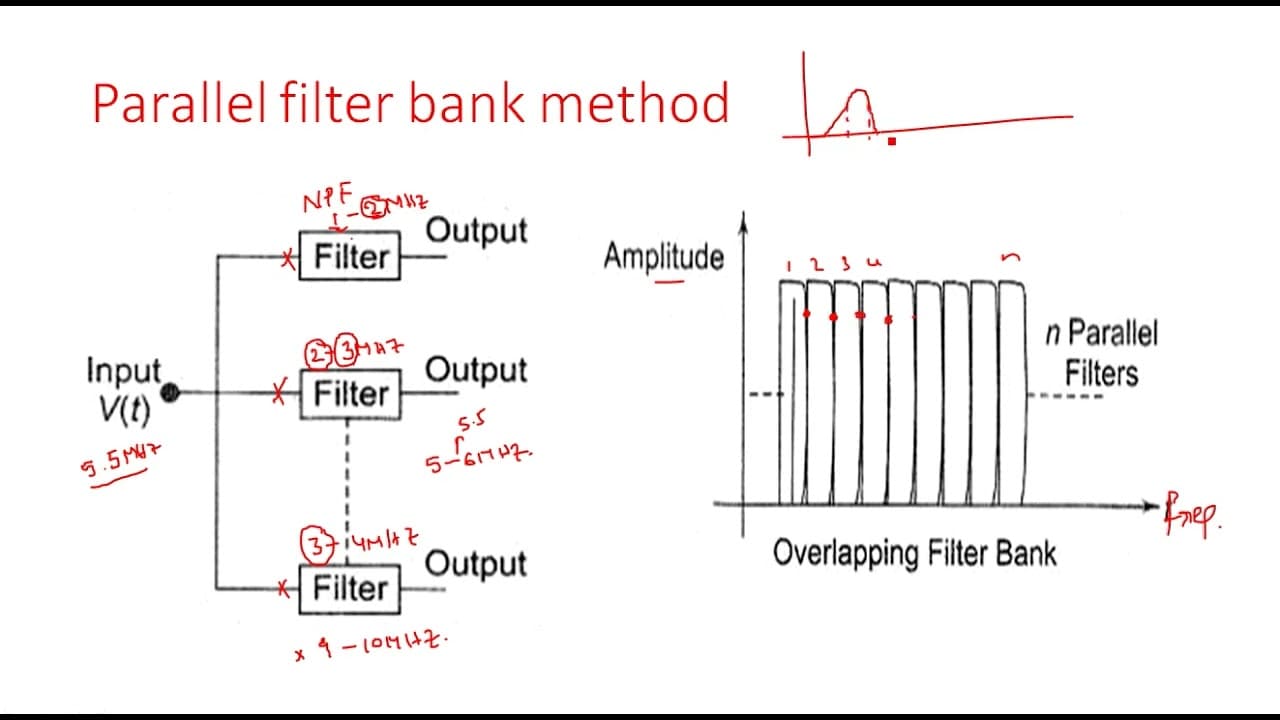
- 😒 Filter bank spectrum analyzers use a series of narrow pass-band filters to enhance measurement accuracy and signal clarity.
- 📡 Heterodyne spectrum analyzers rely on mixing techniques to process signals, allowing for efficient analysis of signals over a wide frequency range.
- 🌸 Overlapping cutoff frequencies in filter bank designs prevent signal loss and ensure continuous frequency coverage, improving analytical results.
- 📊 The graphical representation produced by spectrum analyzers resembles bar charts, displaying amplitude levels rather than traditional waveforms.
- 😁 The manipulation of the electron beam is essential for accurately capturing and displaying the amplitude and frequency of signals on the analyzer screen.
Install to Summarize YouTube Videos and Get Transcripts
Explore YouTube Video Summarizer or Get YouTube Transcript Extractor
Questions & Answers
Q: What is the main function of a spectrum analyzer?
The primary function of a spectrum analyzer is to represent signals graphically by their frequency and amplitude. This allows engineers and technicians to observe the strength and behavior of signals across a range of frequencies, facilitating the identification of unwanted noise and ensuring signal integrity.
Q: How does a filter bank spectrum analyzer work?
A filter bank spectrum analyzer utilizes multiple narrow pass-band filters arranged in parallel. Each filter is tuned to a different frequency range, allowing the analyzer to pass only the signal corresponding to the filter that matches the incoming signal's frequency. This design enhances accuracy and reduces noise by preventing unwanted frequencies from passing through.
Q: What sets heterodyne spectrum analyzers apart from filter bank analyzers?
Heterodyne spectrum analyzers mix an incoming signal with a local oscillator signal to generate an intermediate frequency. This process simplifies the measurement of signals across a wide frequency range and typically involves fewer components, making it suitable for dynamic signal analysis, unlike filter bank analyzers which depend on many specific filters.
Q: Why is overlapping cutoff frequency important in filter bank analyzers?
Overlapping cutoff frequencies in filter bank analyzers are crucial to avoid missing any signal frequencies. By ensuring that the upper cutoff frequency of one filter matches the lower cutoff frequency of the next, the system provides continuous frequency coverage, enabling comprehensive signal analysis without gaps in response.
Q: What does the output of a spectrum analyzer typically look like?
The output of a spectrum analyzer typically appears as a bar chart, representing amplitude values at various frequencies. Unlike oscilloscopes, which display waveforms, this graphical output allows users to quickly assess the presence and strength of multiple frequencies simultaneously, providing insight into signal behavior and quality.
Q: How is the electron beam utilized in a spectrum analyzer?
In a spectrum analyzer, an electron beam is directed and modulated by horizontal and vertical deflection plates, allowing it to create a visual representation of the signal on the display. The modulation is controlled by a Sawtooth generator, which regulates the beam's movement across the screen to correspond with the frequency and amplitude of the analyzed signal.
Q: What advantages do spectrum analyzers offer over oscilloscopes?
Spectrum analyzers provide distinct advantages over oscilloscopes by focusing on frequency domain analysis rather than time-domain. They offer detailed insights into signal strength across frequencies, enabling targeted noise reduction and better assessment of signal interference, which oscilloscopes may not effectively depict.
Q: Can spectrum analyzers capture both analog and digital signals?
Yes, spectrum analyzers are capable of capturing both analog and digital signals. They analyze the frequency components of a signal, regardless of whether the signal is a continuous wave or a series of discrete pulses, making them versatile tools in telecommunications and electronic testing environments.
Summary & Key Takeaways
-
A spectrum analyzer is a display device that visualizes signals in the frequency domain, showing frequency on the x-axis and amplitude on the y-axis, contrasting with oscilloscopes that display time and amplitude.
-
Two primary types of spectrum analyzers are identified: filter bank spectrum analyzers, which use multiple narrow pass-band filters for accuracy, and heterodyne spectrum analyzers, which mix input signals with a local oscillator to derive intermediate frequencies.
-
The spectrum analyzer's output presents the signal graphically, akin to a bar chart that indicates amplitude at specific frequencies rather than waveform shapes, allowing for clear signal analysis and noise elimination.
Read in Other Languages (beta)
Share This Summary 📚
Summarize YouTube Videos and Get Video Transcripts with 1-Click
Try YouTube Summary with ChatGPT & Claude or YouTube Transcript Generator