Products
Features
YouTube Video Summarizer
Summarize YouTube videos
Web & PDF Highlighter
Highlight web pages & PDFs
Chat with PDF
Ask any PDF questions with AI
Ask AI Clone
Chat with your highlights & memories
Audio Transcriber
Transcribe audio files to text
Glasp Reader
Read and highlight articles
Kindle Highlight Export
Export your Kindle highlights
Idea Hatch
Hatch ideas from your highlights
Integrations
Obsidian Plugin
Notion Integration
Pocket Integration
Instapaper Integration
Medium Integration
Readwise Integration
Snipd Integration
Hypothesis Integration
Apps & Extensions
Chrome Extension
Safari Extension
Edge Add-ons
Firefox Add-ons
iOS App
Android App
Discover
Discover
Ideas
Discover new ideas and insights
Articles
Curated articles and insights
Books
Book recommendations by great minds
Posts
Essays and notes from readers
Quotes
Inspiring quotes collection
Videos
Curated videos and summaries
Explore Glasp
Glasp Newsletter
Weekly insights and updates
Glasp Talk
Interview series with great minds
Glasp Blog
Latest news and articles
Glasp Use Cases
Learn how others use Glasp
Build & Support
Glasp API
Access Glasp's API for developers
MCP Connector
Connect Glasp to Claude & ChatGPT
Community
Glasp Reddit Community
Students
Student discount and benefits
FAQs
Frequently Asked Questions
AboutPricing
DashboardLog inSign up

Tense in academic English
117 views
•
November 6, 2022
by
Anthony Pym
YouTube video player
Tense in academic English

TL;DR

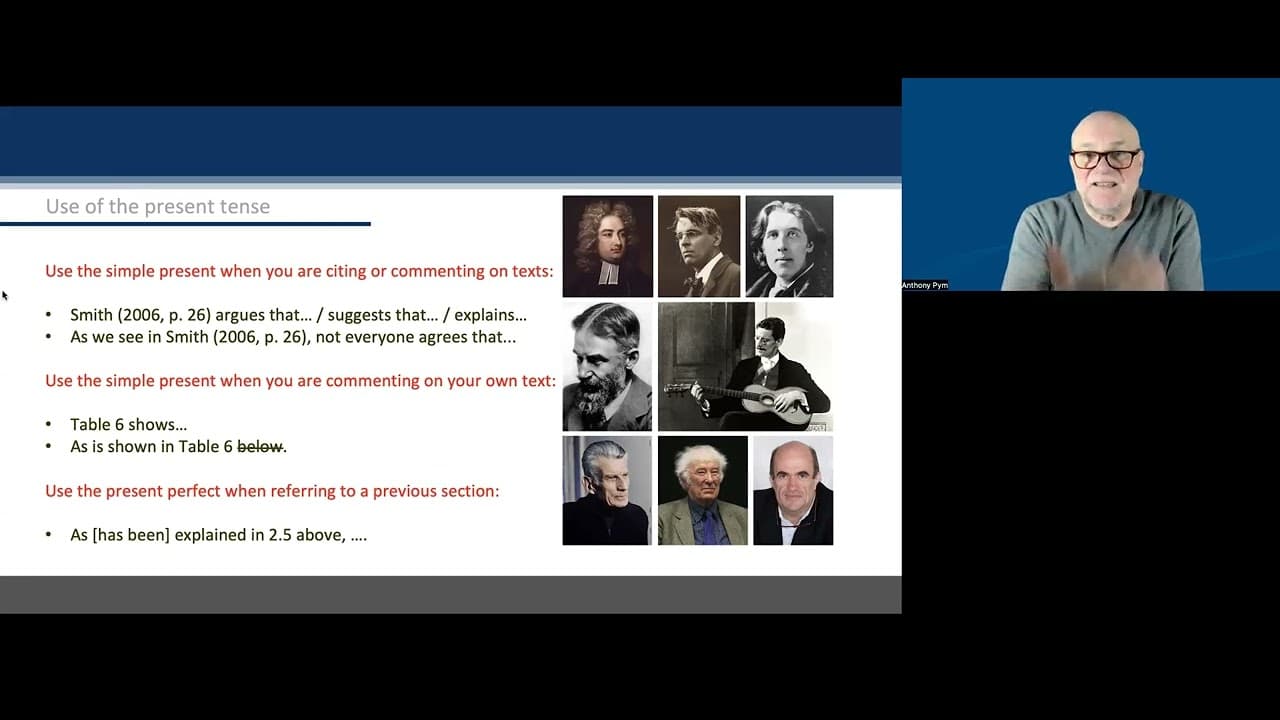
Academic writing should predominantly use the present tense, with exceptions for past actions and future actions.

Transcript

the second main point about academic English especially of the kind you're going to right is the predominance of the present tips all right if in doubt about the tense go for the present it will probably work uh this can happen in your the various parts of your of your dissertation of your paper okay in the introduction there is public debate okay ... Read More

Key Insights

  • ✍️ The present tense is the default tense for academic writing, providing simplicity and consistency.
  • 💯 The present perfect tense is used in the conclusion to summarize findings.
  • 🍝 When discussing or referencing texts, the present tense should be used, even if the text is from the past.

Install to Summarize YouTube Videos and Get Transcripts

Explore YouTube Video Summarizer or Get YouTube Transcript Extractor

Questions & Answers

Q: Why is the present tense commonly used in academic writing?

The present tense is used to maintain consistency and simplify the language in academic writing. It allows for a more straightforward explanation of research and findings.

Q: Should the methodology section be written in the past tense?

No, the methodology section should be written in the present tense. It describes something that has already been done but will be read by the reader in the present.

Q: How should texts be referenced in academic writing?

When referencing texts, the present tense should be used, as the text is considered to be in the present when being read and commented upon.

Q: Is it acceptable to use "above" and "below" to refer to tables or figures?

No, it is not ideal to use "above" or "below" to refer to tables or figures, as their positioning may change when the work is published. Instead, refer to them by their respective numbers.

Summary & Key Takeaways

  • Academic writing should generally use the present tense, even when discussing past events or referencing texts.

  • The methodology section should stick to the present tense, describing something already done.

  • In the conclusion, the present perfect tense should be used to summarize findings.


Read in Other Languages (beta)

English

Share This Summary 📚

Summarize YouTube Videos and Get Video Transcripts with 1-Click

Download browser extensions on:

Try YouTube Summary with ChatGPT & Claude or YouTube Transcript Generator

Explore More Summaries from Anthony Pym 📚
Translating constructive ambiguity thumbnail
Translating constructive ambiguity
Anthony Pym
Don Kiraly, Distributed Cognition in the Translation Classroom thumbnail
Don Kiraly, Distributed Cognition in the Translation Classroom
Anthony Pym
7.1 Equivalence theory vs. Skopos theory thumbnail
7.1 Equivalence theory vs. Skopos theory
Anthony Pym
Andrew Chesterman on Skopos theory (part 1 of 3) thumbnail
Andrew Chesterman on Skopos theory (part 1 of 3)
Anthony Pym
The parts of a research paper thumbnail
The parts of a research paper
Anthony Pym
Abdullah Hassan (translator, linguist and scholar) thumbnail
Abdullah Hassan (translator, linguist and scholar)
Anthony Pym

Summarize YouTube Videos and Get Video Transcripts with 1-Click

Download browser extensions on:

Try YouTube Summary with ChatGPT & Claude or YouTube Transcript Generator

Apps & Extensions

  • Chrome Extension
  • Safari Extension
  • Edge Add-ons
  • Firefox Add-ons
  • iOS App
  • Android App

Key Features

  • YouTube Video Summarizer
  • Web & PDF Summarizer
  • Web & PDF Highlighter
  • Chat with PDF
  • Ask AI Clone
  • Audio Transcriber
  • Glasp Reader
  • Kindle Highlight Export
  • Idea Hatch

Integrations

  • Obsidian Plugin
  • Notion Integration
  • Pocket Integration
  • Instapaper Integration
  • Medium Integration
  • Readwise Integration
  • Snipd Integration
  • Hypothesis Integration

More Features

  • APIs
  • MCP Connector
  • Blog & Post
  • Embed Links
  • Image Highlight
  • Personality Test
  • Quote Shots

Company

  • About us
  • Blog
  • Community
  • FAQs
  • Job Board
  • Newsletter
  • Pricing
Terms

•

Privacy

•

Guidelines

© 2026 Glasp Inc. All rights reserved.