How to Build Backlinks from Outreach Emails
TL;DR
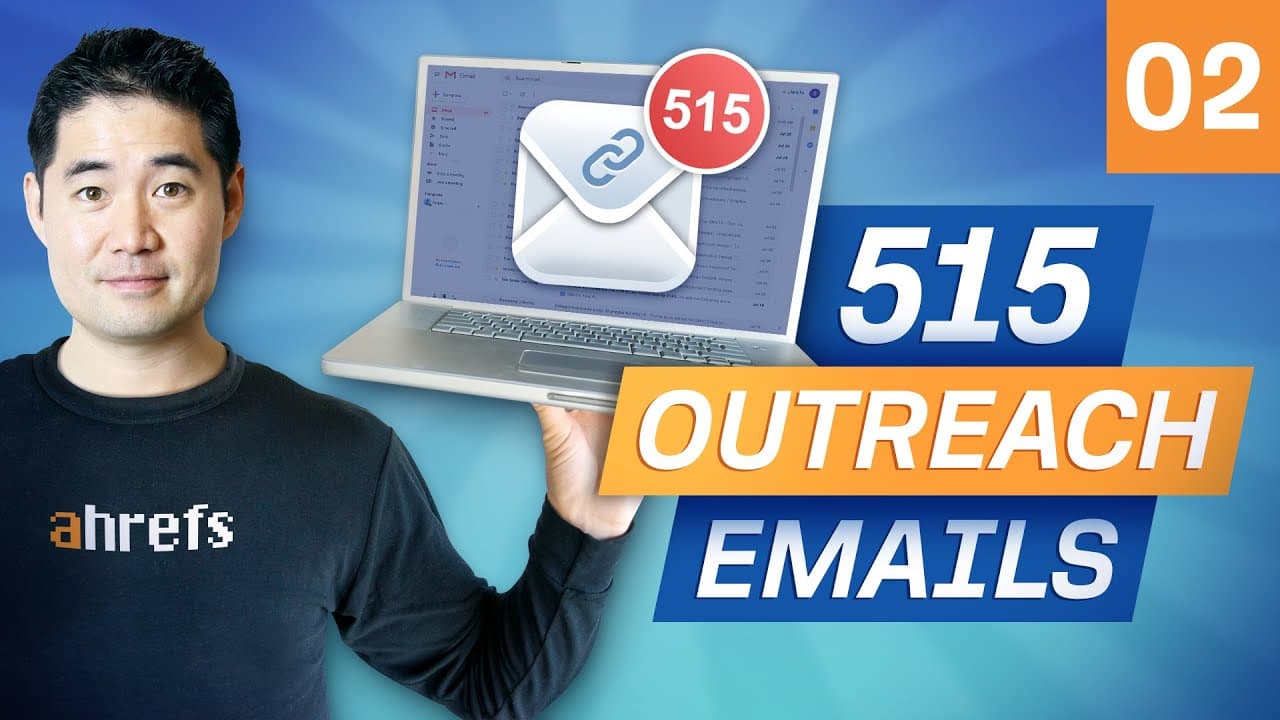
The video outlines a link building campaign where 515 outreach emails were sent, resulting in 27 links from unique websites. The campaign focused on isolating backlinks purely from email outreach by not promoting the post to existing audiences or search engines. The approach highlighted the importance of personalized and segmented outreach to improve conversion rates.
Transcript
We sent 515 emails asking for backlinks, and today, I'm going to share the stats from our campaign, the exact process we used, and key learning points that you can use in your link building efforts. Stay tuned. [music] What's up everyone? Sam Oh here with Ahrefs, and this is the second episode of our 3-part series on creating linkable content and a... Read More
Key Insights
- 515 outreach emails led to 27 links from unique websites, indicating a 5.75% conversion rate.
- The campaign avoided existing audiences and search engines to isolate email outreach effects.
- Personalized emails based on specific stats improved engagement and response rates.
- The reply rate was 17.55%, significantly higher than industry averages.
- Quality of links was prioritized, with all links being editorial and contextually relevant.
- Domain Rating distribution showed 28.1% of links from domains with DR 70 or greater.
- Follow-up emails were not sent, which could have increased conversion rates.
- Link exchanges and payments were avoided, focusing on genuine editorial links.
Install to Summarize YouTube Videos and Get Transcripts
Explore YouTube Video Summarizer or Get YouTube Transcript Extractor
Questions & Answers
Q: How to isolate backlinks from email outreach?
To isolate backlinks from email outreach, the campaign avoided promoting the post to existing audiences, such as email subscribers, customers, or social followers. Additionally, the post was hidden from blog indexes, category pages, RSS feeds, and was noindexed to prevent discovery via search engines, ensuring that backlinks resulted solely from outreach emails.
Q: What was the reply rate for the outreach campaign?
The outreach campaign achieved a reply rate of 17.55%, which is significantly higher than the industry average of 8.5%. This high reply rate was attributed to the personalized nature of the emails, which were tailored to mention specific statistics relevant to each recipient's content.
Q: What factors contributed to the link acquisition rate?
The link acquisition rate of 5.75% was influenced by several factors, including the personalized outreach strategy, the high quality of editorial links obtained, and the avoidance of follow-up emails. The campaign also faced challenges such as requests for link exchanges and payments, which were declined, impacting the overall acquisition rate.
Q: Why were follow-up emails not used in the campaign?
Follow-up emails were not used in the campaign to avoid bothering recipients without a good reason. The primary goal was to conduct a case study rather than acquire a large number of links. However, follow-ups were sent to those who agreed to link but hadn't done so within two weeks, which helped secure additional links.
Q: What was the Domain Rating distribution of acquired links?
The Domain Rating distribution of acquired links showed that 28.1% of referring domains had a DR of 70 or greater, 37.5% had a DR of 40 to 69, and 34.4% had DR values of 4 to 39. This distribution indicates a focus on obtaining links from domains with strong backlink profiles.
Q: How did the campaign handle non-deliverable emails?
Non-deliverable emails were identified using NeverBounce's API, which categorized them as invalid. These emails required manual intervention to find valid addresses. Automation was used to streamline the process, with valid emails being checked for quality before outreach was conducted.
Q: What were the two main outreach angles used?
The two main outreach angles were: 1) Highlighting that the page being linked to did not mention the stat, and offering more recent data, and 2) Pointing out that the stat being referenced was outdated, providing newer data to encourage linking to the updated source.
Q: What challenges did the campaign face in acquiring links?
The campaign faced challenges such as requests for link exchanges, payments, and other exchanges, which were declined. Additionally, some recipients linked to the original source of the stat rather than the pitched article. These factors, along with the lack of follow-up emails, impacted the link acquisition rate.
Summary & Key Takeaways
-
The outreach campaign sent 515 emails, achieving a 5.75% conversion rate with 27 unique links. The strategy emphasized personalized outreach and excluded existing audiences to isolate email effects. Although follow-ups were not used, the campaign achieved a high reply rate of 17.55%, indicating effective engagement.
-
The video demonstrates the importance of quality over quantity in link building. By focusing on editorial links from contextually relevant pages, the campaign achieved a high Domain Rating distribution. Personalized outreach based on specific stats helped stand out, despite not using follow-up emails.
-
Key takeaways include the increasing difficulty of link building due to awareness of link value, the necessity of targeted approaches, and the benefits of personalized outreach. The campaign's success highlights the potential of carefully planned and executed email outreach strategies in link building.
Read in Other Languages (beta)
Share This Summary 📚
Summarize YouTube Videos and Get Video Transcripts with 1-Click
Try YouTube Summary with ChatGPT & Claude or YouTube Transcript Generator
Explore More Summaries from Ahrefs 📚


![Three Customer Acquisition Channels That Actually Work [1.2] thumbnail](/_next/image?url=https%3A%2F%2Fi.ytimg.com%2Fvi%2F1HhE_ewaOxQ%2Fhqdefault.jpg&w=750&q=75)
Summarize YouTube Videos and Get Video Transcripts with 1-Click
Try YouTube Summary with ChatGPT & Claude or YouTube Transcript Generator