5. Search: Optimal, Branch and Bound, A*
TL;DR
The A* algorithm is used to find the shortest path in a given graph or map by considering both the actual distance traveled and an admissible heuristic estimate to the destination.
Transcript
PROFESSOR: It was written about Route 66, which used to be the main highway between Chicago, Illinois and Los Angeles, California. Very famous highway because anybody who wanted to go across country always took route 66 because it was the shortest way to go. And the question is, how do you find the shortest path? Not just any old path or a good pat... Read More
Key Insights
- 🗺️ The A* algorithm is used to find the shortest path in a graph or map by considering both the actual distance traveled and an admissible heuristic estimate.
- 👂 Using an extended list can reduce the number of path extensions and improve the efficiency of the algorithm.
- ❓ Admissible and consistent heuristics are important for ensuring the effectiveness of the A* algorithm in finding optimal paths.
Install to Summarize YouTube Videos and Get Transcripts
Explore YouTube Video Summarizer or Get YouTube Transcript Extractor
Questions & Answers
Q: What is the purpose of the interstate highway system created by President Eisenhower?
The interstate highway system was created to allow for rapid movement of troops and weapons in case of an invasion in the United States.
Q: What does the A* algorithm consider when finding the shortest path?
The A* algorithm considers both the actual distance traveled and an admissible heuristic estimate to the destination when finding the shortest path.
Q: Can the A* algorithm be used on any type of map or graph?
Yes, the A* algorithm can be used on any type of map or graph as long as an admissible or consistent heuristic estimate is available.
Q: What is the difference between an admissible and a consistent heuristic?
An admissible heuristic is one where the estimated distance to the goal is always less than or equal to the actual distance, while a consistent heuristic is one where the absolute difference between the estimated distance from one node to the goal and the estimated distance from another node to the goal is less than or equal to the actual distance between the two nodes.
Summary & Key Takeaways
-
The professor introduces the topic of finding the shortest path, specifically using the example of Route 66 in the US.
-
He discusses the creation of the interstate highway system by President Eisenhower, citing its purpose of quickly moving troops in case of an invasion.
-
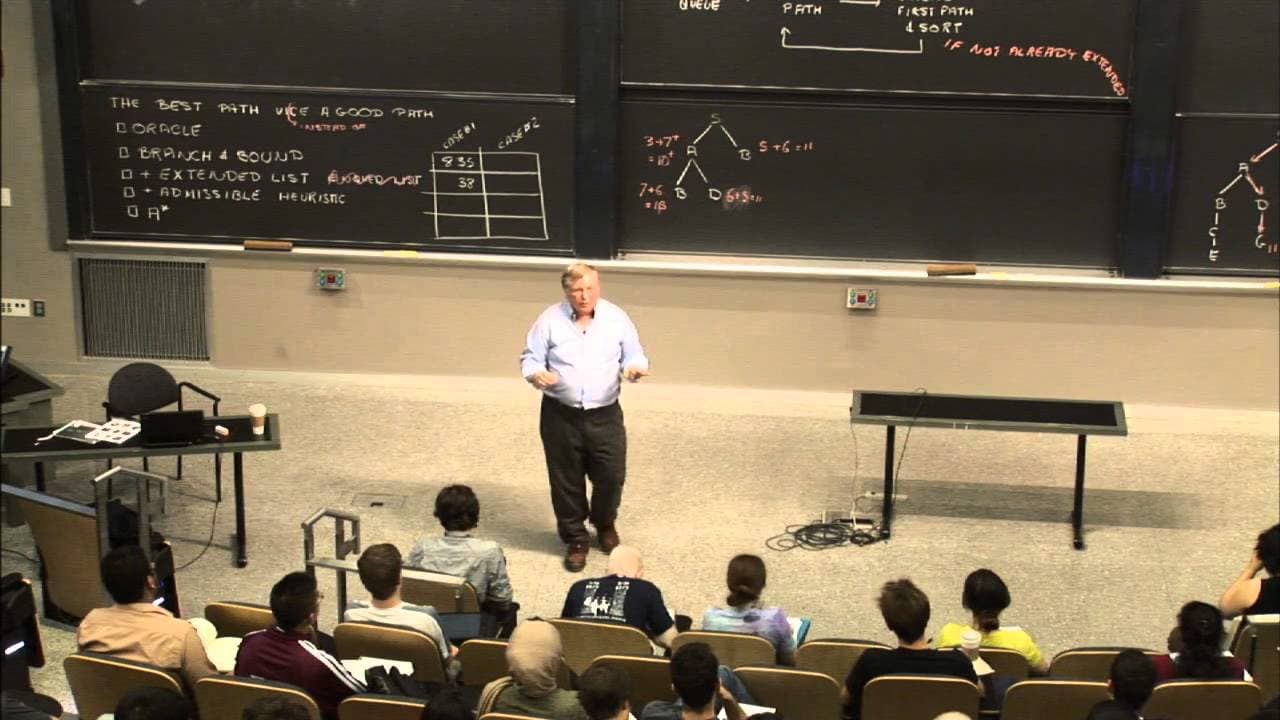
The professor explains the concept of finding the best path, rather than just a good path, and introduces the A* algorithm.
-
He demonstrates the A* algorithm using examples on a classroom map and a map of Cambridge.
Read in Other Languages (beta)
Share This Summary 📚
Summarize YouTube Videos and Get Video Transcripts with 1-Click
Try YouTube Summary with ChatGPT & Claude or YouTube Transcript Generator
Explore More Summaries from MIT OpenCourseWare 📚



Summarize YouTube Videos and Get Video Transcripts with 1-Click
Try YouTube Summary with ChatGPT & Claude or YouTube Transcript Generator