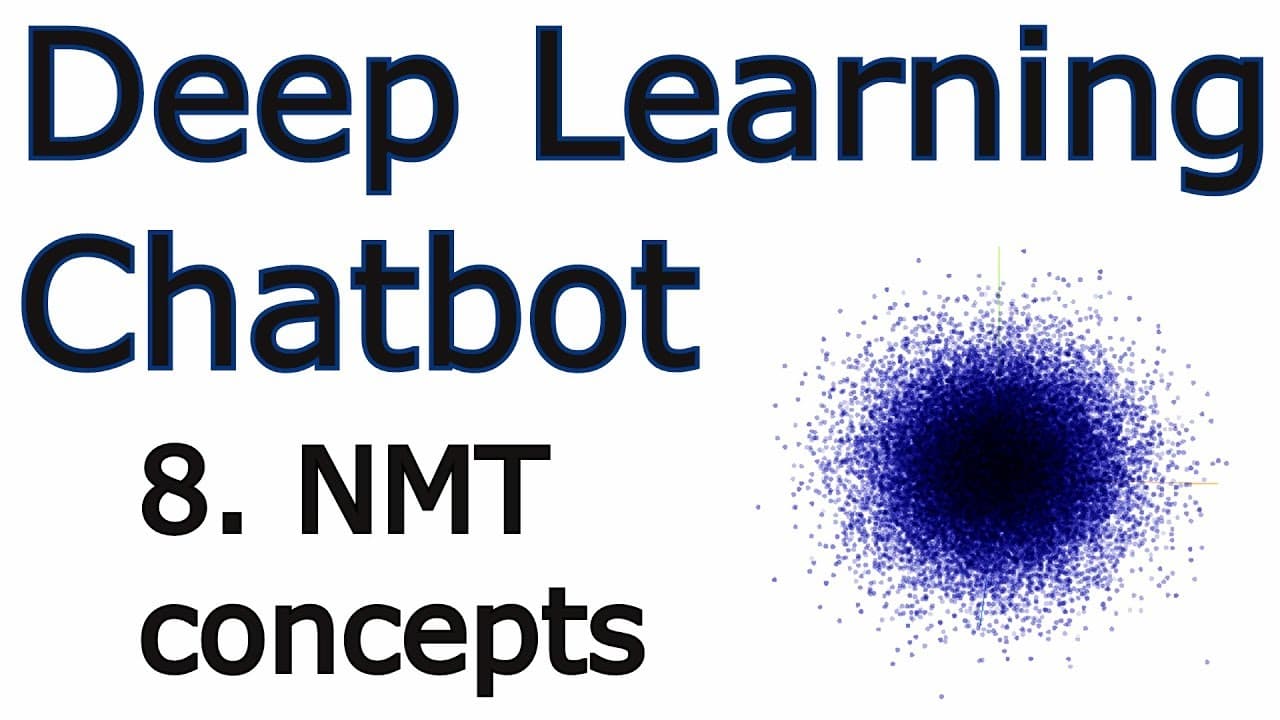
NMT Concepts and Parameters - Creating a Chatbot with Deep Learning, Python, and TensorFlow p.8
TL;DR
This tutorial series explores the high-level concepts and parameters of a chatbot with a neural machine translation code using Python in TensorFlow.
Transcript
what is going on everybody welcome to part eight of our chat pot with Python in tensorflow tutorial series in this tutorial what I'd like to do is talk about some of the more high-level concepts and parameters of our chat bot with the neural machine translation code that we're using and I hope to at least give you an idea of a better idea of what's... Read More
Key Insights
- 🔑 Tokenization and word vectorization are important for processing input data and improving translation accuracy.
- ❓ Recurrent neural networks, especially LSTM, are commonly used in chatbot models for language translation.
- 🔠 Problems like input-output matching and varying sentence lengths can be addressed through techniques like padding, bucketing, and dynamic recurrent neural networks.
- 😃 Bi-directional recurrent neural networks and attention models help in understanding context and improving translation accuracy.
- 💙 Metrics like blue score and perplexity are useful in evaluating the quality of translations during training.
- 📈 TensorBoard can be used to visualize training progress and metrics.
Install to Summarize YouTube Videos and Get Transcripts
Explore YouTube Video Summarizer or Get YouTube Transcript Extractor
Questions & Answers
Q: How do we tokenize the input data in a chatbot?
Input data can be tokenized by splitting the words by space and punctuation. This helps in converting words into tokens that the encoder can process.
Q: Why do we assign meaningful IDs to tokens instead of arbitrary ones?
Assigning meaningful IDs to tokens helps in translating words accurately and also helps in evaluating the quality of translations. Similar words are given similar IDs to improve translation accuracy.
Q: How do recurrent neural networks (RNNs) help in language translation?
RNNs, specifically LSTM, are used in the encoder and decoder of the chatbot to process language information in a non-static temporal sense. They help in remembering and understanding the sequence of words.
Q: Why is padding not an ideal solution for varying sentence lengths?
Padding is not ideal because it reduces the impact of longer sentences on the translation accuracy. Neural networks learn that padded words have no meaning and tend to ignore them, resulting in poor training and performance.
Summary & Key Takeaways
-
The tutorial discusses the basics of building a chatbot using neural machine translation and TensorFlow.
-
It covers the tokenization of input data and the assignment of meaningful IDs to tokens using word vectors.
-
The tutorial explains the use of recurrent neural networks (specifically LSTM) in the encoder and decoder for translating language data.
-
It introduces the problems associated with input-output matching and varying sentence lengths and discusses solutions like padding and bucketing.
-
The tutorial explores the use of dynamic recurrent neural networks, bi-directional recurrent neural networks, and attention models to improve the translation accuracy and context understanding of the chatbot.
Read in Other Languages (beta)
Share This Summary 📚
Summarize YouTube Videos and Get Video Transcripts with 1-Click
Try YouTube Summary with ChatGPT & Claude or YouTube Transcript Generator
Explore More Summaries from sentdex 📚

Summarize YouTube Videos and Get Video Transcripts with 1-Click
Try YouTube Summary with ChatGPT & Claude or YouTube Transcript Generator