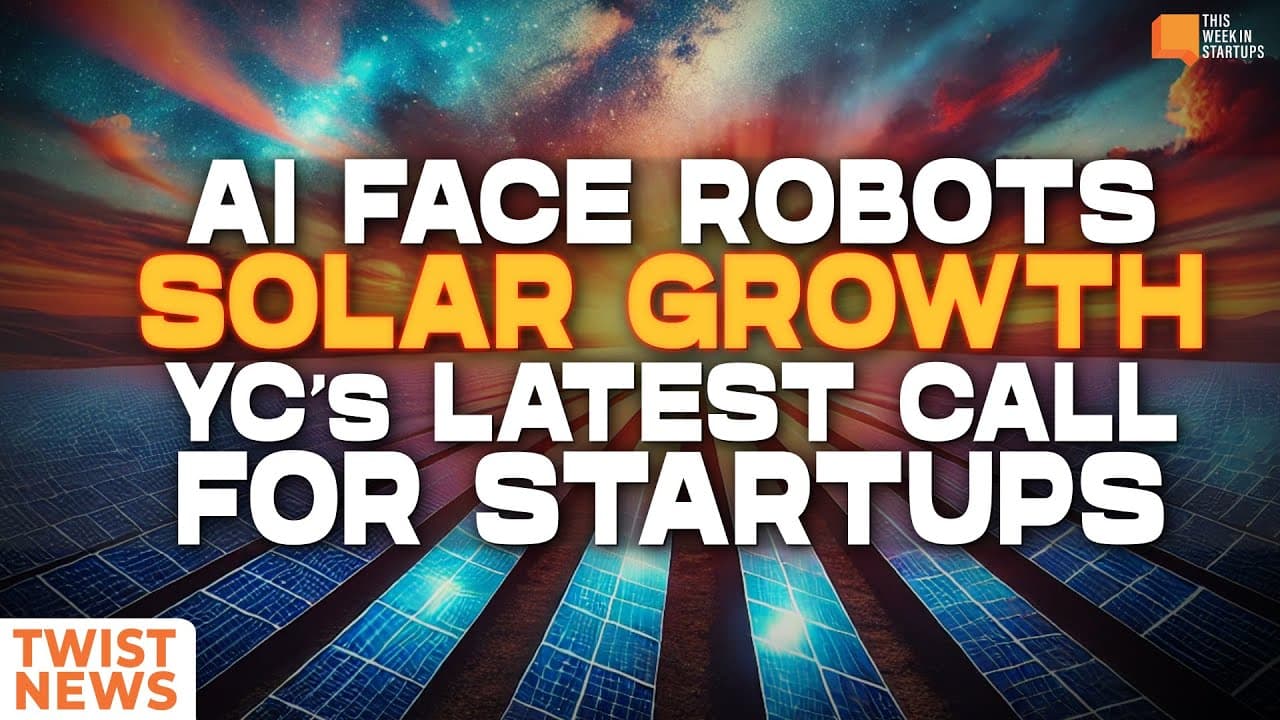
TWiST News: Face Robots, Solar's Growth, The Polymarket Mess, and more | E2044
TL;DR
Energy prices may drastically decrease in the coming decades, driven by solar technology and AI innovations.
Transcript
if you walk inside of Starbucks right you can have free Wi-Fi and free electricity actually too I think that over the next 20 30 years whether it's smrs or renewable penetration big nukes getting bigger I think we're going to see Energy prices really go very close to zero and I think electric vehicles and the home we have a much more sophisticated ... Read More
Key Insights
- 🌏 The rapid growth of solar energy, particularly in countries like Australia and Germany, demonstrates the increasing viability of renewables as mainstream electricity sources.
- 🤗 Generative AI's advancements open new doors in human-robot interactions, potentially reshaping job markets in customer service and other human-centric roles.
- 💨 Societal trends among younger generations indicate a shift away from traditional relationship structures toward technology-facilitated companionship.
- 🚙 Utilities must adapt their revenue models to account for the increasing saturation of residential solar installations that enable homeowners to generate their own energy.
- 🥺 The integration of electric vehicles with renewable energy sources could lead to a transformative decrease in energy consumption and pollution levels.
- 😘 Interest in small modular reactors (SMRs) may signal a resurgence of nuclear energy in the U.S., promoting a low-carbon future.
- 🥶 The trajectory of energy costs suggests a future where energy becomes virtually free, similar to how Wi-Fi evolved from a paid service to a commonplace offering.
Install to Summarize YouTube Videos and Get Transcripts
Explore YouTube Video Summarizer or Get YouTube Transcript Extractor
Questions & Answers
Q: How might energy prices evolve over the next few decades?
Experts predict that energy prices could get very close to zero, driven by advancements in solar energy technology, nuclear developments, and the increasing efficiency of electric vehicles and other renewable energy sources. This trend could lead to a fundamental shift in how we view energy and its cost.
Q: What role does generative AI play in service industries?
Generative AI has the potential to reshape service industries by creating robots capable of mimicking human interactions. This technology could reduce the need for human employees in customer-facing roles as robots become more adept at understanding and responding to human emotions, potentially revolutionizing service delivery.
Q: What are the societal implications of shifting relationships due to technology?
As AI and robotics evolve to meet human companionship needs, traditional views around marriage, family, and work may change. Many younger individuals seem to prioritize companionship in artificial forms over traditional relationships, resulting in transformative shifts in family dynamics and relationship structures.
Q: Why is Australia considered a leader in solar energy?
Australia leads in solar energy due to its favorable geography, government support, and significant investment in residential solar installation. With millions of homes now equipped with solar panels, it's setting examples for other countries in renewable energy deployment.
Q: What challenges do utilities face with the rise of residential solar?
Utilities grapple with the financial dynamics of residential solar, as more homeowners opt for solar installations and rely less on grid energy. This phenomenon creates a potential strain on utility revenue models, raising concerns over how to maintain infrastructure and service costs when fewer customers use traditional energy sources.
Q: How might electric vehicles impact future energy consumption?
As electric vehicles become more prevalent, their integration with renewable energy sources will likely lead to more efficient power consumption. This could facilitate a significant decrease in dependence on traditional fossil fuels while promoting a cleaner energy ecosystem.
Q: What does the future of nuclear energy look like in the U.S.?
The future of nuclear energy in the U.S. appears promising, with increasing interest in small modular reactors (SMRs) to meet growing energy demands, particularly from tech giants. This trend signals a potential return to nuclear power as a significant energy source, counteracting longstanding fears surrounding nuclear technology.
Summary & Key Takeaways
-
The discussion focuses on the future of energy production, particularly highlighting the rapid growth of solar energy in countries like Australia, where rooftop solar is becoming mainstream.
-
Generative AI is emerging as a significant force in various sectors, including robotics that can mimic human facial expressions, potentially diminishing the demand for human interactions in service industries.
-
The implications of advanced energy technology, such as nuclear power and EVs, raise questions about societal changes, including marriage trends, work-life balance, and autonomous living scenarios.
Read in Other Languages (beta)
Share This Summary 📚
Summarize YouTube Videos and Get Video Transcripts with 1-Click
Try YouTube Summary with ChatGPT & Claude or YouTube Transcript Generator
Explore More Summaries from This Week in Startups 📚




Summarize YouTube Videos and Get Video Transcripts with 1-Click
Try YouTube Summary with ChatGPT & Claude or YouTube Transcript Generator