2.2.11 An Introduction to Linear Regression - Video 6: Correlation and Multicollinearity
TL;DR
Correlation measures the linear relationship between two variables and is represented by a number between -1 and +1.
Transcript
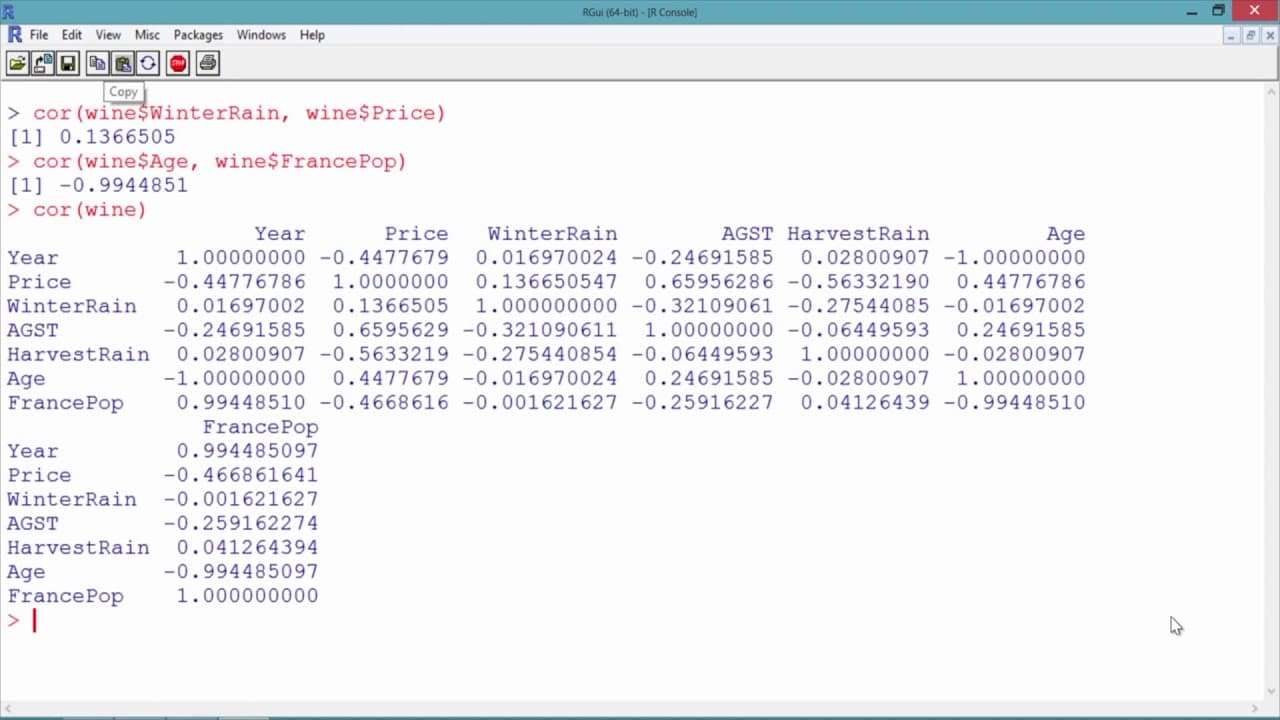
In the previous video, we observed that Age and FrancePopulation are highly correlated. But what is correlation? Correlation measures the linear relationship between two variables and is a number between -1 and +1. A correlation of +1 means a perfect positive linear relationship. A correlation of -1 means a perfect negative linear relationship. In ... Read More
Key Insights
- 📶 Correlation measures the linear relationship between two variables, indicating the strength and direction of the relationship.
- 💯 A correlation of +1 or -1 represents a perfect linear relationship, while a correlation of 0 means no linear relationship.
- 💻 Correlation can be visually examined through scatter plots but is more accurately computed using statistical methods.
- 🥺 High correlation between independent variables can lead to multicollinearity issues in linear regression models.
- 🏃 Removing insignificant variables can help address multicollinearity, but caution should be exercised to avoid removing important variables.
- ❓ Coefficients in linear regression models should be interpreted in the presence of other variables.
- 🍉 Correlations above 0.7 or below -0.7 are generally considered to be cause for concern in terms of multicollinearity.
Install to Summarize YouTube Videos and Get Transcripts
Explore YouTube Video Summarizer or Get YouTube Transcript Extractor
Questions & Answers
Q: What does correlation measure?
Correlation measures the strength and direction of the linear relationship between two variables.
Q: How is correlation represented?
Correlation is represented by a number between -1 and +1, with -1 indicating a perfect negative linear relationship and +1 indicating a perfect positive linear relationship.
Q: What does a correlation of 0 mean?
A correlation of 0 means that there is no linear relationship between the two variables.
Q: How are correlations computed in R?
Correlations can be computed in R using the "cor" function, which takes the names of the two variables as input and returns the correlation value.
Summary & Key Takeaways
-
Correlation measures the linear relationship between two variables, ranging from -1 to +1, with 0 indicating no linear relationship.
-
Various examples are provided to demonstrate different levels of correlation between variables.
-
The R programming language is used to compute correlations between variables in a dataset.
Read in Other Languages (beta)
Share This Summary 📚
Summarize YouTube Videos and Get Video Transcripts with 1-Click
Try YouTube Summary with ChatGPT & Claude or YouTube Transcript Generator
Explore More Summaries from MIT OpenCourseWare 📚



Summarize YouTube Videos and Get Video Transcripts with 1-Click
Try YouTube Summary with ChatGPT & Claude or YouTube Transcript Generator