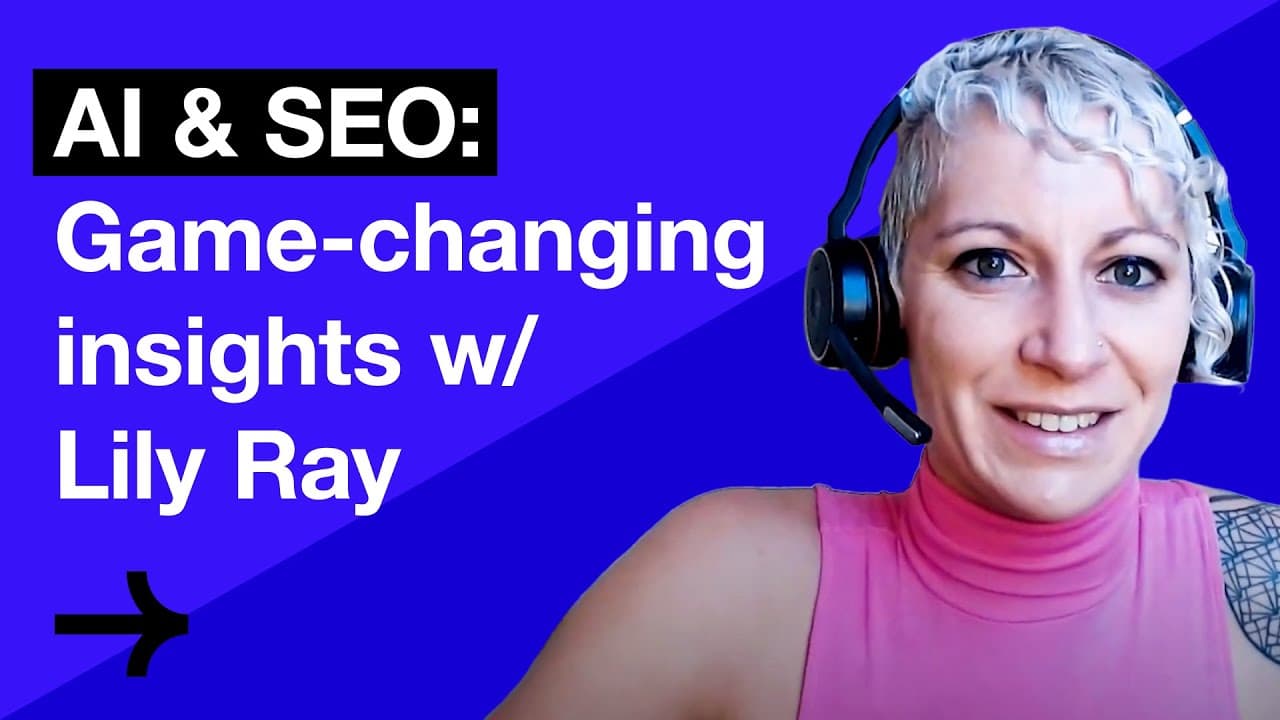
The Role of AI Content and SEO w/ Lily Ray
TL;DR
Lily Ray discusses AI's role in SEO and content creation.
Transcript
foreign digital Lily is a really respected SEO across the industry if you haven't seen her or followed her content yet I highly suggest doing that on Twitter she specifically brings research and expertise no pun intended around the e-e-a-t vertical or expertise experience Authority and Trust in there so we're all just got a lot of clients in that H... Read More
Key Insights
- Lily Ray emphasizes the importance of EEAT (Expertise, Experience, Authority, Trust) in SEO, which could be challenged by AI content generation.
- The integration of AI in search engines like Bing and Google has sparked industry excitement and concern about potential impacts on SEO traffic.
- Google's AI product, Bard, faced initial backlash for not citing sources, highlighting the importance of maintaining publisher relations.
- AI content tools can be valuable for tasks like summarization and creating structured data, but they pose risks when used for generating factual content.
- Google encourages transparency with AI content, advising site owners to label AI-generated content and associate it with real authors.
- The potential for AI content to harm brand reputation and SEO effectiveness is a significant concern, especially for enterprise-level companies.
- The rapid evolution of AI tools may lead to increased low-quality content online, prompting Google to refine its algorithms to address this.
- Despite AI advancements, the core principles of creating high-quality, expert-driven content remain crucial for SEO success.
Install to Summarize YouTube Videos and Get Transcripts
Explore YouTube Video Summarizer or Get YouTube Transcript Extractor
Questions & Answers
Q: What are Lily Ray's thoughts on the recent AI announcements by Bing and Google?
Lily Ray finds the recent AI announcements by Bing and Google to be exciting yet concerning. She notes that Microsoft's announcement brought renewed attention to Bing, creating unexpected competition for Google. However, she is wary of the potential negative impact on SEO traffic, particularly with Google's initial failure to include source citations in their AI product, Bard.
Q: How does Lily Ray view the future of AI integration in search engines?
Lily Ray believes that while AI integration in search engines is a significant development, it is still in its early stages. She anticipates that both Google and Microsoft will face challenges in ensuring factual accuracy and maintaining positive relationships with publishers. Lily is not convinced that AI will drastically change SEO in the short term but acknowledges the potential for long-term impacts.
Q: What are some potential use cases for AI content tools according to Lily Ray?
Lily Ray identifies several potential use cases for AI content tools, such as summarization, creating lists, and generating structured data. These applications can enhance content creation efficiency without compromising quality. However, she cautions against using AI for generating factual content, as current models may produce inaccuracies and lack proper citations.
Q: What are the risks associated with AI content generation for enterprises?
For enterprises, AI content generation poses risks related to brand reputation and SEO effectiveness. Lily Ray highlights the potential for AI-generated content to contain factual inaccuracies, leading to negative publicity. Additionally, Google's emphasis on EEAT means that enterprises must be cautious in using AI content tools, as they could undermine the perceived authority and trustworthiness of their content.
Q: How should site owners approach labeling AI-generated content?
Lily Ray advises site owners to be transparent about AI-generated content by labeling it and associating it with real authors. Google recommends not naming AI as the author, as AI is not a person. This approach helps maintain user trust and aligns with Google's guidelines on content transparency and quality.
Q: What challenges might search engines face with AI content integration?
Search engines like Google and Bing may face challenges in ensuring the factual accuracy of AI-generated content and maintaining positive relationships with publishers. The potential for AI tools to produce inaccurate or biased information could lead to backlash and require search engines to continuously refine their algorithms to address these issues.
Q: How does Lily Ray predict AI content generation will evolve?
Lily Ray predicts that AI content generation will lead to an increase in low-quality content online, prompting search engines to implement significant algorithm updates to address this. She expects that ethical SEO practitioners will find ways to incorporate AI into their workflows responsibly, while others may exploit AI tools, leading to a surge in borderline spam content.
Q: What is the impact of AI content tools on small businesses compared to enterprises?
AI content tools may offer more value to small businesses by helping them efficiently create content with limited resources. However, for enterprises, the risks associated with brand reputation and SEO effectiveness are more pronounced. Enterprises must be cautious in using AI tools, ensuring that content quality and factual accuracy are not compromised.
Summary & Key Takeaways
-
Lily Ray discusses the recent announcements from Bing and Google regarding AI integration, focusing on the implications for SEO and content creation. She highlights the importance of EEAT and the potential risks of AI content tools undermining these principles.
-
The conversation explores the competitive landscape between Google and Microsoft, with both companies racing to integrate AI into their search engines. Lily expresses skepticism about the readiness of these AI tools and the potential backlash from publishers.
-
Lily advises cautious use of AI content tools, emphasizing transparency and the need for human oversight to ensure factual accuracy. She predicts that the rise of AI-generated content will lead to significant changes in SEO strategies and search engine algorithms.
Read in Other Languages (beta)
Share This Summary 📚
Summarize YouTube Videos and Get Video Transcripts with 1-Click
Try YouTube Summary with ChatGPT & Claude or YouTube Transcript Generator
Explore More Summaries from Content and Conversation 📚

Summarize YouTube Videos and Get Video Transcripts with 1-Click
Try YouTube Summary with ChatGPT & Claude or YouTube Transcript Generator