HOW OLD Is Indian Civilization? (Your History Books Lie To You)
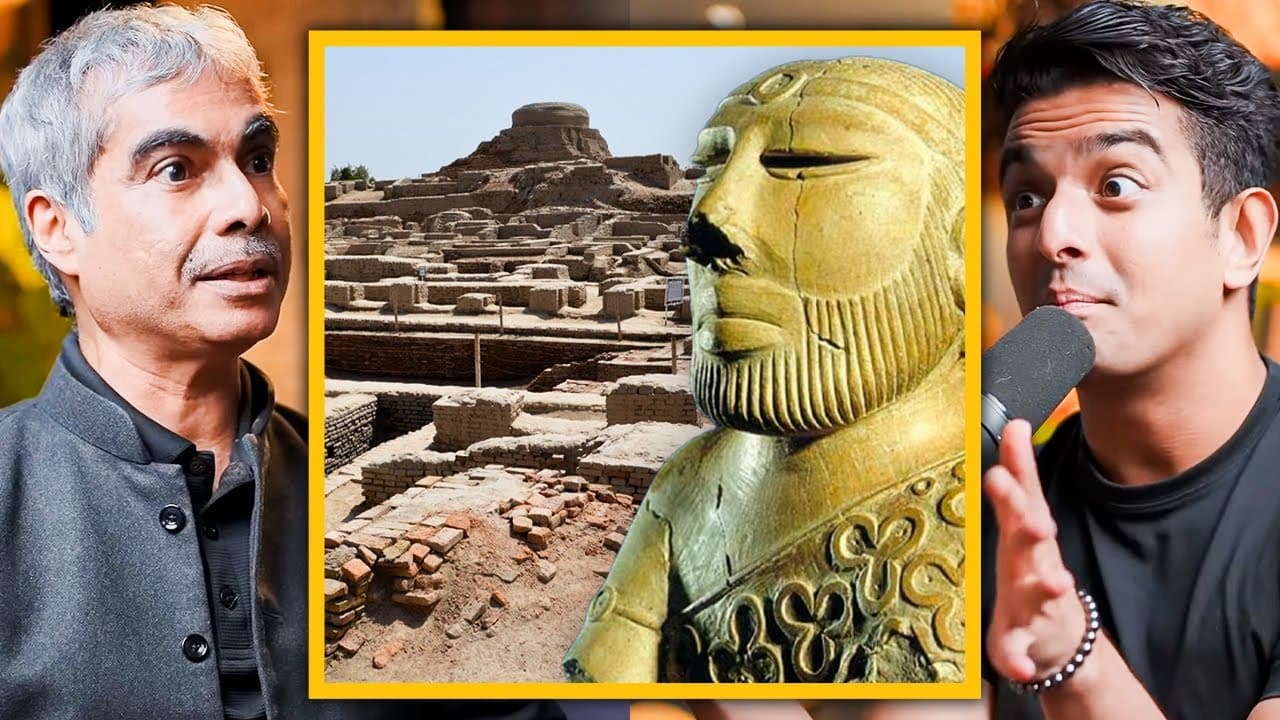
TL;DR
Exploring the impact of cataclysmic events on civilization growth and technology.
Transcript
binge watch and learn on PRS Clips perhaps my last question on this entire show for you would be another thought experiment related to the younger D impact Theory okay now that was supposedly a very important cataclysmic event in the history absolutely of the earth yes I remember Joe Rogan and Randle Carlson both saying that even that reduced the h... Read More
Key Insights
- 🫷 Past cataclysmic events like the Younger Dryas impacted human civilization and technological development significantly, pushing societies back to survivalism.
- 🌥️ Modern technological infrastructure is highly susceptible to large-scale natural disasters, emphasizing the need for preparedness.
- 🌸 Artifacts that challenge historical timelines suggest that civilizations have experienced knowledge loss, indicating the complexity of technological evolution.
- 💱 Historical advancement often relies on rediscovering knowledge from earlier periods, and cultural exchanges can spur rapid development.
- 😀 The fragility of modern conveniences highlights the importance of resilience and adaptability in the face of potential crises.
- 🫵 Understanding the effects of nature on civilization helps foster a more holistic view of history beyond textbook narratives.
- 😚 Engaging with speculative history encourages open-mindedness about lost technologies and civilizations in the ancient world.
Install to Summarize YouTube Videos and Get Transcripts
Explore YouTube Video Summarizer or Get YouTube Transcript Extractor
Questions & Answers
Q: What is the Younger Dryas impact theory, and why is it significant?
The Younger Dryas impact theory posits that a meteor hit Earth approximately 10,000 years ago, causing catastrophic changes that drastically reduced the human population and reset civilization. This event is significant because it is believed to have led to a societal reboot, where skills were lost, and people reverted to basic survival techniques similar to hunter-gatherer societies.
Q: How would a modern apocalyptic event differ from ancient catastrophes?
A modern apocalyptic event, like a meteor strike or solar flare, would disrupt our advanced technology and infrastructure, resulting in immediate chaos as communication systems fail and essential services collapse. Unlike ancient events, our reliance on technology means that recovery might take much longer, and the societal structure could revert to primitive survival modes rather than simply rebuilding from existing knowledge.
Q: What role does ancient technology play in understanding past civilizations?
Discoveries such as the Antikythera mechanism and the Baghdad Battery challenge our understanding of ancient technological capabilities, suggesting that advanced knowledge and skills may have existed long before recorded history. Such findings imply that civilizations have potentially experienced cycles of advancement and decline, prompting us to rethink the linear progression of human knowledge.
Q: How did the historical context of Western Europe influence technology?
After adopting Christianity around the early centuries AD, Western Europe entered a period of stagnation in scientific and mathematical knowledge, largely discarding prior Greek advancements. The subsequent Renaissance marked a revival fueled by re-acquiring knowledge from other cultures, particularly India, leading to unparalleled technological growth over the subsequent centuries.
Q: Why is the Carington Event mentioned in relation to modern technology?
The Carington Event, a massive solar flare that hit Earth in 1859, serves as a warning about the vulnerability of our technological infrastructure. Modern society relies heavily on electricity and communication systems, which would face catastrophic failures in the event of a similarly sized solar flare today, emphasizing the fragility of our technological advancements.
Q: What lessons about history does the speaker want to pass on to future generations?
The speaker intends to teach future generations that history is significantly influenced by nature's impact. This perspective highlights the interconnectedness of environmental events and human development, promoting a view of history that recognizes both dramatic changes due to nature and the lessons we can derive from them as a society.
Summary & Key Takeaways
-
The Younger Dryas impact theory suggests that a meteor event drastically reduced human population and reset civilization around 10,000 BC, necessitating a return to primitive survival skills.
-
Modern technology, like the internet and power grids, is extremely vulnerable to significant events such as solar flares or meteor strikes, which could lead to an apocalyptic scenario reminiscent of historical catastrophes.
-
Throughout history, there have been periods of lost knowledge and technological advancement, suggesting civilizations may have repeatedly peaked and reset, a notion supported by ancient artifacts that challenge linear historical science growth.
Read in Other Languages (beta)
Share This Summary 📚
Summarize YouTube Videos and Get Video Transcripts with 1-Click
Try YouTube Summary with ChatGPT & Claude or YouTube Transcript Generator
Explore More Summaries from TRS Clips 📚





Summarize YouTube Videos and Get Video Transcripts with 1-Click
Try YouTube Summary with ChatGPT & Claude or YouTube Transcript Generator