Switch logic | Pass Transistor | Transmission Gate | VLSI | Lec-53
TL;DR
Learn about switch logic, pass transistor logic, and transmission gates in CMOS circuitry.
Transcript
hi everyone in this video you are going to learn about switch logic switch logic and gate logic these are the two different logic functions which are used to generate or create different types of CMOS logic circuitry switch logic already you might have seen in the form of past transistor logic so so past transistor logic we have seen and another ga... Read More
Key Insights
- 🧭 Switch logic comprises crucial components such as pass transistors and transmission gates used in CMOS logic circuits.
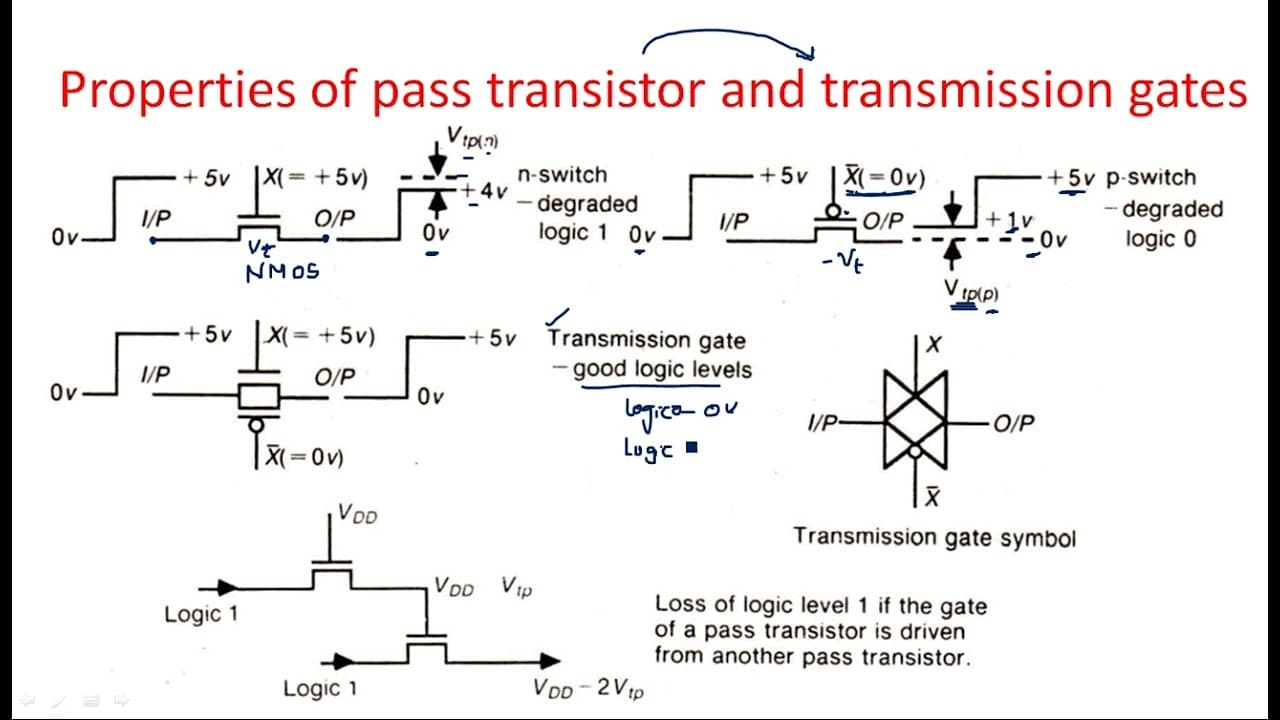
- 😀 Pass transistor logic facilitates signal transfer but faces challenges with degraded voltage levels and logic state accuracy.
- ⚡ The threshold voltage directly impacts the performance of pass transistor logic, causing undesirable output voltage drops.
- 🎚️ Transmission gates, by employing both nMOS and pMOS transistors, enable precise logic levels in circuit outputs.
- 👻 Utilizing both types of transistors in a single configuration allows for more robust logic design, reducing degradation issues.
- 🧭 Logic function realization using transmission gates avoids the pitfalls of logic level degradation observed in pass transistor setups.
- 🎨 Understanding transistor behavior under different inputs is essential for optimizing circuit design in digital electronics.
Install to Summarize YouTube Videos and Get Transcripts
Explore YouTube Video Summarizer or Get YouTube Transcript Extractor
Questions & Answers
Q: What is switch logic and how is it implemented in CMOS circuitry?
Switch logic refers to the use of components like pass transistors and transmission gates to manipulate logical states in CMOS circuits. It allows for efficient signal transfer and the creation of various logic gates, such as AND, NAND, NOR. By employing control inputs, switch logic plays a crucial role in designing complex circuits with minimal power loss.
Q: What is the main drawback of pass transistor logic?
The primary drawback of pass transistor logic is signal degradation, particularly evident in voltage output levels. For nMOS transistors, the logic high signal faces a reduction due to the threshold voltage, leading to an imperfect logic level. Similarly, pMOS transistors degrade the logic low signal. This can result in incorrect logic states if the output does not accurately reflect the intended input, making reliable circuit operation difficult.
Q: How do transmission gates improve upon pass transistor logic?
Transmission gates enhance logic level integrity by combining nMOS and pMOS transistors, effectively minimizing voltage degradation issues that plague pass transistor logic. They allow both logic high and low signals to retain their intended voltage levels by compensating for the threshold voltage drops of each transistor type. This ensures outputs remain close to the expected 0V or 5V, enabling reliable digital logic design.
Q: Can you explain pass transistor logic in more detail?
Pass transistor logic consists of one or more transistors that pass input signals based on control signals. When the control input of an nMOS is high, it allows the input to pass to the output; when low, it behaves like an open circuit. In circuits with multiple transistors, if any control input is low, the entire output becomes zero. While simple and effective, this setup results in voltage drops and degraded logic levels.
Q: What is the significance of threshold voltage in pass transistor logic?
Threshold voltage is critical in pass transistor logic since it dictates the behavior of the transistors during operation. For nMOS transistors, it creates a voltage drop that results in signal degradation when passing from input to output. This drop affects the logic levels that the output can accurately represent, complicating how signals are processed in a circuit, particularly when they must meet strict logic requirements.
Q: Why are voltage levels important in digital circuits?
Digital circuits rely on precise voltage levels to represent binary states (0s and 1s). Accurate logic high (commonly 5V) and low (0V) levels ensure that logical operations are performed correctly. Variability in these levels can cause misinterpretations of signal states, resulting in errors in computation, timing issues, or reduced reliability in electronic devices, which is why the integrity of these levels is essential in circuit design.
Summary & Key Takeaways
-
The video explains the concepts of switch logic and gate logic, particularly focusing on pass transistor logic and transmission gates, which are fundamental in CMOS circuit design.
-
Pass transistor logic uses a control input to pass signals through a single transistor, but it suffers from logic level degradation and insufficient output voltage levels.
-
Transmission gates combine nMOS and pMOS technologies to overcome pass transistor limitations, ensuring accurate logic levels without voltage degradation.
Read in Other Languages (beta)
Share This Summary 📚
Summarize YouTube Videos and Get Video Transcripts with 1-Click
Try YouTube Summary with ChatGPT & Claude or YouTube Transcript Generator