What Is China's Social Structure? Wu Si Explains
TL;DR
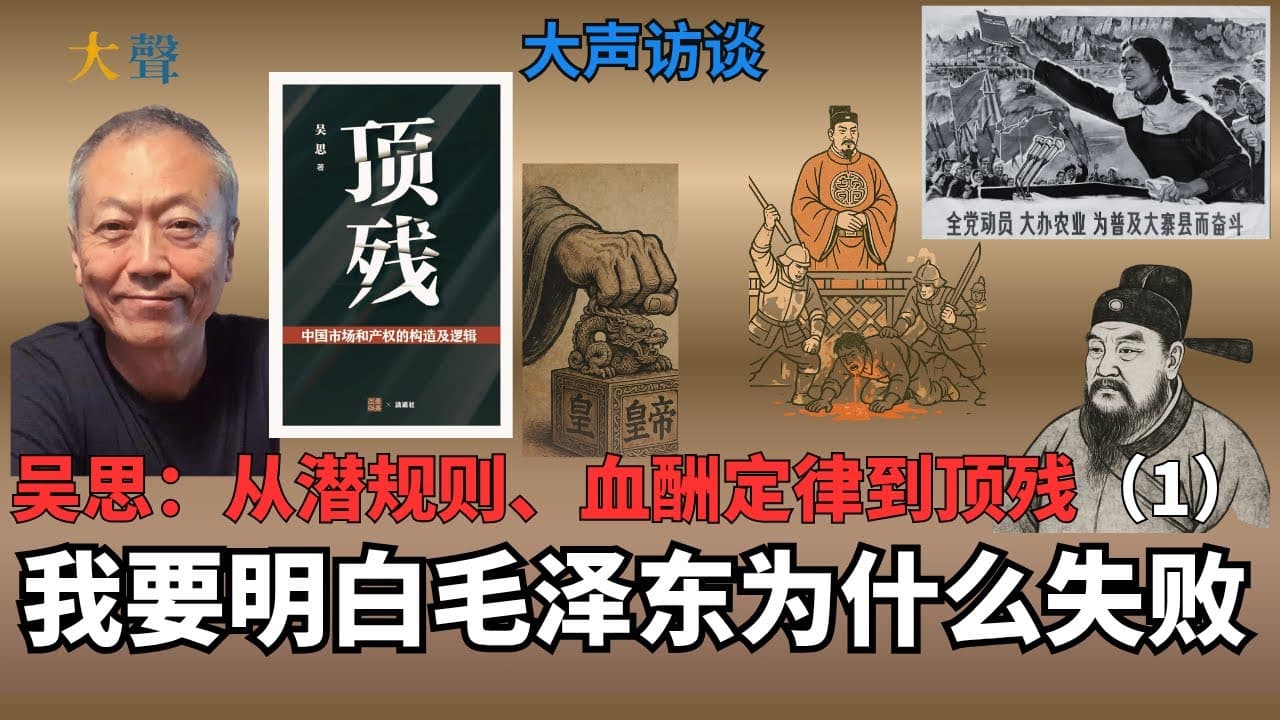
China's social structure is deeply influenced by a power system Wu Si calls 'officialism,' which has persisted since the Qin and Han dynasties. This structure results in incomplete property rights and markets, where economic entities lack resistance to top-level power infringement. Wu Si's book 'Top Remnant' explores these dynamics, highlighting the challenges and failures of past and present governance models in China.
Transcript
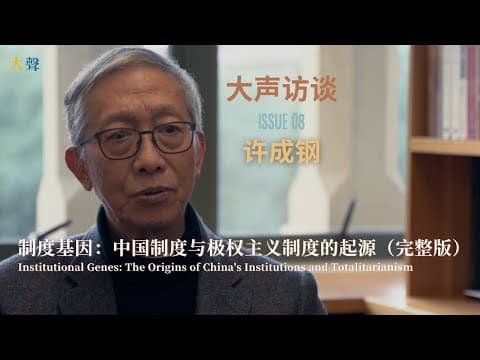
Hello everyone, welcome back to "Da Sheng Interview". This time we are launching a new series in which historian Wu Si explains his new book "Top Remnant: The Structure and Logic of China's Market and Property Rights". This book is another in-depth series launched by Da Sheng after Xu Chenggang interviews on the institutional genes . We hope to inv... Read More
Key Insights
- Wu Si introduces the concept of 'officialism' to describe China's enduring power structure.
- The term 'top-remnant' refers to incomplete property rights and markets in China.
- China's social structure has not significantly changed from the imperial system to the present.
- Mao Zedong's policies led to economic failures due to lack of freedom and incentives.
- Deng Xiaoping's reforms succeeded by mobilizing individual incentives and property rights.
- The 'unwritten rules' and 'blood pay law' illustrate the unique power dynamics in China.
- Wu Si's personal experiences in rural communes shaped his understanding of Chinese governance.
- The book 'Top Remnant' aims to provide a comprehensive analysis of China's market and property rights.
Install to Summarize YouTube Videos and Get Transcripts
Explore YouTube Video Summarizer or Get YouTube Transcript Extractor
Questions & Answers
Q: What is the concept of 'officialism' in China's social structure?
'Officialism' is a term coined by Wu Si to describe China's enduring power structure, which has persisted since the Qin and Han dynasties. It refers to a system where the government exercises centralized control, resulting in incomplete property rights and markets. Economic entities lack resistance to top-level power infringement, leading to a unique governance model that influences China's social and economic dynamics.
Q: How does 'top-remnant' relate to China's market and property rights?
The term 'top-remnant' describes the incomplete property rights and markets in China, where economic entities are unable to resist power infringement from the top. This concept highlights the challenges within China's social structure, where centralized control and lack of economic freedom hinder the development of robust markets and property rights, affecting the overall economic and social landscape.
Q: Why did Mao Zedong's economic policies fail according to Wu Si?
Mao Zedong's economic policies failed because they did not provide sufficient freedom and incentives for individual economic actors. The lack of personal property rights and the emphasis on collective ownership led to widespread inefficiency and lack of motivation among workers. Wu Si argues that without the ability to reap the rewards of one's labor, there is little incentive to work hard, resulting in economic stagnation.
Q: What were the successes of Deng Xiaoping's reforms?
Deng Xiaoping's reforms succeeded by introducing elements of market economy and individual incentives. By allowing farmers to own and manage their land, productivity increased significantly, leading to better harvests and improved living standards. This shift towards recognizing individual property rights and incentives mobilized people's efforts and contributed to China's economic growth and modernization.
Q: How do 'unwritten rules' and 'blood pay law' affect Chinese governance?
'Unwritten rules' and 'blood pay law' are concepts used by Wu Si to describe the informal power dynamics in China. These rules govern interactions and decision-making processes, often bypassing formal legal systems. They illustrate how power is exercised and maintained in Chinese society, affecting governance by creating a parallel system of influence and control that operates alongside official laws.
Q: What personal experiences shaped Wu Si's understanding of Chinese governance?
Wu Si's understanding of Chinese governance was shaped by his experiences as a young man working in rural communes during Mao Zedong's era. Observing the inefficiencies and failures of collective farming firsthand, he became disillusioned with the official ideology. These experiences, combined with his later historical research, informed his analysis of China's social and economic structures, leading to his development of the concepts of 'officialism' and 'top-remnant.'
Q: What is the main argument of Wu Si's book 'Top Remnant'?
Wu Si's book 'Top Remnant' argues that China's market and property rights are characterized by 'top-remnant' structures, where economic entities lack the means to resist power infringement from the top. The book provides a comprehensive analysis of these incomplete rights and markets, linking them to the broader power structure of 'officialism' that has persisted in China since ancient times. It explores the implications of these dynamics for China's social and economic development.
Q: How does Wu Si's historical analysis contribute to understanding China's social dynamics?
Wu Si's historical analysis provides insights into the continuity of power structures in China, from ancient times to the present. By examining historical patterns and governance models, he identifies the persistent influence of 'officialism' and the resulting 'top-remnant' markets and property rights. His work highlights the challenges faced in reforming these structures, offering a deeper understanding of the factors shaping China's social and economic landscape.
Summary & Key Takeaways
-
Wu Si discusses China's social structure, highlighting the concept of 'officialism,' which has persisted since the Qin and Han dynasties. This system results in incomplete property rights and markets, where economic entities lack resistance to power infringement. His book 'Top Remnant' explores these dynamics and the challenges of governance in China.
-
The video emphasizes the failures of Mao Zedong's economic policies due to a lack of freedom and incentives, contrasting with Deng Xiaoping's successful reforms that mobilized individual incentives and property rights. Wu Si uses his personal experiences and historical analysis to explain these governance dynamics.
-
Wu Si's book 'Top Remnant' provides a comprehensive analysis of China's market and property rights structure. It links past and present governance models, illustrating the challenges and failures faced in managing China's unique social and economic landscape.
Read in Other Languages (beta)
Share This Summary 📚
Summarize YouTube Videos and Get Video Transcripts with 1-Click
Try YouTube Summary with ChatGPT & Claude or YouTube Transcript Generator
Explore More Summaries from 大聲姐和朋友們 📚
Summarize YouTube Videos and Get Video Transcripts with 1-Click
Try YouTube Summary with ChatGPT & Claude or YouTube Transcript Generator