Common source amplifier | without source resistor | MOS Transistor | VLSI | Lec-64
TL;DR
Learn about common source amplifiers and their analysis for voltage gain, input, and output impedance.
Transcript
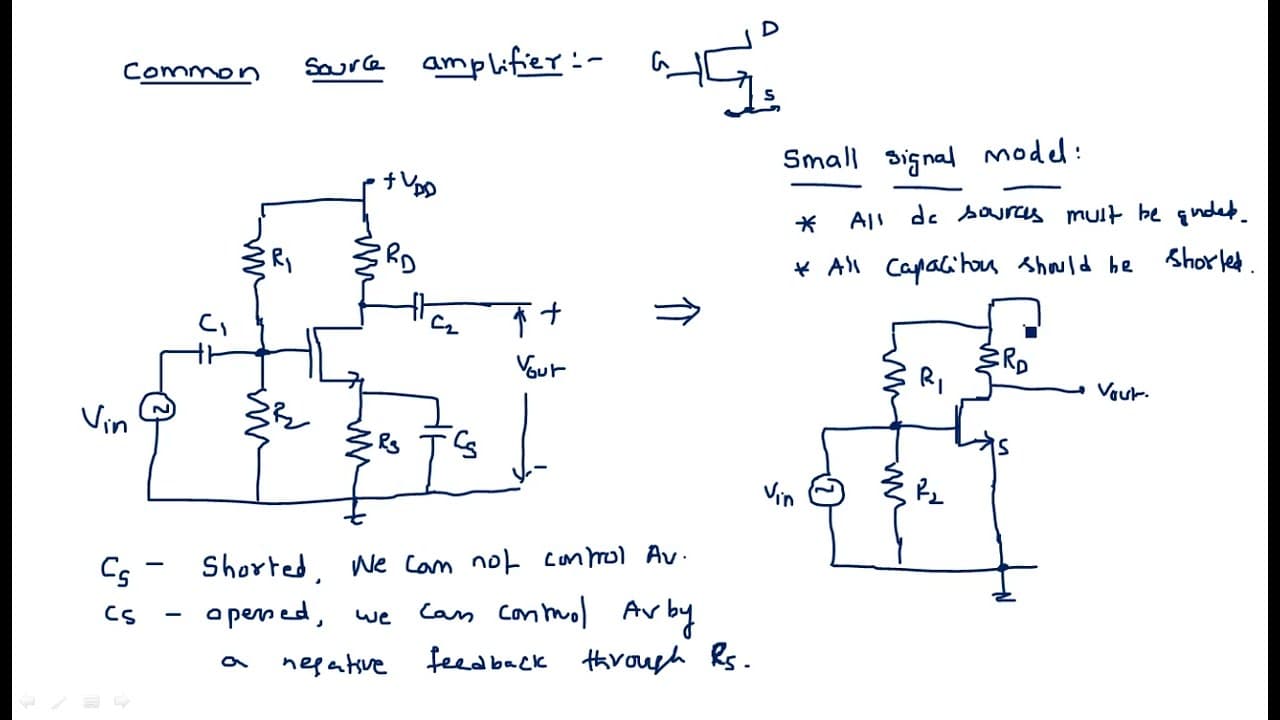
hi everyone in this video you are going to learn about the common source amplifier one of the three stages like a common drain common source common gate so first you are going to learn about common source amplifier and its analysis small signal analysis to calculate the voltage gain input impedance and output impedance so first common source amplif... Read More
Key Insights
- ℹ️ A common source amplifier features a common source terminal, differentiating it from other amplifier types.
- 😥 Biasing resistors are essential for establishing the operating point, directly affecting the amplifier's stability and gain.
- 🛩️ Small signal analysis is crucial for determining voltage gain and input/output impedances in the amplifier circuit.
- 😒 The configuration allows manipulation of gain through the use of bypass and source resistors, essential for performance tuning.
- 🖐️ The coupling capacitors play a vital role in isolating AC signals from DC levels, maintaining amplifier integrity.
- ⚡ Transconductance (GM) is central to voltage gain calculation in common source amplifiers.
- 📡 The input impedance is essential for integrating the amplifier with different circuit components without degradation of signal integrity.
Install to Summarize YouTube Videos and Get Transcripts
Explore YouTube Video Summarizer or Get YouTube Transcript Extractor
Questions & Answers
Q: What is the role of the source terminal in a common source amplifier?
The source terminal in a common source amplifier serves as a common reference point for both the input and output signals. It connects the input signal taken between the gate and source to the output at the drain and source, allowing for specific amplification characteristics associated with this configuration.
Q: How do coupling capacitors impact the operation of the common source amplifier?
Coupling capacitors in a common source amplifier prevent DC signals from affecting the input and output circuits while allowing AC signals to pass through. This ensures that the amplifier operates only on the desired AC components of the input signal, thus enhancing the overall performance and preventing interference from DC components.
Q: What factors influence the voltage gain in a common source amplifier?
Voltage gain in a common source amplifier is influenced primarily by the transconductance (GM) of the transistor and the load resistor (Rd). The output voltage is expressed as a function of the input voltage, and adjusting the load resistor can modify the gain. Additionally, the presence of bypass capacitors and source resistors can affect gain dynamics significantly.
Q: How is the small signal model developed for a common source amplifier?
To develop the small signal model, all DC voltage sources are grounded, and all coupling capacitors are short-circuited. This approach simplifies the analysis as it reserves the gate-source voltage and enables the determination of the equivalent circuit, leading to clearer calculations for voltage gain and input/output impedances in the amplifier.
Q: What is the significance of the source resistor (Rs) in affecting gain?
The source resistor (Rs) is critical in controlling the voltage gain of the amplifier. When Rs is present, it provides feedback that stabilizes the gain, influencing its performance. An increase in Rs typically results in a decrease in gain, highlighting the resistor's importance in managing amplifier operation.
Q: What parameters are critical for calculating input and output impedances?
The input impedance (Zin) can be calculated as the parallel connection of biasing resistors R1 and R2, while the output impedance (Zout) depends on the load resistor Rd and the small internal resistance of the transistor. These parameters are essential for understanding the amplifier's behavior in various signal environments.
Q: How does biasing influence the common source amplifier's performance?
Biasing is pivotal in establishing the operating point of the common source amplifier, ensuring that it operates within its linear region. Proper biasing helps achieve the desired gain, stability, and reduced distortion during amplification. It sets the DC levels necessary for optimal AC signal amplification.
Q: What is the formula for voltage gain in a common source amplifier?
The voltage gain (Av) in a common source amplifier is calculated as Av = -GM(Rd parallel Rd). In this formula, GM represents the transconductance of the transistor, and Rd signifies the load resistance. This negative sign indicates a phase inversion characteristic of typical common source configurations.
Summary & Key Takeaways
-
The common source amplifier is one of three amplifier configurations and has the source terminal common between input and output, providing unique amplification properties.
-
Key components of the amplifier include biasing resistors, coupling capacitors, and a load resistor, which influence its gain and performance.
-
The small signal model for the amplifier is derived by grounding DC voltage sources and short-circuiting capacitors, which allows calculation of voltage gain and input/output impedances.
Read in Other Languages (beta)
Share This Summary 📚
Summarize YouTube Videos and Get Video Transcripts with 1-Click
Try YouTube Summary with ChatGPT & Claude or YouTube Transcript Generator