Lag compensator | Effects | CS | Control Systems | Lec-132
TL;DR
Lag compensators serve as low pass filters enhancing steady state performance by reducing steady state error.
Transcript
hello everyone in this session we will discuss the next compensator is the lag compensator so name itself it is a lagging that means the output always lags the input right so if the system if the system in input applied to a network so we have some network we are applying some input that is the voltage input voltage it produces steady state output ... Read More
Key Insights
- 🎏 Lag compensators produce a phase lag in the output relative to the input, enhancing stability in steady state conditions.
- 🛂 Characterized as low pass filters, they effectively reduce high-frequency noise, optimizing signal clarity in control systems.
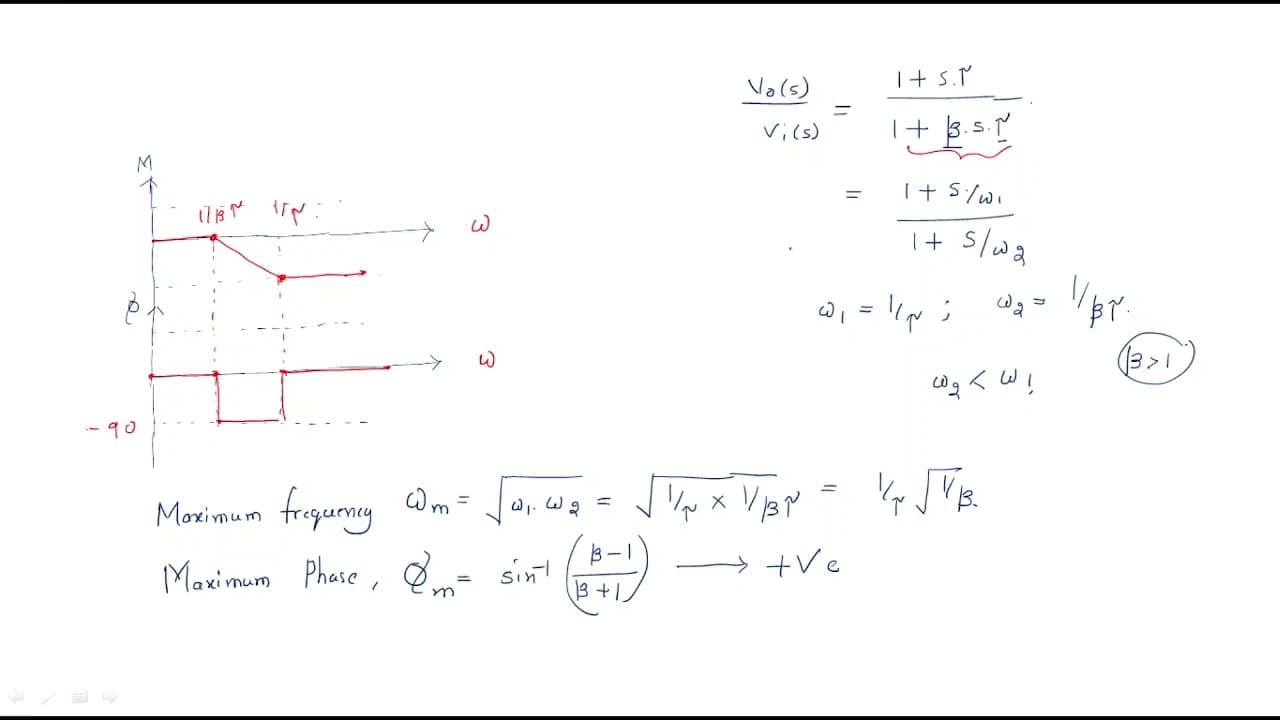
- 💈 The lag compensator's transfer function dictates its performance, determined by pole-zero locations which influence both stability and frequency response.
- 😥 Maximum phase shifts and corner frequency points are critical for understanding how the system will react to different frequency inputs.
- 💨 The trade-off between response time and steady state performance underlines the importance of lag compensators over faster transient responses in specific applications.
- 🥺 The choice between lag and lead compensators should depend on application requirements, prioritizing steady state accuracy or transient responsiveness accordingly.
- 🎮 Designing control systems with lag compensators leads to lower steady state errors, which is crucial for applications in precision control.
Install to Summarize YouTube Videos and Get Transcripts
Explore YouTube Video Summarizer or Get YouTube Transcript Extractor
Questions & Answers
Q: What is the primary function of a lag compensator?
The primary function of a lag compensator is to delay the output signal in relation to the input, thereby improving the steady state performance of control systems. This is particularly vital in applications that require precise output management over time, as it adjusts the phase and minimizes steady state error by filtering out high-frequency noise.
Q: How does a lag compensator differ from a lead compensator?
A lag compensator acts as a low pass filter and is focused on improving steady state performance by allowing lower frequency signals while filtering out high frequencies, which may introduce noise. In contrast, a lead compensator serves as a high-pass filter and is more concerned with enhancing transient response, which helps in faster system reactions but may lead to increased steady state error.
Q: What insights can be derived from the pole-zero configuration of a lag compensator?
The pole-zero configuration provides vital information on the system's stability and frequency response. The location of the pole, which is closer to the imaginary axis, indicates that the system is more stable under low frequencies, while the zero influences how the output amplitude changes with respect to the input, which is essential for the design and analysis of feedback control systems.
Q: Why is the steady state performance emphasized in lag compensators?
Steady state performance is emphasized in lag compensators because it impacts how accurately and reliably the system can maintain its output in relation to a setpoint over time. Unlike transient responses, which may be less critical in certain applications, a stable and low steady state error is essential for consistent operation, especially in precision-control environments.
Q: What are the implications of using a lag compensator regarding bandwidth?
Using a lag compensator results in a reduced bandwidth, meaning the system is designed to primarily respond to lower frequency signals. While this helps in enhancing steady state performance and reducing noise, it also leads to an increased rise time, indicating that the system will respond more slowly to changes, which can be detrimental in applications requiring rapid response.
Q: How does a lag compensator affect the system’s sensitivity to parameter variations?
A lag compensator increases the system's sensitivity to variations in parameters. Because the lag compensator is designed for low frequency performance, any changes in system characteristics can significantly impact the output, thereby necessitating careful design considerations to ensure robustness against parameter fluctuations.
Summary & Key Takeaways
-
Lag compensators produce an output that lags behind the input, characterized by a phase shift in the output signal. This phase lag indicates that the output signal stabilizes after the input is applied.
-
As low pass filters, lag compensators allow low-frequency signals to pass through while filtering out higher frequencies, thereby reducing noise and improving the signal-to-noise ratio in control systems.
-
The transfer function of a lag compensator reveals its poles and zeros, which influence system behavior and are critical for analyzing stability, rise time, and phase characteristics.
Read in Other Languages (beta)
Share This Summary 📚
Summarize YouTube Videos and Get Video Transcripts with 1-Click
Try YouTube Summary with ChatGPT & Claude or YouTube Transcript Generator