How to Build an Infinity Mirror Dodecahedron
TL;DR
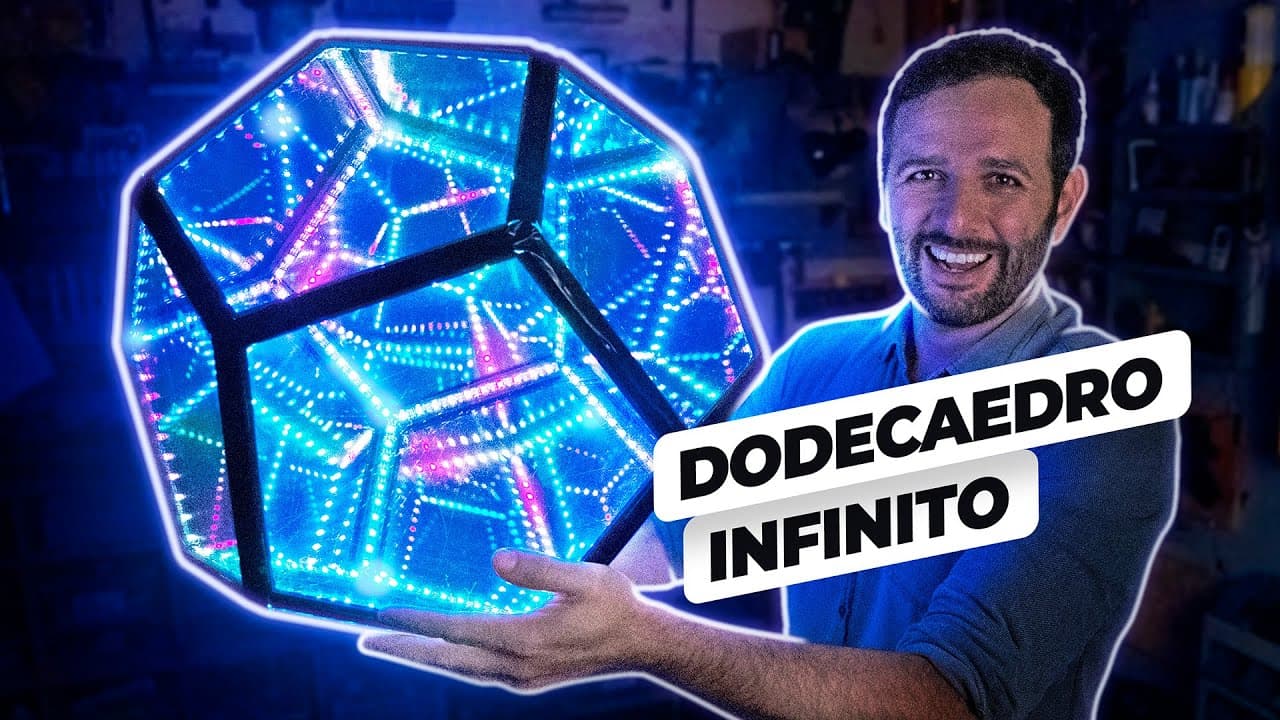
An infinity mirror dodecahedron is created using a combination of addressable LEDs, semi-mirrored acrylic, and a dodecahedron structure made from MDF. The project involves precise measurements, laser cutting, and careful assembly to achieve a stunning visual effect that mimics infinite reflections.
Transcript
Today we are going to build this object that practically multiplies the dimensions that we know. It creates new universes! If you watch Manual do Mundo, you must remember that here we have already created some portals to infinity. The first one was made with a mirror, some Christmas lights... then we made an infinite cube using several LEDs and sem... Read More
Key Insights
- A dodecahedron is a solid with 12 faces, ideal for creating an infinity mirror effect due to its multiple reflective surfaces.
- The project uses addressable LEDs controlled by Arduino, allowing for customizable lighting patterns within the structure.
- Semi-mirrored acrylic is crucial for the infinity effect, as it reflects some light while allowing other light to pass through.
- The structure's skeleton is crafted from MDF, with laser-cut pentagons forming the 12 faces of the dodecahedron.
- Proper assembly requires precise angles and strong adhesives, such as super glue and hot glue, to ensure stability.
- Installing the semi-mirrored film on acrylic requires careful cleaning and application to avoid bubbles and ensure clarity.
- The project is inspired by the fictional 'pollen' device from the Disney+ series 'Mila in the Multiverse'.
- The final result is a visually captivating object that appears to contain infinite light reflections, simulating a journey through dimensions.
Install to Summarize YouTube Videos and Get Transcripts
Explore YouTube Video Summarizer or Get YouTube Transcript Extractor
Questions & Answers
Q: How to create an infinity mirror effect using a dodecahedron?
To create an infinity mirror effect with a dodecahedron, use a structure made from MDF with laser-cut pentagons. Install addressable LEDs for customizable lighting and cover the structure with semi-mirrored acrylic. This setup allows light to reflect multiple times within the dodecahedron, creating the illusion of infinite reflections.
Q: What materials are needed for building a dodecahedron infinity mirror?
Materials needed include MDF for the structure, laser-cut pentagons for the faces, addressable LEDs for lighting, and semi-mirrored acrylic for the reflective surfaces. Additionally, you will need super glue, hot glue, and tools for precise assembly, such as a laser cutter and soldering equipment.
Q: Why use a dodecahedron shape for an infinity mirror project?
A dodecahedron shape is ideal for an infinity mirror project because it has 12 faces, providing multiple reflective surfaces that enhance the infinity effect. This shape allows for a more complex and visually appealing reflection pattern compared to simpler shapes like cubes.
Q: What role do addressable LEDs play in the infinity mirror dodecahedron?
Addressable LEDs play a crucial role by providing customizable lighting effects within the dodecahedron. Controlled by an Arduino, they allow for dynamic patterns and colors, enhancing the visual complexity and appeal of the infinity mirror effect. Each LED can be individually controlled for precise lighting designs.
Q: How is the semi-mirrored acrylic applied to the dodecahedron?
Semi-mirrored acrylic is applied by first cleaning the surface with isopropyl alcohol to remove any debris. A film is then applied using soapy water to prevent bubbles, and the acrylic is carefully attached to the MDF structure. This process ensures clarity and effectiveness of the infinity mirror effect.
Q: What challenges might arise when assembling the dodecahedron?
Challenges include ensuring precise angles for structural integrity, avoiding bubbles when applying the semi-mirrored film, and managing the wiring of addressable LEDs. Proper adhesive use is critical to maintain the structure's stability, and errors in assembly can lead to misalignment of parts.
Q: How does the infinity mirror effect create the illusion of infinite reflections?
The infinity mirror effect is achieved by using semi-mirrored surfaces that reflect some light while allowing other light to pass through. This setup causes light to bounce back and forth between the reflective surfaces, creating the illusion of infinite reflections and depth within the structure.
Q: What inspired the creation of the infinity mirror dodecahedron project?
The project was inspired by the fictional 'pollen' device from the Disney+ series 'Mila in the Multiverse'. This device is used for interdimensional travel in the series, and the project aims to replicate its aesthetic and concept by creating a visually captivating object that simulates infinite dimensions.
Summary & Key Takeaways
-
An infinity mirror dodecahedron is constructed using a dodecahedron shape, addressable LEDs, and semi-mirrored acrylic. The structure is made from MDF, with laser-cut pentagons forming its faces, and precise assembly is required to achieve the desired effect. The project draws inspiration from a fictional device in the Disney+ series 'Mila in the Multiverse'.
-
Addressable LEDs are used for customizable lighting effects, controlled by Arduino. The semi-mirrored acrylic is key to creating the illusion of infinite reflections, as it reflects some light while allowing other light to pass through. This combination results in a visually stunning object that simulates a journey through dimensions.
-
The project involves precise measurements, laser cutting, and careful application of semi-mirrored film to avoid bubbles and ensure clarity. Strong adhesives like super glue and hot glue are used for stability. The result is a captivating visual effect that mimics infinite reflections, inspired by the Disney+ series 'Mila in the Multiverse'.
Read in Other Languages (beta)
Share This Summary 📚
Summarize YouTube Videos and Get Video Transcripts with 1-Click
Try YouTube Summary with ChatGPT & Claude or YouTube Transcript Generator
Explore More Summaries from Manual do Mundo 📚

Summarize YouTube Videos and Get Video Transcripts with 1-Click
Try YouTube Summary with ChatGPT & Claude or YouTube Transcript Generator