Regression Trees, Clearly Explained!!!
TL;DR
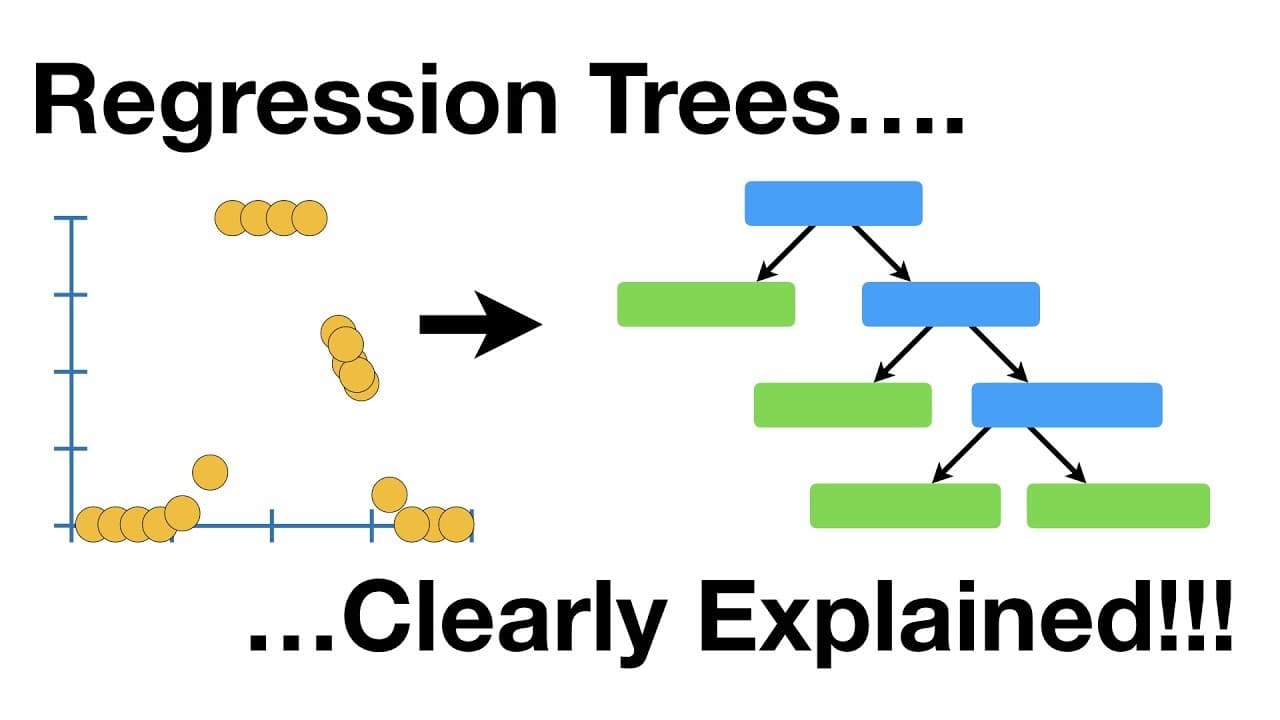
Regression trees segment data into predictive clusters for accurate predictions with multiple variables.
Transcript
regression tree is for you and for me stat quest hello I'm Josh Starman welcome to stat quest today we're going to talk about regression trees and they're gonna be clearly explained this stat quest assumes you are already familiar with the trade-off that plagues all of machine learning the bias-variance tradeoff and the basic ideas behind decision ... Read More
Key Insights
- 🌲 Regression trees segment data for accurate predictions by creating thresholds.
- 🌲 Handling multiple predictors in regression trees involves finding optimal thresholds for each variable.
- 🥺 Overfitting can occur in regression trees with a perfect fit on training data, leading to poor generalization.
- 😫 Preventing overfitting in regression trees can be achieved by setting a minimum number of observations in a node.
- 🌲 Regression trees excel at handling complex data by creating predictive clusters for accurate predictions.
- 🌲 Building a regression tree involves finding thresholds that minimize the sum of squared residuals for optimal prediction.
- 🌲 Evaluation of regression tree predictions involves comparing observed and predicted values using the sum of squared residuals.
Install to Summarize YouTube Videos and Get Transcripts
Explore YouTube Video Summarizer or Get YouTube Transcript Extractor
Questions & Answers
Q: What is the main purpose of using regression trees in machine learning?
Regression trees are used to predict numeric values by segmenting data into clusters based on thresholds, ensuring accurate predictions in complex datasets.
Q: How does a regression tree handle data with multiple predictors?
A regression tree with multiple predictors determines the optimal threshold for each predictor to create predictive clusters, leading to accurate predictions across various variables.
Q: How does overfitting in regression trees affect model performance?
Overfitting in regression trees, indicated by a perfect fit to training data, can lead to poor performance on new data due to high variance and lack of generalization.
Q: What technique can prevent overfitting in regression trees?
Setting a minimum number of observations in a node, commonly 20 but adjustable as in this example to 7, helps prevent overfitting in regression trees and improves model performance.
Summary & Key Takeaways
-
Regression trees segment data based on thresholds to predict numeric values accurately.
-
These trees handle complex data by dividing observations into clusters for better predictions.
-
To avoid overfitting, setting a minimum number of observations in a node is crucial for model performance.
Read in Other Languages (beta)
Share This Summary 📚
Summarize YouTube Videos and Get Video Transcripts with 1-Click
Try YouTube Summary with ChatGPT & Claude or YouTube Transcript Generator
Explore More Summaries from StatQuest with Josh Starmer 📚


Summarize YouTube Videos and Get Video Transcripts with 1-Click
Try YouTube Summary with ChatGPT & Claude or YouTube Transcript Generator