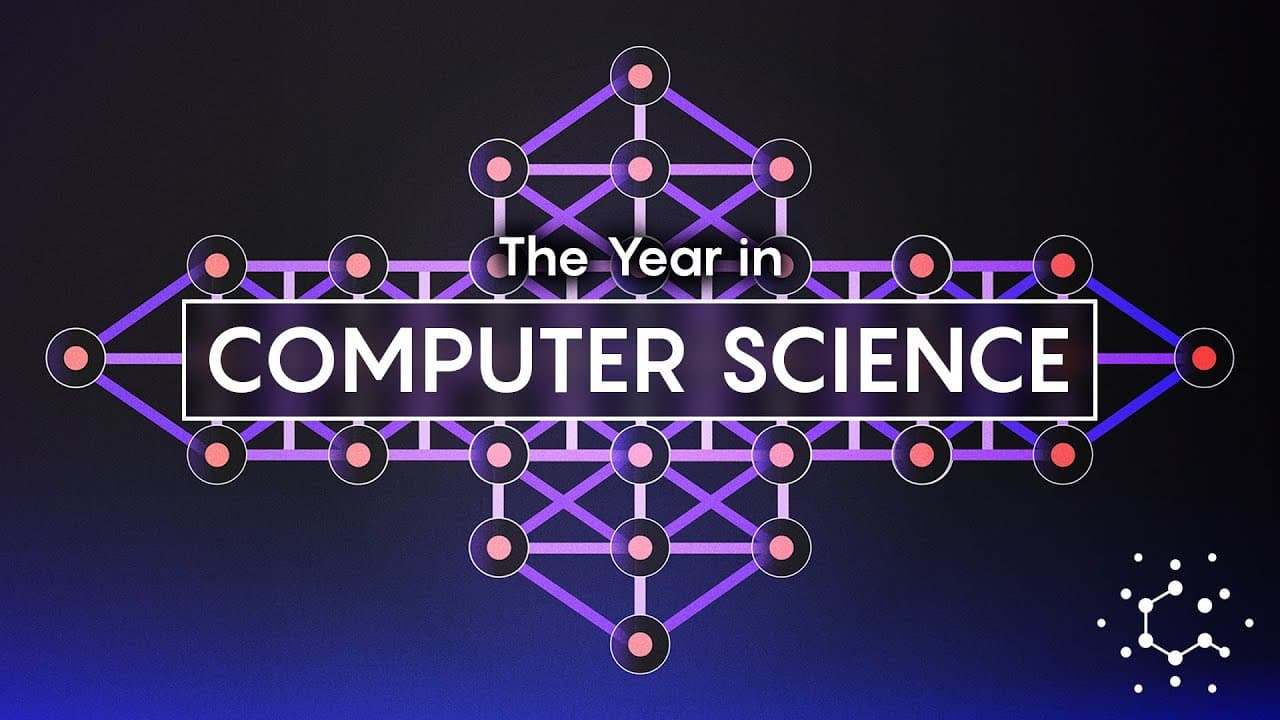
Computer Science - 2023's Biggest Breakthroughs
TL;DR
Artificial neural networks struggle with reasoning by analogy, while symbolic AI uses logic-based programming. Hyperdimensional computing aims to combine statistical AI and symbolic computing by using complex vectors. In quantum computing, Oded Regev discovers a new algorithm that enhances Shor's algorithm for factoring large numbers. Large language models exhibit emergent behaviors when scaled up, leading to new capabilities.
Transcript
From ChatGPT to Dall-E, It might seem like the pace of progress in artificial intelligence is unstoppable. But the artificial neural networks that underpin these programs are coming up against some major limitations. For one, they have a hard time reasoning. Human brains are able to reason by analogy. When we see something new, we don't have to gro... Read More
Key Insights
- 🧠 Artificial neural networks struggle with reasoning by analogy, while human brains can easily generalize new concepts from existing knowledge.
- 😒 Symbolic AI, which uses logic-based programming and symbols, is incompatible with statistical AI, but the challenge is to combine them to achieve the best of both worlds.
- 💨 Hyperdimensional computing combines statistical AI and symbolic computing by using vectors to encode information in a complex and multi-dimensional way.
- 🧑🏭 Oded Regev discovers an improved algorithm that enhances Shor's algorithm for factoring large numbers in quantum computing.
- 👶 Large language models exhibit emergent behaviors when scaled up, enabling them to solve new problems and generalize better.
- 🌥️ The source of emergence in large language models is still a mystery, and understanding their capabilities and potential harms is an ongoing challenge.
- 🥺 Scaling up models leads to unpredictable behaviors, which can be both beneficial and harmful, emphasizing the importance of measuring the possible types of harms that may emerge.
Install to Summarize YouTube Videos and Get Transcripts
Explore YouTube Video Summarizer or Get YouTube Transcript Extractor
Questions & Answers
Q: Why do artificial neural networks struggle with reasoning by analogy?
Artificial neural networks require more artificial nodes to scale up their statistical abilities and learn new concepts from new information. They lack the ability to reason by analogy like human brains do.
Q: What is hyperdimensional computing and how does it combine statistical AI and symbolic computing?
Hyperdimensional computing utilizes vectors, ordered lists of numbers that represent information in a complex and multi-dimensional way. It combines the power of statistical AI with the ability to emulate symbolic computing by using these vectors to encode concepts and rules.
Q: How did Oded Regev improve Shor's algorithm for factoring large numbers in quantum computing?
Regev transformed the periodic function from one dimension to multiple dimensions, including more numbers to find the period of repetition in the outputs. This improved method could factor integers faster and more efficiently than Shor's algorithm.
Q: What are emergent behaviors in large language models, and how do they enable solving new problems?
Emergent behaviors are unexpected abilities that arise when enough digital nodes combine in large language models. They allow the models to solve problems they have not seen before, known as zero-shot or few-shot learning, by breaking down complex tasks into smaller steps.
Key Insights:
- Artificial neural networks struggle with reasoning by analogy, while human brains can easily generalize new concepts from existing knowledge.
- Symbolic AI, which uses logic-based programming and symbols, is incompatible with statistical AI, but the challenge is to combine them to achieve the best of both worlds.
- Hyperdimensional computing combines statistical AI and symbolic computing by using vectors to encode information in a complex and multi-dimensional way.
- Oded Regev discovers an improved algorithm that enhances Shor's algorithm for factoring large numbers in quantum computing.
- Large language models exhibit emergent behaviors when scaled up, enabling them to solve new problems and generalize better.
- The source of emergence in large language models is still a mystery, and understanding their capabilities and potential harms is an ongoing challenge.
- Scaling up models leads to unpredictable behaviors, which can be both beneficial and harmful, emphasizing the importance of measuring the possible types of harms that may emerge.
- The field of AI is rapidly evolving, with new approaches and breakthroughs continually being made.
Summary & Key Takeaways
-
Artificial neural networks have limitations in reasoning by analogy, while human brains can generalize new concepts from existing knowledge.
-
Hyperdimensional computing combines statistical AI and symbolic computing by using vectors to encode information without adding more nodes to the network.
-
Oded Regev finds an improved algorithm that enhances Shor's algorithm for factoring large numbers in quantum computing.
-
Large language models exhibit emergent behaviors when scaled up, allowing for solving problems not seen before.
Read in Other Languages (beta)
Share This Summary 📚
Summarize YouTube Videos and Get Video Transcripts with 1-Click
Try YouTube Summary with ChatGPT & Claude or YouTube Transcript Generator
Explore More Summaries from Quanta Magazine 📚


Summarize YouTube Videos and Get Video Transcripts with 1-Click
Try YouTube Summary with ChatGPT & Claude or YouTube Transcript Generator