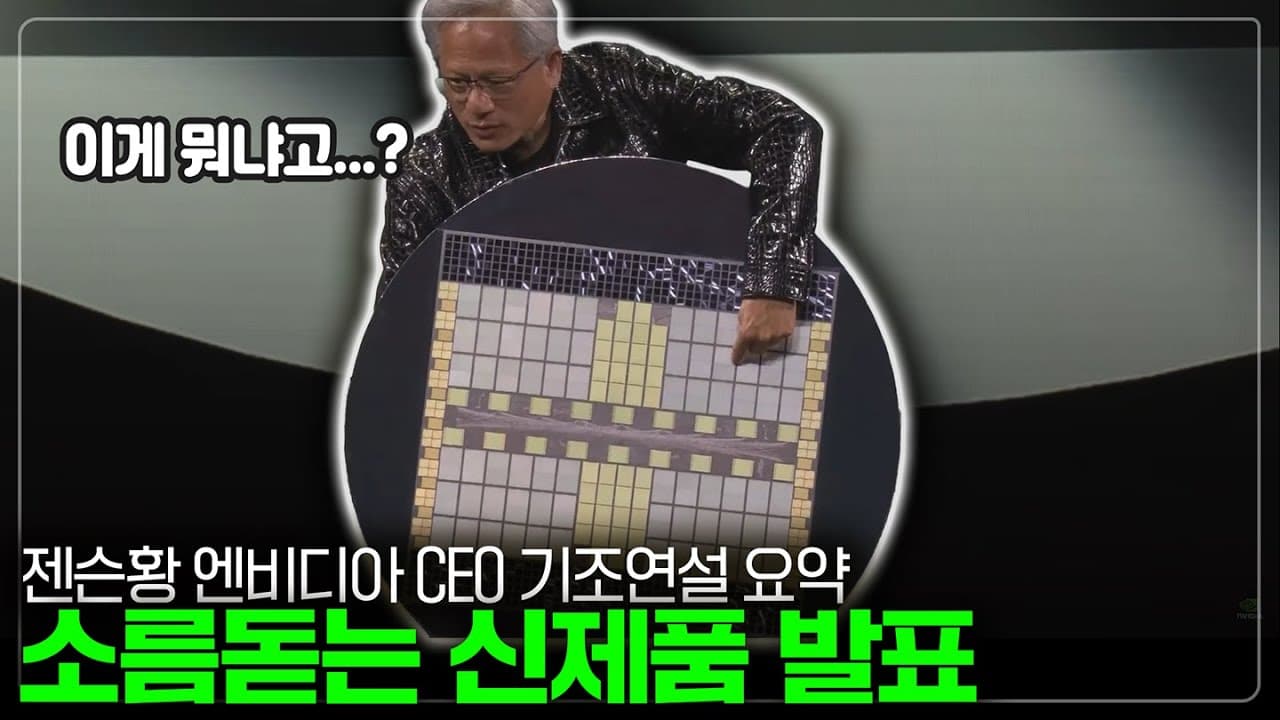
말도 안되는 크기의 반도체칩, 성능은 진짜.../ CES 엔비디아 기조연설 번역
TL;DR
NVIDIA introduces the powerful Blackwell architecture with groundbreaking AI and graphics capabilities.
Transcript
here it is our brand new GeForce RTX 50 Series Blackwell architecture the GPU is just a beast 92 billion transistors 4,000 tops four pedop flop of AI three times higher than the last generation Ada and we need all of it to generate those pixels that I showed you 380 Ray tra teraflops so that we could for the pixels that we have to compute compute t... Read More
Key Insights
- NVIDIA's GeForce RTX 50 Series, based on the Blackwell architecture, boasts 92 billion transistors and 4,000 TOPS, significantly enhancing AI and graphics performance.
- The new architecture enables the mixing of AI and graphics workloads, introducing innovations like neurotexture compression and neuromaterial shading.
- The RTX 50 Series offers twice the performance of its predecessor, with G7 memory from Micron delivering 1.8 terabytes per second bandwidth.
- NVIDIA Cosmos, a foundational AI model, is designed to understand the physical world, leveraging 20 million hours of video training to enhance robotics and language models.
- The Cosmos platform supports real-time applications with an autoregressive model and high-quality image generation with a diffusion model.
- NVIDIA's Thor processor, a universal robotics computer, processes vast sensor data for autonomous vehicles and robots, offering 20 times the performance of its predecessor.
- The introduction of NVIDIA's AI supercomputer, Project Digits, integrates the entire NVIDIA AI stack, featuring a top-secret GB110 chip for exceptional processing capabilities.
- NVIDIA collaborates with MediaTek to develop the Grace CPU, part of the AI supercomputer, enhancing connectivity and performance through chip-to-chip MVLink technology.
Install to Summarize YouTube Videos and Get Transcripts
Explore YouTube Video Summarizer or Get YouTube Transcript Extractor
Questions & Answers
Q: What are the key features of NVIDIA's new GeForce RTX 50 Series?
NVIDIA's GeForce RTX 50 Series, based on the Blackwell architecture, features 92 billion transistors and 4,000 TOPS, providing significant enhancements in AI and graphics performance. It supports the mixing of AI and graphics workloads, introducing innovations like neurotexture compression and neuromaterial shading. Additionally, it offers twice the performance of its predecessor with G7 memory delivering 1.8 terabytes per second bandwidth.
Q: How does the NVIDIA Cosmos platform contribute to AI development?
The NVIDIA Cosmos platform is designed to teach AI about the physical world using 20 million hours of video. It supports real-time applications with an autoregressive model and high-quality image generation with a diffusion model. The platform's open licensing on GitHub encourages widespread adoption and innovation, facilitating the development of advanced robotics and language models.
Q: What advancements does the Thor processor bring to robotics and autonomous vehicles?
The Thor processor, a universal robotics computer, processes vast sensor data for autonomous vehicles and robots, offering 20 times the performance of its predecessor. It integrates sensors from cameras, radars, and LIDARs, transforming them into actionable data for path prediction. This advancement significantly enhances the capabilities of autonomous systems and robotics applications.
Q: What is Project Digits, and how does it enhance NVIDIA's AI capabilities?
Project Digits is NVIDIA's AI supercomputer that integrates the entire NVIDIA AI stack. It features a top-secret GB110 chip and a collaborative Grace CPU developed with MediaTek, enhancing connectivity and processing power through chip-to-chip MVLink technology. This supercomputer supports NVIDIA's AI applications, offering exceptional processing capabilities and facilitating advanced AI research and development.
Q: How does NVIDIA's collaboration with MediaTek contribute to their AI supercomputer?
NVIDIA's collaboration with MediaTek results in the development of the Grace CPU, which is part of the AI supercomputer. This collaboration enhances the connectivity and performance of the supercomputer through chip-to-chip MVLink technology. The Grace CPU, combined with the top-secret GB110 chip, significantly boosts the processing capabilities of NVIDIA's AI supercomputer, supporting advanced AI applications.
Q: What impact does the Blackwell architecture have on AI and graphics workloads?
The Blackwell architecture enables the seamless integration of AI and graphics workloads, significantly enhancing performance. It introduces innovations like neurotexture compression and neuromaterial shading, allowing for more efficient processing and rendering of graphics. This architecture supports advanced AI capabilities, facilitating the development of more sophisticated and efficient AI and graphics applications.
Q: How does the new architecture improve memory performance in NVIDIA's GPUs?
The new architecture in NVIDIA's GPUs, specifically the GeForce RTX 50 Series, improves memory performance by incorporating G7 memory from Micron, which delivers 1.8 terabytes per second bandwidth. This enhancement allows for faster data processing and improved overall performance, supporting the demanding requirements of modern AI and graphics applications.
Q: What are the potential applications of the NVIDIA Cosmos platform in AI development?
The NVIDIA Cosmos platform has potential applications in various AI development areas, including robotics and language models. By teaching AI about the physical world, the platform can enhance the capabilities of robotics systems, allowing them to understand and interact with their environment more effectively. Additionally, it supports the development of advanced language models, enabling more sophisticated natural language processing and understanding.
Summary & Key Takeaways
-
NVIDIA's new GeForce RTX 50 Series, powered by the Blackwell architecture, delivers unprecedented AI and graphics performance with innovations like neurotexture compression and neuromaterial shading. The series offers twice the performance of previous models, supported by G7 memory and advanced AI capabilities, revolutionizing the computing landscape.
-
The NVIDIA Cosmos platform aims to teach AI about the physical world, leveraging 20 million hours of video. It supports real-time applications and high-quality image generation, enhancing robotics and language models. The platform's open licensing on GitHub facilitates widespread adoption and innovation in AI development.
-
NVIDIA introduces the Thor processor, a universal robotics computer for autonomous vehicles and robots, offering 20 times the performance of its predecessor. The AI supercomputer, Project Digits, integrates NVIDIA's AI stack, featuring a secret GB110 chip and a collaborative Grace CPU, enhancing connectivity and processing power.
Read in Other Languages (beta)
Share This Summary 📚
Summarize YouTube Videos and Get Video Transcripts with 1-Click
Try YouTube Summary with ChatGPT & Claude or YouTube Transcript Generator