How Democracy Is Sold To Us and Why It Doesn't Exist | Eon Podcast #25
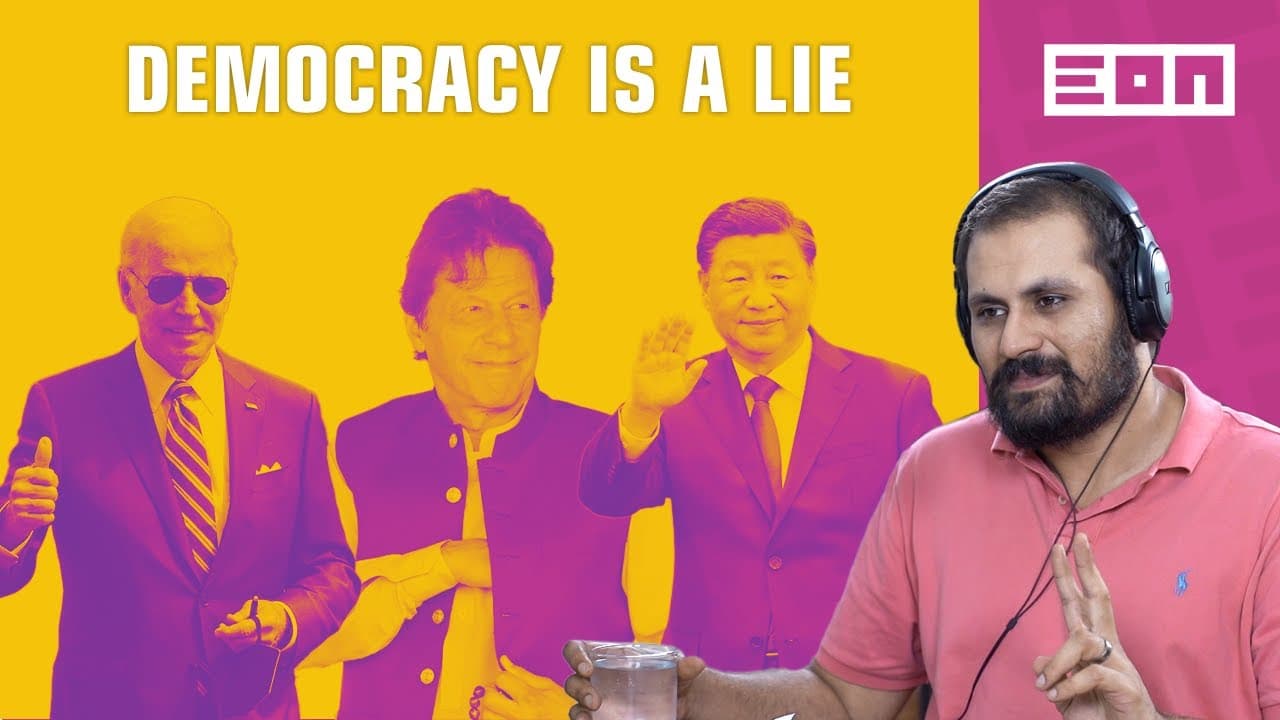
TL;DR
Democracy is a flawed illusion, often serving the powerful over the people.
Transcript
democracy is a joke it's a life being told by the west and that is what we're gonna tell you I said [Laughter] democracy at its core means literally people ruling over themselves by the people for the people of the people but the people are but the people are the problem is that when you go for a system that is because not everybody has the same ki... Read More
Key Insights
- 🍦 Democracy is often perceived as an ideal, but it frequently operates as a soft dictatorship where the elite maintain control.
- 🥺 Societal perspectives influenced by education and experience lead to divergent views on governance, complicating democratic processes.
- ✊ The concept of power extends beyond political positions to include economic influence, suggesting an inherent inequality in how democracy functions.
- ⛔ While citizens have a theoretical voice, actual influence is often limited by systemic corruption and elite interests.
- 🥺 The illusion of choice in democratic systems can lead to complacency, preventing necessary societal changes.
- 🫥 Political parties often blur the lines between differing ideologies, maintaining the status quo instead of implementing meaningful reform.
- 🖤 A lack of empathy and moral responsibility among leaders contributes to a governance model that prioritizes self-interest over public welfare.
Install to Summarize YouTube Videos and Get Transcripts
Explore YouTube Video Summarizer or Get YouTube Transcript Extractor
Questions & Answers
Q: What does the speaker imply about the nature of democracy?
The speaker suggests that democracy is a façade that provides the illusion of choice while actually allowing the powerful elite to retain control. They argue that real democracy, characterized by collective governance, rarely functions as envisioned because different societal perspectives, shaped by personal experiences, create a fractured political reality where true representation is compromised.
Q: How does the speaker view the impact of personal background on political perspectives?
The speaker indicates that personal backgrounds significantly affect political perspectives, leading to divergent understandings of democracy. A military veteran may focus on security, while a businessman zeroes in on economic growth. This fragmentation within society undermines the potential for a unified democratic decision-making process and often leads to policies that do not truly reflect the will of the populace.
Q: What criticism is made about political parties in democratic systems?
The content criticizes political parties for often lacking substantial differences in policy, implying that they merely provide a veneer of choice while serving overarching interests. The speaker argues that the parties previously in power, regardless of their names, fundamentally operate within the same inefficient, corrupt framework, prioritizing their own survival over the well-being of citizens.
Q: How do personal relationships and connections influence governance, according to the speaker?
The speaker posits that strong personal relationships, often developed through shared interests like real estate, can lead to significant advantages in understanding and influencing political and economic landscapes. This interconnectedness can yield benefits for those in power, illustrating that empathy and moral integrity are often overshadowed by personal gain and financial interest.
Q: What is said about the concept of relative freedom in democracy?
The speaker argues that relative freedom is a misleading construct that still equates to oppression. They contend that freedom is not something that can be compromised, and the notion that democracy provides relative freedom ultimately blinds citizens to deeper systemic issues such as economic inequality and the erosion of individuality.
Q: What examples are given to illustrate the failures of democracy globally?
The speaker cites various countries, including the United States, China, and Pakistan, noting how each operates under a guise of democracy while unduly prioritizing elite power and subjugating the average citizen's voice. They highlight similar patterns of governance, showing that the challenges faced in one nation are mirrored in others, regardless of political labels.
Summary & Key Takeaways
-
The speaker argues that democracy, as it exists in various nations, is more of an illusion than an effective system of governance and that it often protects the interests of the powerful elite rather than serving the populace.
-
Different perspectives among citizens based on their backgrounds lead to skewed interpretations of democracy, which ultimately fails to create the equitable society it promises, leaving power dynamics unchanged.
-
The content proposes that both wealth and personal influence dictate the actual operational efficiencies of democracies, with money often leading to more significant power than the collective voice of the people.
Read in Other Languages (beta)
Share This Summary 📚
Summarize YouTube Videos and Get Video Transcripts with 1-Click
Try YouTube Summary with ChatGPT & Claude or YouTube Transcript Generator