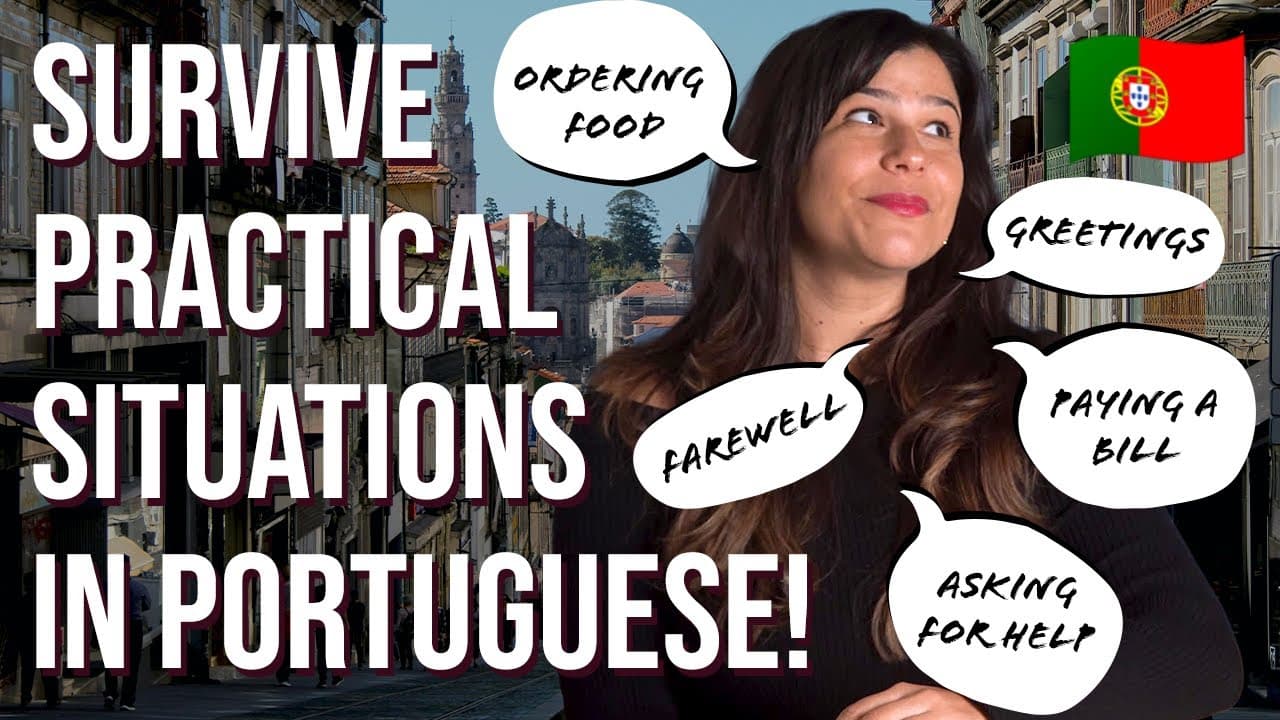
5 Practical Situations in European Portuguese you NEED to Prepare For! (Essential Phrases)
TL;DR
Learn essential Portuguese phrases for five key situations.
Transcript
you're arriving in Portugal maybe to stay and you so badly want to make a good impression on the locals there's just one problem you are terrified of attempting Portuguese you just know that your accent will make you stick out like a sore thumb and probably have people responding to you in English if this is something that you are worrying about th... Read More
Key Insights
- Pronunciation is crucial when speaking Portuguese; focusing on nasal sounds and the tapped 'r' can enhance your accent.
- Greeting people politely in Portugal involves using 'Bom dia' or 'Boa tarde', with attention to time and pronunciation.
- Using the imperfect tense in requests, like 'Queria', makes interactions more polite and culturally appropriate.
- Understanding the nuances between 'desculpe' and 'com licença' can help in asking for help or permission effectively.
- Tipping in Portugal is not expected as a percentage of the bill, but it is a kind gesture towards service staff.
- Being able to say 'obrigado' or 'obrigada' correctly, and using responses like 'obrigado eu', can improve conversational fluency.
- Learning to ask for the bill and understanding the pronunciation of 'a conta' is essential for dining out.
- Using diminutives and colloquial phrases like 'tchauzinho' or 'beijinhos' can make interactions more friendly and natural.
Install to Summarize YouTube Videos and Get Transcripts
Explore YouTube Video Summarizer or Get YouTube Transcript Extractor
Questions & Answers
Q: Why is pronunciation important when speaking Portuguese?
Pronunciation is crucial because it helps you sound more like a local, which can prevent people from replying in English. Focusing on nasal sounds and the tapped 'r' can help you blend in better and make a good impression on the locals.
Q: What is the polite way to order in Portuguese?
The polite way to order in Portuguese is by using the verb 'queria', which is the imperfect tense of 'querer'. This form is used to make polite requests, as opposed to the direct 'quero', which can be perceived as too direct or demanding.
Q: How should you handle tipping in Portugal?
Tipping in Portugal is not required as a certain percentage of the bill, unlike in the US or UK. However, it is a nice gesture to tip service staff. It's appreciated but not expected, so a small tip is a kind way to show appreciation for good service.
Q: What are some key polite phrases to know in Portuguese?
Key polite phrases include greetings like 'Bom dia' or 'Boa tarde', saying 'obrigado' or 'obrigada' for thank you, and using 'desculpe' or 'com licença' to ask for help or permission. These phrases, when pronounced correctly, can greatly enhance your interactions.
Q: How can you ask for the bill in Portuguese?
To ask for the bill in Portuguese, you can say 'A conta, por favor'. It's important to pronounce 'a conta' with the correct closed 'a' sound to ensure you are understood. This phrase is essential for dining out and settling your bill politely.
Q: What is the difference between 'desculpe' and 'com licença'?
'Desculpe' is used to ask for forgiveness, while 'com licença' is used to ask for permission. Both mean 'excuse me', but understanding their nuances can help you use them appropriately in different situations when trying to get someone's attention or passing by.
Q: What are some common ways to say goodbye in Portuguese?
Common ways to say goodbye include 'tchau', 'tchauzinho', and 'beijinhos'. These are friendly and colloquial ways to bid farewell, often used among friends. Using diminutives like 'zinho' or 'inhos' can make the phrases sound more affectionate and natural.
Q: How can you respond to someone thanking you in Portuguese?
When someone thanks you in Portuguese, you can respond with 'obrigado eu', which means 'no, thank you'. This phrase shows humility and gratitude, making it a polite way to acknowledge someone's thanks and reciprocate the sentiment in a conversation.
Summary & Key Takeaways
-
The video provides essential phrases and pronunciation tips for navigating five practical situations in Portugal, focusing on greeting, ordering, asking for help, and saying goodbye.
-
Liz Sharma emphasizes the importance of correct pronunciation, including nasal sounds and the tapped 'r', to sound more like a local and avoid being replied to in English.
-
Understanding cultural nuances, such as using the imperfect tense for politeness and the differences in tipping customs, can significantly improve interactions with locals.
Read in Other Languages (beta)
Share This Summary 📚
Summarize YouTube Videos and Get Video Transcripts with 1-Click
Try YouTube Summary with ChatGPT & Claude or YouTube Transcript Generator
Explore More Summaries from Talk the Streets 📚

![Practice Portuguese with Mixologist Fábio Guerreiro! [English & Portuguese Subtitles] thumbnail](/_next/image?url=https%3A%2F%2Fi.ytimg.com%2Fvi%2F1-T2PNWuiWY%2Fhqdefault.jpg&w=750&q=75)
![Learn European Portuguese Outside of Portugal! [NEW apps & TOP tips!] thumbnail](/_next/image?url=https%3A%2F%2Fi.ytimg.com%2Fvi%2F0K81C-5Z1I0%2Fhqdefault.jpg&w=750&q=75)

Summarize YouTube Videos and Get Video Transcripts with 1-Click
Try YouTube Summary with ChatGPT & Claude or YouTube Transcript Generator