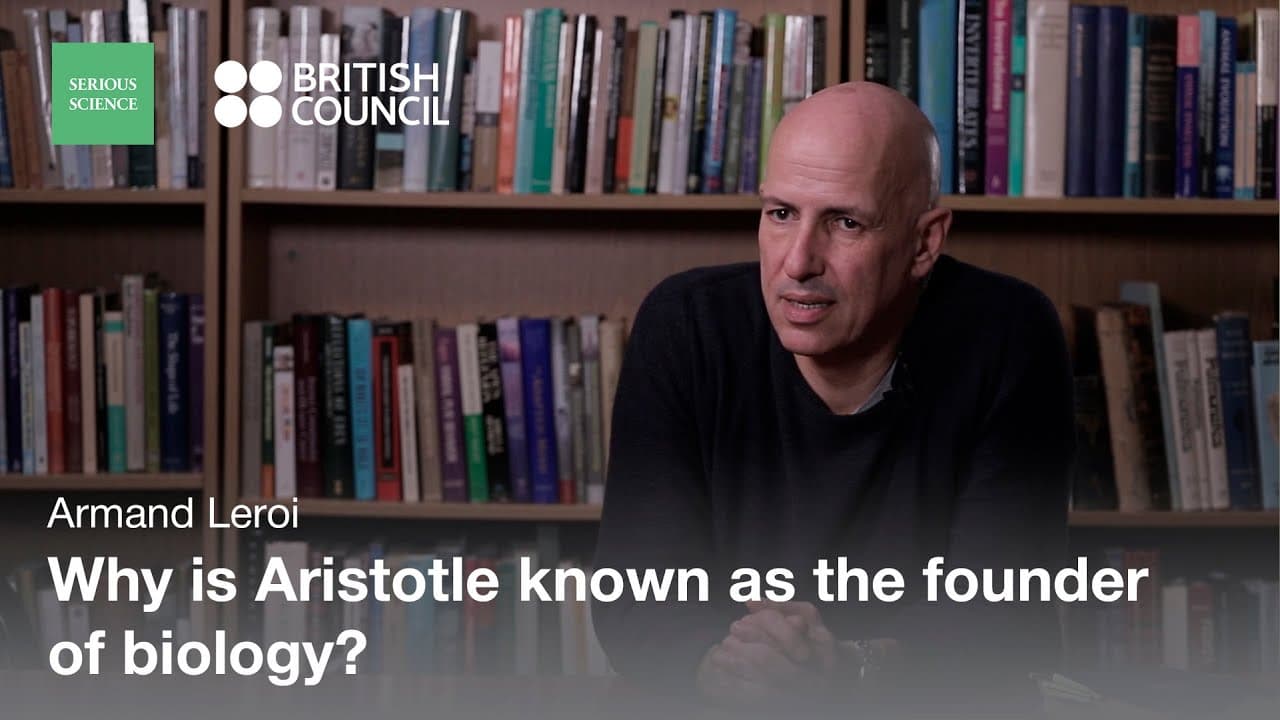
Aristotle's Biology — Armand Leroi / Serious Science
TL;DR
Aristotelian biology, as described in his book "Historia Animalium," laid the foundation for the field of biology as we know it today.
Transcript
many years ago i was in a bookshop in athens it was an old bookshop a very beautiful one sold second-hand books i was on i was in greece on a holiday and it was hot and there were crowds outside so i went inside this book shop and it wasn't very useful all the books were in greek but there was were a few that were in english and among them were the... Read More
Key Insights
- 📔 Aristotle's book "Historia Animalium" contains detailed descriptions of animal anatomy, demonstrating his keen observational skills.
- 💋 Aristotle's research in Lesvos marked the beginning of biological inquiry and the accumulation of empirical knowledge on animals.
- 💁 Aristotle's books on biology served as the first scientific database, organizing and sorting information to identify patterns and provide explanations.
- 🤔 Despite some inaccuracies, Aristotle's contributions to the field have shaped the way we think about biology, including concepts like the soul and the interrelation of parts.
Install to Summarize YouTube Videos and Get Transcripts
Explore YouTube Video Summarizer or Get YouTube Transcript Extractor
Questions & Answers
Q: How did the speaker become interested in Aristotle's works?
The speaker stumbled upon Aristotle's book "Historia Animalium" and was amazed to find that his understanding of snail anatomy matched modern knowledge.
Q: Where did Aristotle conduct his biological research?
Aristotle conducted his research in Lesvos, Greece, specifically in a lagoon called Pira, which became the birthplace of biology.
Q: What topics did Aristotle cover in his books on biology?
Aristotle covered a wide range of topics, including the relationships between body parts, animal locomotion, biochemistry, and the generation of animals.
Q: How does Aristotle's biology differ from modern understanding?
While some of Aristotle's specific details were inaccurate, such as his physics and chemistry, his overall approach and methodology laid the foundation for modern biology.
Key Insights:
- Aristotle's book "Historia Animalium" contains detailed descriptions of animal anatomy, demonstrating his keen observational skills.
- Aristotle's research in Lesvos marked the beginning of biological inquiry and the accumulation of empirical knowledge on animals.
- Aristotle's books on biology served as the first scientific database, organizing and sorting information to identify patterns and provide explanations.
- Despite some inaccuracies, Aristotle's contributions to the field have shaped the way we think about biology, including concepts like the soul and the interrelation of parts.
- By studying Aristotle, we can appreciate the historical development of biology and the significant progress made in understanding the natural world.
Summary & Key Takeaways
-
The speaker initially had little interest in Aristotle's works until they stumbled upon his book "Historia Animalium" and discovered his detailed understanding of snail anatomy, which aligned with modern knowledge.
-
Aristotle's biological work began in Lesvos, Greece, where he collected information from various sources to create the first-ever scientific database on animals.
-
He wrote multiple books on biology, covering topics such as the relationships between body parts, animal locomotion, biochemistry, and the generation of animals.
Read in Other Languages (beta)
Share This Summary 📚
Summarize YouTube Videos and Get Video Transcripts with 1-Click
Try YouTube Summary with ChatGPT & Claude or YouTube Transcript Generator
Explore More Summaries from Serious Science 📚



Summarize YouTube Videos and Get Video Transcripts with 1-Click
Try YouTube Summary with ChatGPT & Claude or YouTube Transcript Generator