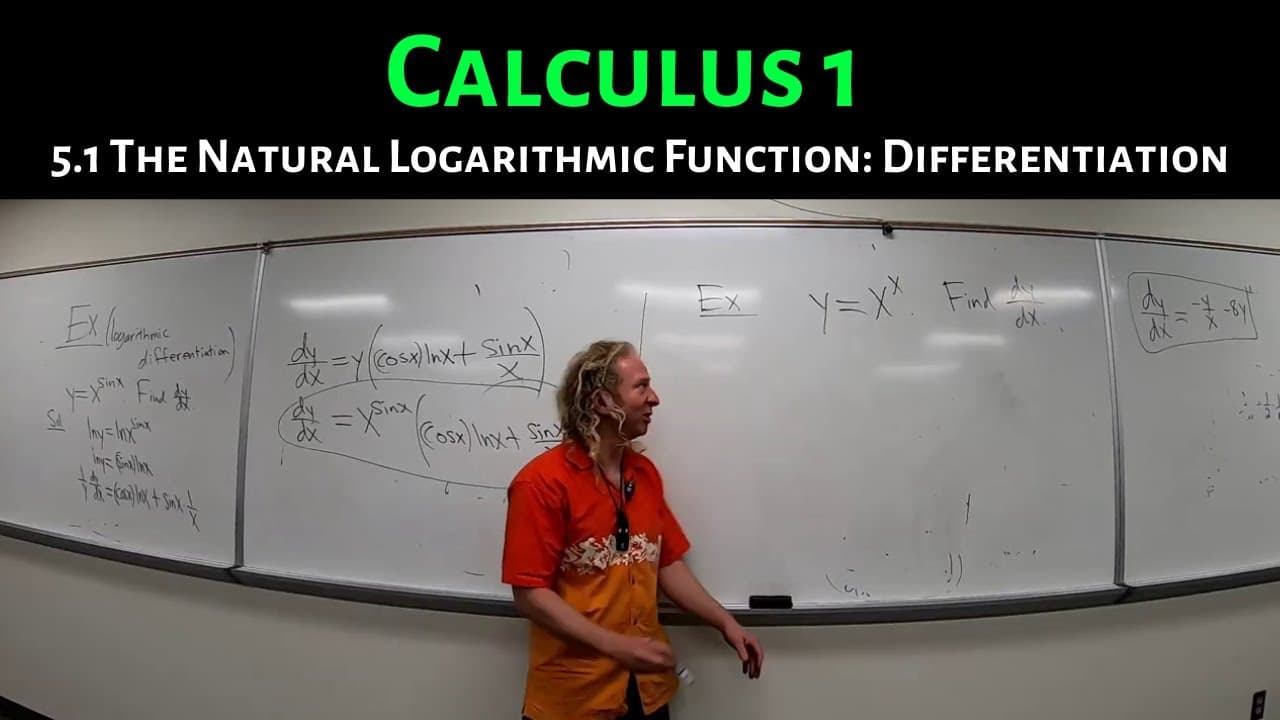
Calculus 1: Lecture 5.1 The Natural Logarithmic Function Differentiation
TL;DR
Exploring logarithmic differentiation for finding derivatives, with comprehensive step-by-step examples.
Transcript
when it stops moving that means the battery's dead and it's game over is on the natural there's a nice section logarithm logarithm logarithms the natural log and it's on derivatives so on differentiation so we're only taking derivatives in this section right we'll just do a bunch of homework ok so it's on derivatives sodor derivatives derivatives d... Read More
Key Insights
- 🙃 Logarithmic differentiation involves taking ln of both sides, placing X as exponent, and applying the product rule for differentiation.
- 😒 The use of logarithmic differentiation simplifies complex derivative calculations by leveraging logarithmic properties.
- ❓ Understanding logarithmic differentiation enhances the efficiency and accuracy of finding derivatives for functions with intricate structures.
- 🈸 Practice examples demonstrate the step-by-step application of logarithmic differentiation in finding derivatives of complex functions.
- ❓ Mastery of logarithmic differentiation is essential for tackling challenging calculus problems and optimizing the computation of derivatives.
- 👍 The logarithmic differentiation technique proves beneficial in solving calculus problems efficiently and accurately.
- ❓ Applying logarithmic differentiation facilitates the derivation of derivatives for functions involving intricate algebraic and exponential components.
Install to Summarize YouTube Videos and Get Transcripts
Explore YouTube Video Summarizer or Get YouTube Transcript Extractor
Questions & Answers
Q: What is the initial step in logarithmic differentiation?
The initial step in logarithmic differentiation is taking the natural logarithm of both sides of the equation.
Q: How does logarithmic differentiation aid in finding derivatives efficiently?
Logarithmic differentiation simplifies the differentiation process by utilizing properties of logarithms and product rule to compute derivatives.
Q: When using the product rule in logarithmic differentiation, what does each term represent?
In the product rule, the derivative of the first term is multiplied by the second term, and the first term is multiplied by the derivative of the second term.
Q: Why is replacing the variable with its original expression the final step in logarithmic differentiation?
Replacing the variable with its original expression in the derived equation allows for a clear representation of the derivative in terms of the initial function.
Summary & Key Takeaways
-
Logarithmic differentiation involves taking ln of both sides, placing X as exponent, and finding derivatives through product rule.
-
Implementing logarithmic differentiation helps simplify and compute derivatives efficiently.
-
Practice examples showcase the application of logarithmic differentiation in finding derivatives of functions with complex structures.
Read in Other Languages (beta)
Share This Summary 📚
Summarize YouTube Videos and Get Video Transcripts with 1-Click
Try YouTube Summary with ChatGPT & Claude or YouTube Transcript Generator
Explore More Summaries from The Math Sorcerer 📚

Summarize YouTube Videos and Get Video Transcripts with 1-Click
Try YouTube Summary with ChatGPT & Claude or YouTube Transcript Generator