DC series motor | Speed | Examples | DC machines | Lec-59
TL;DR
This content explains speed control of DC series motors under different field connections.
Transcript
hello everyone in this session we will discuss a problem regarding the speed control of dc series motor so look at the problem a dc series motor is running at 500 rpm so okay supplying the power to constant torque load right when two fields turns are connected in series if the two fields connected are in parallel then what is the speed generally wh... Read More
Key Insights
- 🧑🦼 Speed increases when the field coils of a DC series motor are connected in parallel as compared to series.
- 🧑🦼 The relationship between speed and armature current is dictated by the configuration of the motor's field connections.
- ✊ Understanding the difference between constant torque and constant power scenarios is crucial for motor operation.
- 🐎 DC series motors display characteristic speed and current relationships based on the load and the circuitry arrangement.
- 🧑🦼 The derived equations from the motor's operation reveal underlying principles of electromagnetism in practical applications.
- 🧑🦼 Practical ramifications from the speed control methods can enhance efficiency in engineering applications of DC motors.
- 🧑🦼 Transitioning between configurations requires careful analysis of ampere turns to avoid motor overload or inefficiency.
Install to Summarize YouTube Videos and Get Transcripts
Explore YouTube Video Summarizer or Get YouTube Transcript Extractor
Questions & Answers
Q: What happens to the speed of a DC series motor when the field coils are connected in parallel?
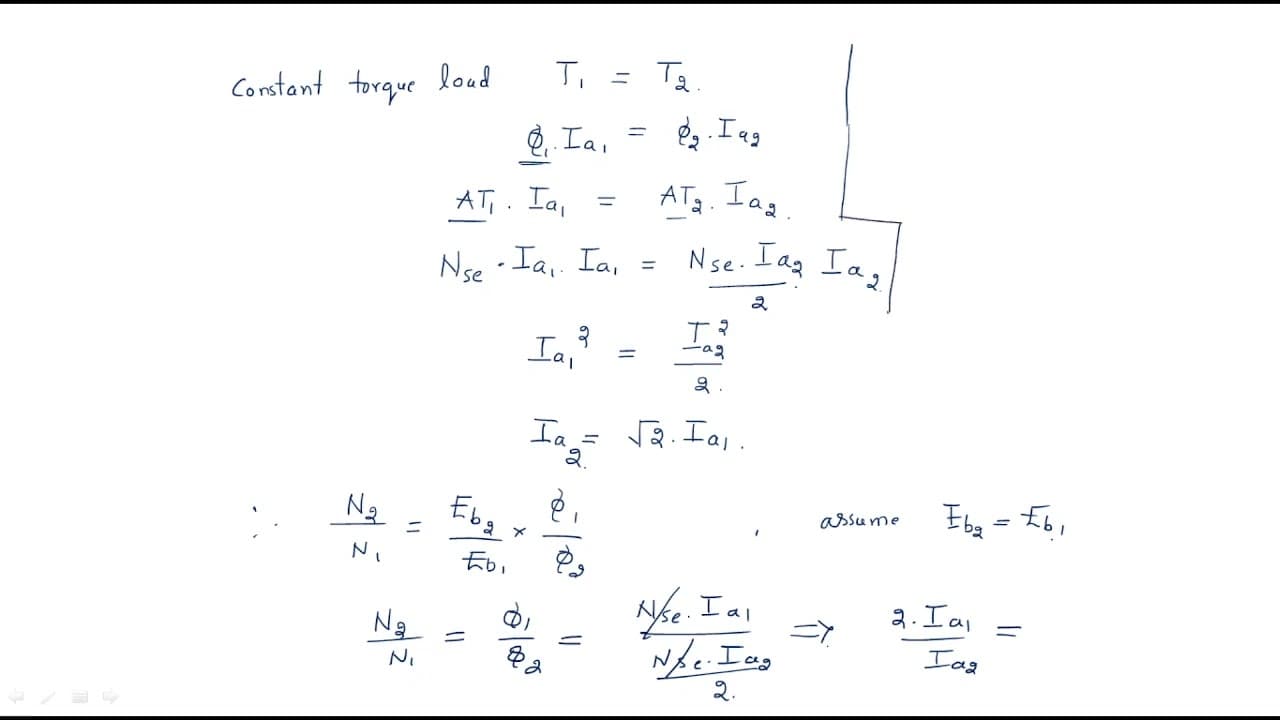
Connecting the field coils in parallel increases the speed of the DC series motor. Specifically, if the motor initially runs at 500 RPM with the coils in series, switching to parallel results in a speed of approximately root 2 times the original speed, leveraging the change in ampere turns and armature current.
Q: How does the concept of constant torque influence the performance of DC series motors?
When operating under a constant torque load, the speed of the motor when the field connections are switched to parallel increases to root 2 times the series speed. However, the armature current remains unchanged, which is critical for maintaining consistent motor performance and preventing overload.
Q: Can you explain the relationship between armature current and speed in DC series motors?
Yes, the relationship between armature current and speed is essential in DC series motors. When field coils are connected in series versus parallel, the armature current must adjust accordingly. The relationship shows that parallel armature current can be expressed as root 2 times the series armature current, affecting overall motor function and efficiency.
Q: What are the derived equations that describe the behavior of DC series motors during operation?
One key equation states that the ratio of the speeds when field connections change is n2/n1 = I1/Φ2. This means that if both back electromotive forces are constant, the increased armature current will lead to higher speeds in the motor, effectively showing how connections impact the operational dynamics.
Summary & Key Takeaways
-
The discussion focuses on how the speed of a DC series motor can change based on whether the field coils are connected in series or parallel.
-
When connected in series, the motor operates at a speed of 500 RPM; connecting the fields in parallel theoretically increases speed to root 2 times the original.
-
Key relationships regarding armature current and torque loads are established, highlighting how these parameters affect speed and performance of the motor.
Read in Other Languages (beta)
Share This Summary 📚
Summarize YouTube Videos and Get Video Transcripts with 1-Click
Try YouTube Summary with ChatGPT & Claude or YouTube Transcript Generator