WAL: Everything you want to know
TL;DR
A detailed exploration of Write-Ahead Logging in PostgreSQL.
Transcript
hi so thanks welcomed to this talk this is the last talk so bear with me then we will have the closing session and it will be done so ten thanks for coming to the conference my name is David M Candace they told this talk about the right head but almost everything you want to know because every time I want to learn about some something more about wa... Read More
Key Insights
- Write-Ahead Logging (WAL) is crucial for data integrity in PostgreSQL, preventing data loss in cases of crashes.
- WAL files are 16MB by default and play a key role in transaction logging, replication, and recovery.
- Do not manually delete WAL files, as they are critical for maintaining database consistency and recovery.
- WAL allows for point-in-time recovery and is essential for database backups and replication.
- The log sequence number (LSN) is vital for tracking changes and ensuring proper recovery processes.
- Checkpoints in PostgreSQL write all dirty buffers to disk, ensuring data consistency across storage.
- Archiving WAL files is important for maintaining a robust backup and recovery strategy.
- PostgreSQL's performance can be optimized by configuring WAL settings and understanding its interaction with hardware and operating systems.
Install to Summarize YouTube Videos and Get Transcripts
Explore YouTube Video Summarizer or Get YouTube Transcript Extractor
Questions & Answers
Q: What is the primary purpose of Write-Ahead Logging in PostgreSQL?
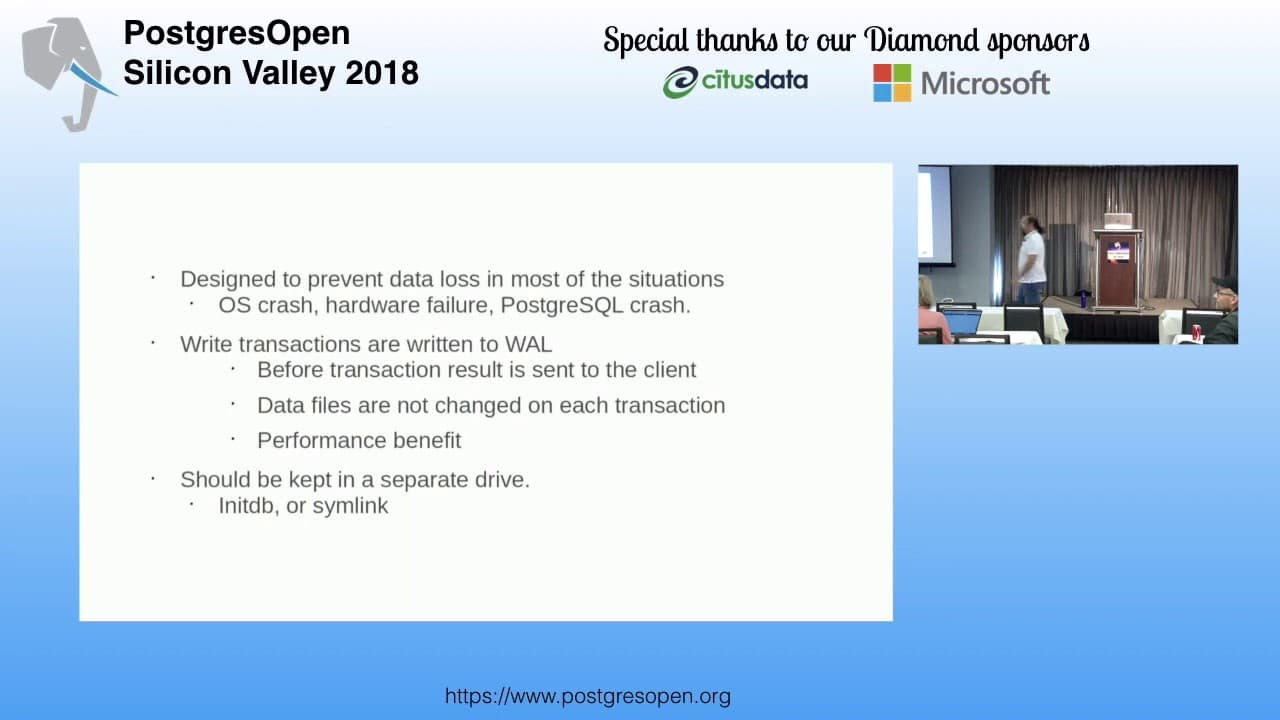
Write-Ahead Logging (WAL) in PostgreSQL is primarily designed to ensure data integrity and prevent data loss in the event of a crash. By logging all changes before they are committed to the database, WAL allows for recovery of the database to a consistent state, even after unexpected failures.
Q: How are WAL files structured and why are they important?
WAL files in PostgreSQL are 16MB in size by default, consisting of log sequence numbers (LSN) that track changes. These files are critical for transaction logging, replication, and recovery, providing a mechanism to replay changes and maintain database consistency across various operations.
Q: What are the best practices for managing WAL files?
Best practices for managing WAL files include not deleting them manually, configuring proper archiving settings, and ensuring that they are stored on separate drives for performance optimization. Regularly archiving WAL files is crucial for maintaining a robust backup and recovery strategy.
Q: How does PostgreSQL handle checkpoints with WAL?
In PostgreSQL, checkpoints are processes that write all dirty buffers to disk, ensuring that data is consistent across storage. Checkpoints are logged in WAL files, and they play a crucial role in recovery processes by providing a known point from which to start replaying changes after a crash.
Q: What role does the log sequence number (LSN) play in WAL?
The log sequence number (LSN) is a critical component of WAL, providing a unique identifier for each record. It is used to track changes and ensure proper recovery processes by comparing LSNs on data pages and in WAL files, determining which changes need to be replayed during recovery.
Q: Why is it discouraged to disable full-page writes in WAL?
Disabling full-page writes in WAL is discouraged because it can lead to data corruption. Full-page writes ensure that entire pages are logged, allowing for recovery from page corruption. While disabling them may improve performance, it poses significant risks to data integrity and recovery capabilities.
Q: How does WAL facilitate point-in-time recovery?
WAL facilitates point-in-time recovery by logging all changes, allowing the database to be restored to a specific state at a given time. By replaying WAL files from a base backup to a specified point, administrators can recover databases to precise moments, aiding in disaster recovery and data restoration.
Q: What considerations should be made when configuring WAL settings?
When configuring WAL settings, considerations include setting appropriate archive modes, ensuring sufficient disk space for WAL files, and tuning parameters for performance optimization. Understanding the interaction between WAL settings, hardware, and operating systems can help improve database performance and reliability.
Summary & Key Takeaways
-
The talk focuses on the importance of Write-Ahead Logging (WAL) in PostgreSQL, emphasizing its role in preventing data loss during crashes and ensuring data integrity. It discusses the structure of WAL files, their default size, and the critical nature of not deleting them manually.
-
Key aspects of WAL, including transaction logging, replication, and point-in-time recovery, are explored. The speaker highlights the importance of log sequence numbers (LSN) and checkpoints in maintaining database consistency and facilitating recovery processes.
-
The discussion includes best practices for managing WAL files, such as archiving and configuring settings for optimal performance. The speaker also touches on the role of WAL in PostgreSQL's interaction with hardware and operating systems, providing insights into performance optimization.
Read in Other Languages (beta)
Share This Summary 📚
Summarize YouTube Videos and Get Video Transcripts with 1-Click
Try YouTube Summary with ChatGPT & Claude or YouTube Transcript Generator