Safety guideline for COVID-19: Transmission rate
TL;DR
Understanding the relationship between probability theory, risk tolerance, and the expected number of transmissions in controlling the spread of infections.
Transcript
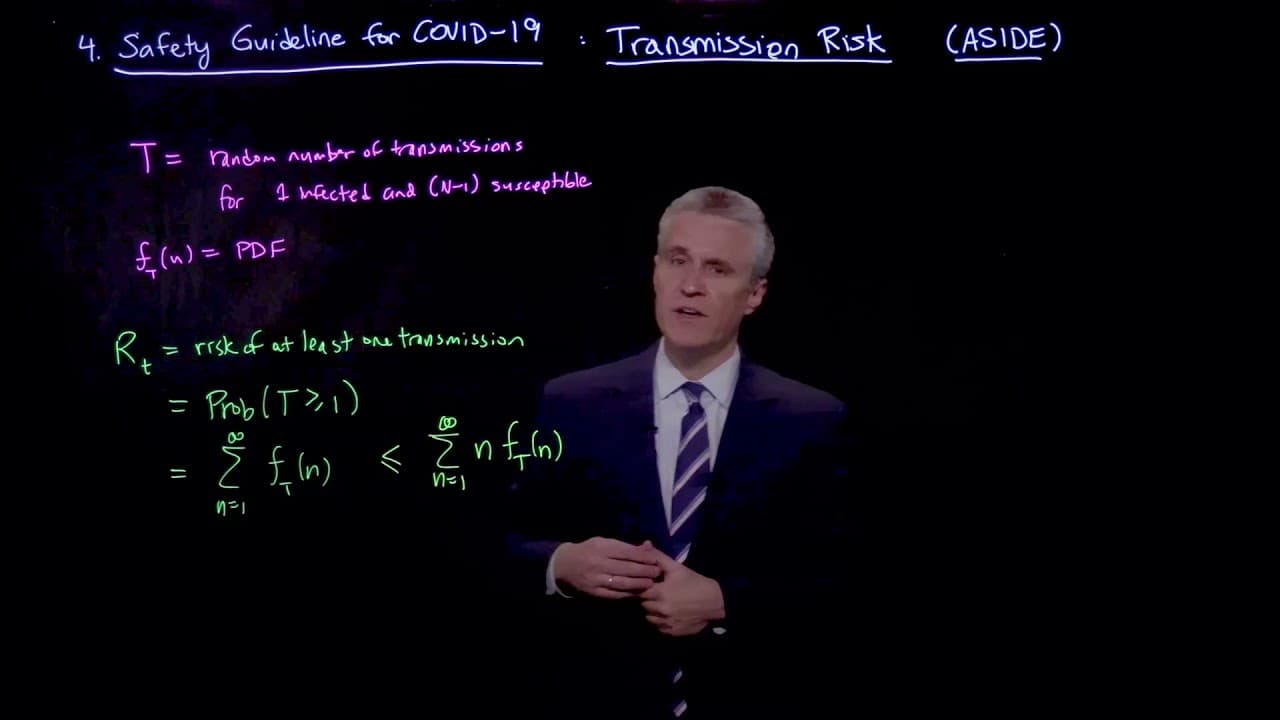
PROFESSOR: So as an aside, for those of you who have an understanding of probability theory and stochastic processes, let me just explain why it is valid to bound the main transmission rate in defining the indoor reproductive number when we might be more concerned about bounding the probability of a transmission. So let's let a capital T be a rando... Read More
Key Insights
- ↗️ Bounding the expected number of transmissions can provide an upper bound for the risk of transmission.
- 🎮 Controlling the probability of transmission often involves minimizing the expected number of transmissions.
- ✳️ As the risk tolerance decreases, the expected number of transmissions becomes a more accurate reflection of the true risk.
- 🔨 Markov's Inequality is a useful tool in probability theory to analyze risks and expected values.
Install to Summarize YouTube Videos and Get Transcripts
Explore YouTube Video Summarizer or Get YouTube Transcript Extractor
Questions & Answers
Q: How can the transmission rate in indoor settings be bounded?
The transmission rate can be bounded by using the expected number of transmissions, which is an upper bound for the risk of transmission.
Q: Why is it important to bound the expected number of transmissions?
Bounding the expected number of transmissions is important when the goal is to control the probability of transmission and minimize the risk. It provides a conservative estimate of the true risk.
Q: What is the relationship between risk tolerance and the expected number of transmissions?
If the risk tolerance is defined as epsilon, then bounding the expected number of transmissions to be less than epsilon ensures a desired level of risk control. As epsilon approaches 0, the risk of transmission and the expected number of transmissions become asymptotically similar.
Q: What is the significance of Markov's Inequality in this context?
The example discussed in the content is an application of Markov's Inequality, which is a general result in probability theory. It helps in understanding the relationship between risk tolerance, probability, and the expected number of events.
Summary & Key Takeaways
-
The transmission rate in indoor settings can be bounded by the expected number of transmissions, even though the concern is about the probability of transmission.
-
By defining the risk of transmission as the probability of having at least one transmission, the risk can be conservatively bound by the expected number of transmissions.
-
If the goal is to control the probability of transmission and ensure no transmissions occur, it is important to bound the expected number of transmissions.
Read in Other Languages (beta)
Share This Summary 📚
Summarize YouTube Videos and Get Video Transcripts with 1-Click
Try YouTube Summary with ChatGPT & Claude or YouTube Transcript Generator
Explore More Summaries from MIT OpenCourseWare 📚



Summarize YouTube Videos and Get Video Transcripts with 1-Click
Try YouTube Summary with ChatGPT & Claude or YouTube Transcript Generator