Lecture 17: Uniform Continuity and the Definition of the Derivative
TL;DR
The content discusses continuous functions, the Bolzano intermediate value theorem, uniform continuity, and differentiability.
Transcript
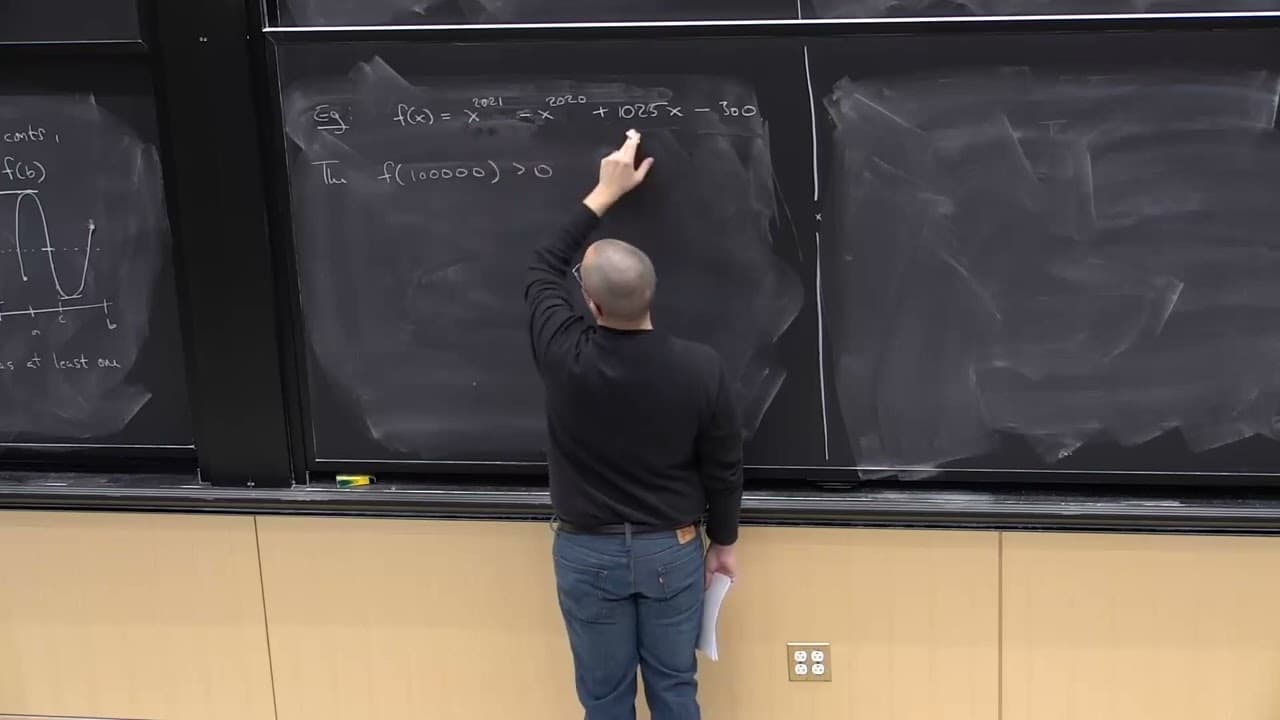
CASEY RODRIGUEZ: So last time we finished by proving Bolzano's intermediate value theorem, which states that a continuous function achieves all values in between the function evaluated at the endpoint. So if I have a continuous function, neither-- I take a value y between f of a and f of b, so either f of a is less than f of b and y's in between is... Read More
Key Insights
- ❓ The Bolzano intermediate value theorem guarantees that a continuous function achieves all values between its endpoints.
- 😚 The image of a closed and bounded interval by a continuous function is also a closed and bounded interval.
- 🈸 The bisection method is an application of the Bolzano intermediate value theorem.
- ❓ Polynomials are an example of differentiable functions.
Install to Summarize YouTube Videos and Get Transcripts
Explore YouTube Video Summarizer or Get YouTube Transcript Extractor
Questions & Answers
Q: What is the Bolzano intermediate value theorem?
The Bolzano intermediate value theorem states that a continuous function achieves all values between the function evaluated at the endpoints of an interval.
Q: How does the bisection method relate to the Bolzano intermediate value theorem?
The bisection method is an application of the Bolzano intermediate value theorem. It involves repeatedly dividing the interval into two subintervals, one of which must contain a root of a function.
Q: What is the significance of the image of a closed and bounded interval by a continuous function being a closed and bounded interval?
The fact that the image of a closed and bounded interval is a closed and bounded interval demonstrates that continuous functions are well-behaved on such intervals.
Q: What is uniform continuity?
Uniform continuity is a stronger notion than continuity. It means that for any given tolerance level, there exists a single distance that works for all points in the interval, rather than each point having its own specific distance.
Q: What is the definition of differentiability?
A function f is differentiable at a point c in its domain if the limit of (f(x) - f(c))/(x - c) as x approaches c exists. The function is differentiable if it is differentiable at every point in its domain.
Summary & Key Takeaways
-
The video begins with a review of the Bolzano intermediate value theorem, which states that a continuous function achieves all values between the function evaluated at the endpoints.
-
The concepts of uniform continuity, the bisection method, and the image of a closed and bounded interval by a continuous function are then introduced.
-
The video concludes with a definition of differentiability and an example demonstrating that polynomials are differentiable.
Read in Other Languages (beta)
Share This Summary 📚
Summarize YouTube Videos and Get Video Transcripts with 1-Click
Try YouTube Summary with ChatGPT & Claude or YouTube Transcript Generator
Explore More Summaries from MIT OpenCourseWare 📚



Summarize YouTube Videos and Get Video Transcripts with 1-Click
Try YouTube Summary with ChatGPT & Claude or YouTube Transcript Generator