Pie chart | Subjects Allotment | Data Interpretation | Reasoning | Part - 07 | Bharath Kumar
TL;DR
Understanding and analyzing teacher distribution across various subjects via pie charts.
Transcript
hi everyone welcome to the session in this session I will continue pie chart data interpretation first of all read the information carefully and according to that we need to solve the questions first of all what is the given information we need to understand the information which is provided in this pie chart after that we need to solve the questio... Read More
Key Insights
- 🦻 Pie charts effectively illustrate teacher distributions across different subjects, aiding visual understanding of data.
- 👻 Efficient problem-solving in exams often relies on percentage calculations, allowing rapid estimations without extensive calculations.
- 🤝 Understanding how to derive totals from percentages streamlines problem-solving, particularly when dealing with multiple subjects at once.
- 🐎 Quick answers are essential in competitive examinations where precision can sometimes be sacrificed for speed.
- 🥳 The ability to directly calculate ratios without additional conversions can save considerable time.
- 🖐️ Analytical skills in interpreting charts and deriving values play a critical role in academic performance.
- 📈 Patterns in teaching distributions can suggest trends in educational focus and resource allocation.
Install to Summarize YouTube Videos and Get Transcripts
Explore YouTube Video Summarizer or Get YouTube Transcript Extractor
Questions & Answers
Q: What is the total number of teachers teaching Chemistry, English, and Biology combined?
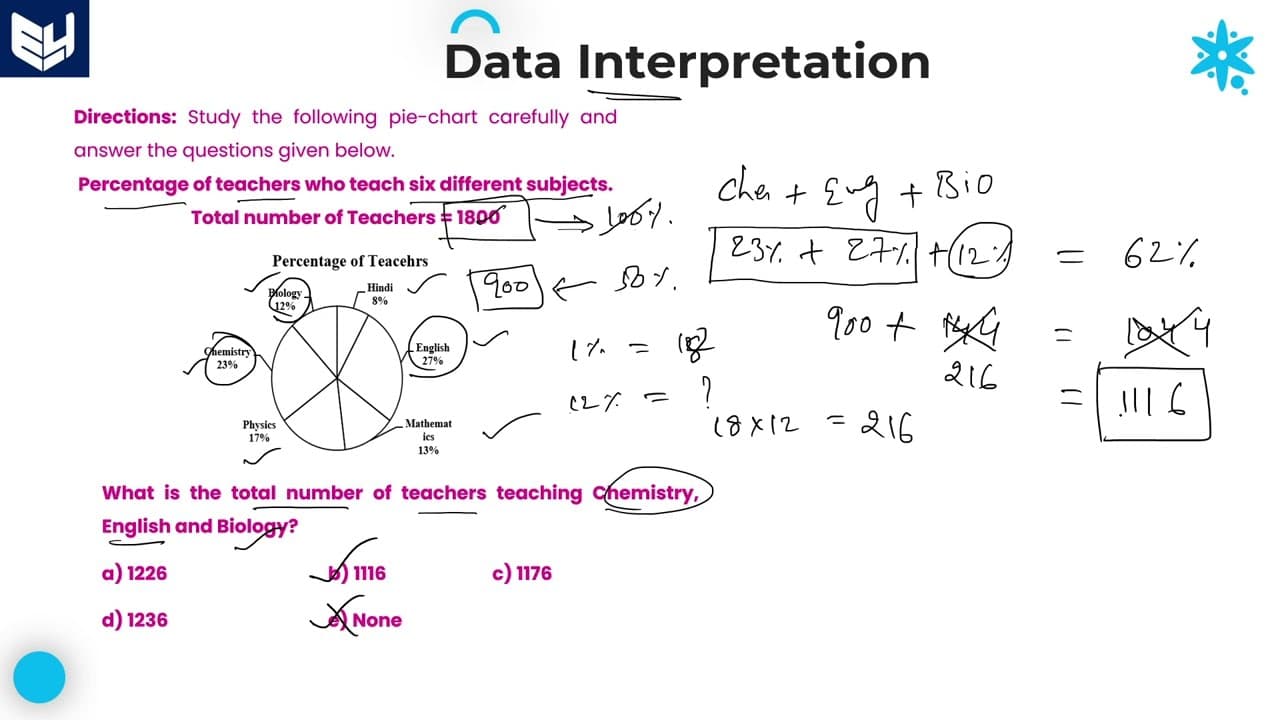
To find the total, we sum the percentages: Chemistry (23%), English (27%), and Biology (12%) for a total of 62%. With 1% of 1800 teachers equaling 18, we calculate 62% as 62 x 18, resulting in 1116 teachers teaching those subjects.
Q: How do we find the difference between teachers teaching English and Physics versus Mathematics and Biology?
First, add the percentages: English (27%) and Physics (17%) total 44%, while Mathematics (13%) and Biology (12%) total 25%. Their difference is 19%. With 1% being 18 teachers, 19% equals 342 teachers, which represents the required difference.
Q: What is the ratio of teachers teaching Mathematics to those teaching Hindi?
The percentages are Mathematics at 13% and Hindi at 8%. The ratio simplifies to 13:8, allowing us to directly compare the percentages without converting to individual teacher counts, making it efficient.
Q: What occurs when the percentage of Mathematics teachers increases by 50%?
Initially, Mathematics constitutes 13% of 1800 teachers. A 50% increase means recalculating their new percentage to 150%, resulting in 351 teachers after applying the increase.
Q: How is the total number of Mathematics and Hindi teachers calculated after adjustments?
After a 50% increase in Mathematics (totaling 351) and a 25% decrease in Hindi (down to 108), we simply add 351 and 108 to get a total of 459 teachers.
Q: How do we determine the percentage of male Physics teachers in relation to Chemistry teachers?
We first find the number of male Physics teachers (238) and Chemistry teachers (414). To compute the percentage, we take (238/414) x 100, resulting in an approximate value that is expected to stay below 59.5 due to simplifications made while calculating.
Q: What is the significance of approximating answers during competitive exams?
Approximating values allows for faster calculations and is essential in competitive settings where time management is crucial. Relying on close estimates can help avoid lengthy arithmetic while still providing viable answers.
Summary & Key Takeaways
-
The content focuses on interpreting a pie chart representing the distribution of teachers across six subjects: Hindi, English, Mathematics, Physics, Chemistry, and Biology, with teacher counts based on percentages.
-
It emphasizes the importance of quickly calculating values from percentages to save time during examinations, illustrating various methods to derive total counts for selected subjects.
-
Questions are analyzed, including calculating totals, finding differences, and determining ratios, while encouraging approximations for efficiency in competitive settings.
Read in Other Languages (beta)
Share This Summary 📚
Summarize YouTube Videos and Get Video Transcripts with 1-Click
Try YouTube Summary with ChatGPT & Claude or YouTube Transcript Generator