Local picture of the wavefunction
TL;DR
The way a wave function looks in quantum mechanics can be classified as either positive or negative convexity depending on the energy levels and the potential shape.
Transcript
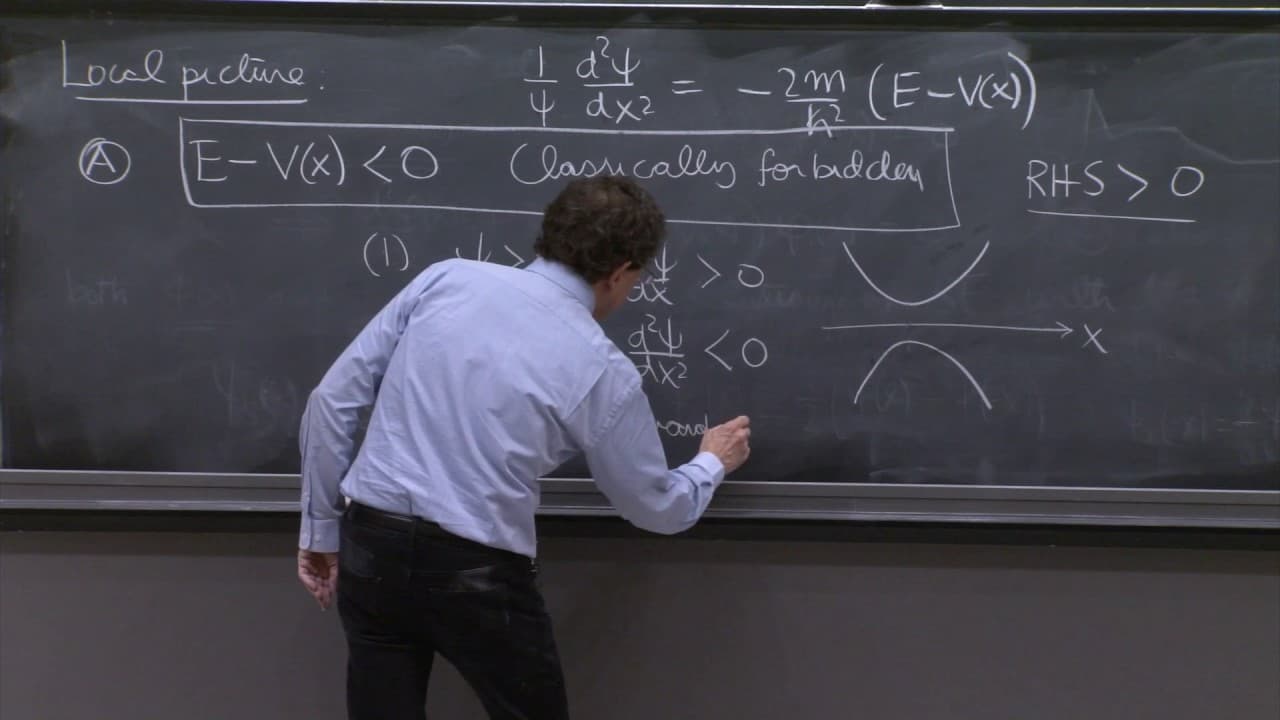
PROFESSOR: OK, so, local picture. It's all about getting insight into how the way function looks. That's what we'll need to get. These comments now will be pretty useful. For this equation you have one over psi, d second psi, d x squared is minus 2 m over h squared, E minus v of x. Look how I wrote it, I put the psi back here, and that's useful. No... Read More
Key Insights
- 👋 Understanding the convexity of wave functions is crucial for analyzing their behavior in different energy and potential conditions.
- 👋 In the classically forbidden region, the wave function is convex towards the x-axis, with positive or negative convexity depending on the signs of the wave function and its second derivative.
- ❎ In the classically allowed region, the wave function can have positive convexity with a negative second derivative or negative convexity with a positive second derivative.
- 👈 Inflection points, where the second derivative vanishes, indicate turning points in the wave function and can be found at nodes or where the wave function crosses the x-axis.
Install to Summarize YouTube Videos and Get Transcripts
Explore YouTube Video Summarizer or Get YouTube Transcript Extractor
Questions & Answers
Q: What is the difference between classically forbidden and classically allowed regions in wave function convexity?
In the classically forbidden region, the energy is less than the potential, and the wave function can have positive or negative convexity depending on the signs of the wave function and its second derivative. In the classically allowed region, where the energy is greater than the potential, the wave function can also have positive or negative convexity, but with different signs for the second derivative.
Q: What are inflection points in wave functions?
Inflection points are points where the second derivative of the wave function vanishes. They indicate turning points in the wave function and can be found at nodes or where the wave function crosses the x-axis.
Q: Can the wave function in the classically forbidden region have different convexities at different points?
No, the wave function in the classically forbidden region can only have one type of convexity, either positive or negative. At any given point, the wave function will exhibit the same convexity.
Q: What happens to the wave function in the classically forbidden region as you approach infinity?
As you approach infinity in the classically forbidden region, the wave function may exhibit asymptotic behavior. It can either have a left asymptote (positive convexity) or a right asymptote (negative convexity), with the second derivative maintaining the same sign.
Summary & Key Takeaways
-
The wave function in a classically forbidden region (where energy is less than potential) can have positive convexity if both the wave function and its second derivative are positive, or negative convexity if both are negative.
-
In the classically allowed region (where energy is greater than potential), the wave function can have positive convexity with a negative second derivative, or negative convexity with a positive second derivative.
-
Inflection points, where the second derivative of the wave function vanishes, indicate turning points and can be found at nodes or where the wave function crosses the axis.
Read in Other Languages (beta)
Share This Summary 📚
Summarize YouTube Videos and Get Video Transcripts with 1-Click
Try YouTube Summary with ChatGPT & Claude or YouTube Transcript Generator
Explore More Summaries from MIT OpenCourseWare 📚



Summarize YouTube Videos and Get Video Transcripts with 1-Click
Try YouTube Summary with ChatGPT & Claude or YouTube Transcript Generator