1.3 History of Special Relativity
TL;DR
Einstein developed the theory of special relativity in 1905, influenced by various scientific and technological advancements of the time.
Transcript
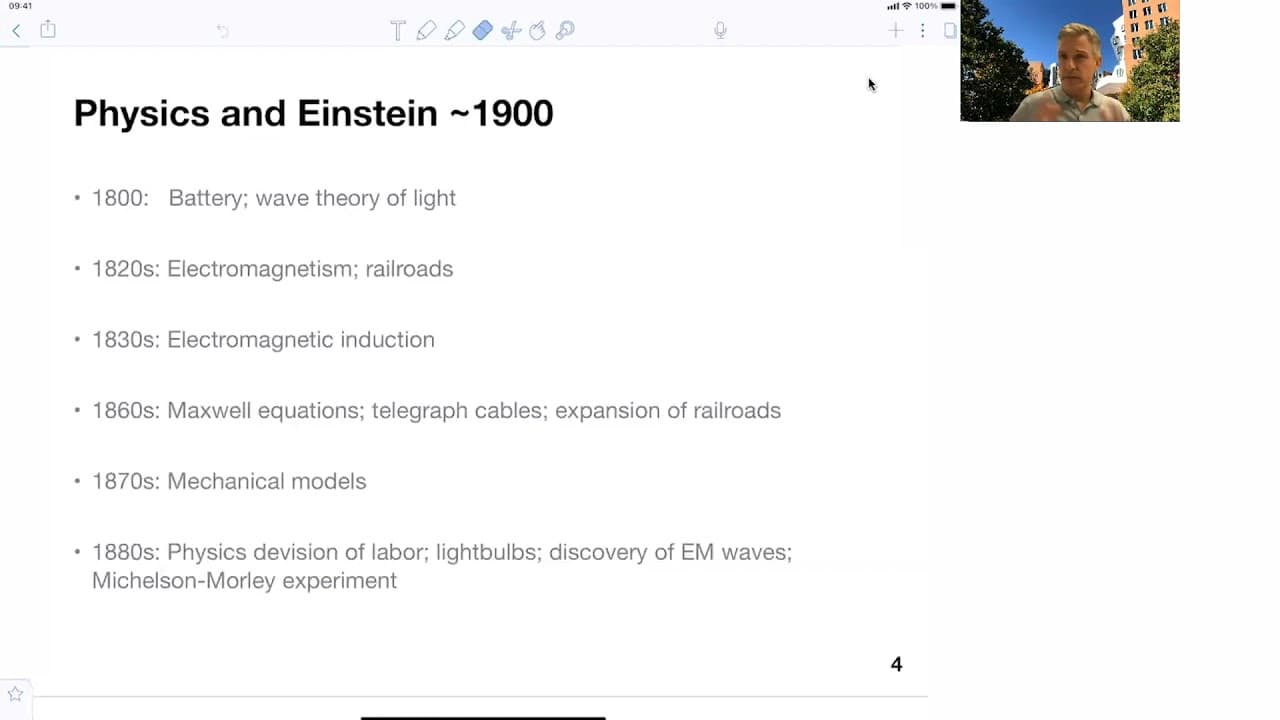
MARKUS KLUTE: Welcome back to 8.20-- Special Relativity. In this short video, we look at the historic backdrop, the time in which Einstein was able to develop the theory of special relativity. What were people thinking? What was the physics landscape of the time? How was technology developed? And how did all those things come together for Einstein ... Read More
Key Insights
- 🙂 The development of special relativity was influenced by scientific advancements in electromagnetism, wave theory of light, and understanding electromagnetic effects.
- 👋 The expansion of railroads and the need for synchronized clocks necessitated a deeper understanding of the speed and travel of electromagnetic waves.
- ⌛ Einstein's early struggles and experiences, including his time as a patent clerk, influenced his path toward developing the theory of special relativity.
- 🙂 Einstein's papers from 1905 made significant contributions to our understanding of light, molecules, atoms, and the concepts of special relativity and the equivalence of energy and mass.
- 🇺🇸 Following his breakthrough, Einstein's career progressed with positions at various universities and institutes, eventually leading him to flee Germany and settle in the United States.
- 🦾 The development of general relativity further fueled the exploration of quantum mechanics and the challenges of describing both concepts simultaneously.
Install to Summarize YouTube Videos and Get Transcripts
Explore YouTube Video Summarizer or Get YouTube Transcript Extractor
Questions & Answers
Q: What were some significant scientific and technological advancements during the time Einstein developed special relativity?
During this time, advancements in electromagnetism, wave theory of light, and electromagnetic effects, as well as the development of railroads and synchronized clocks, contributed to Einstein's discoveries.
Q: How did Einstein's early life and education influence his development of the theory of special relativity?
Einstein's education in physics, his struggles to find a career, and his time spent with friends and mentors all played a role in his ability to develop his ideas and theories.
Q: What were the key findings of Einstein's papers from 1905?
In his papers, Einstein described the emission and absorption of light, characterized the size of molecules, showed the existence of atoms, and introduced the concept of special relativity and the equivalence of energy and mass.
Q: How did Einstein's career progress after the development of special relativity?
Einstein's career grew systematically, with positions at various universities and institutes. He eventually fled Germany due to the rise of the Nazis and settled in the United States, where he took a position at Princeton University.
Summary & Key Takeaways
-
The development of electromagnetism, wave theory of light, and the understanding of electromagnetic effects paved the way for Einstein's theory of special relativity.
-
The expansion of railroads and the need for synchronized clocks led to the importance of understanding the speed and travel of electromagnetic waves.
-
Einstein's early life, education, and struggles, including his career as a patent clerk, eventually led to the formulation of the theory of special relativity.
Read in Other Languages (beta)
Share This Summary 📚
Summarize YouTube Videos and Get Video Transcripts with 1-Click
Try YouTube Summary with ChatGPT & Claude or YouTube Transcript Generator
Explore More Summaries from MIT OpenCourseWare 📚


Summarize YouTube Videos and Get Video Transcripts with 1-Click
Try YouTube Summary with ChatGPT & Claude or YouTube Transcript Generator