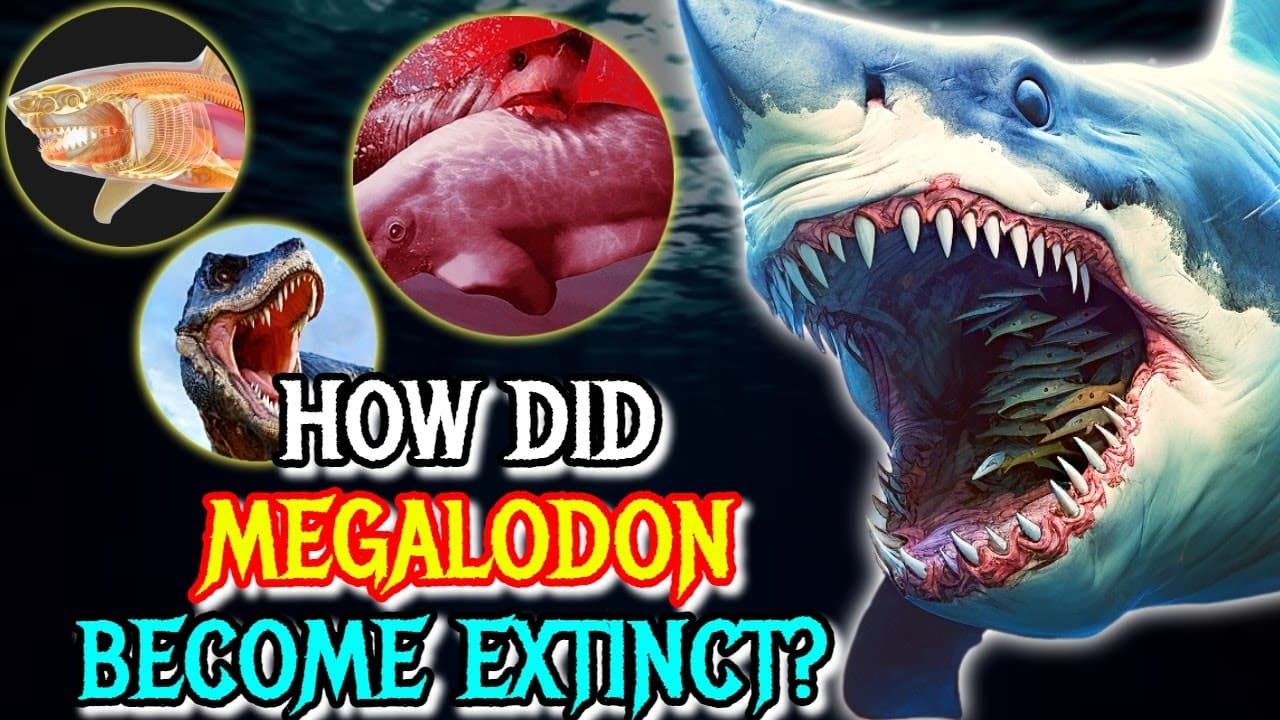
How Did the Megalodon Become Extinct?
TL;DR
The Megalodon went extinct due to significant global cooling and dropping sea levels, which resulted in habitat loss and a decline in prey availability. These changes hampered their ability to find food, leading to their gradual decline as they could not adapt to the evolving ocean conditions.
Transcript
foreign while the deep sea is quite a fascinating place it is home to some terrifying animals that are best left alone many movies have explored these creatures and the Meg was one such film that introduced us to a prehistoric shark species known as the Megalodon the Megalodon was a gigantic shark that was at least 50 to 60 feet long and a group of... Read More
Key Insights
- 🫤 The Megalodon was a colossal mackerel shark that lived approximately 3.6 million years ago and could reach lengths of up to 60 feet.
- 🥹 This apex predator held the top position in the ocean due to its powerful jaws and effective hunting strategies, including ambushing its prey from below.
- 🦺 Megalodon gave birth to live young in warm coastal waters, providing a safe environment for their infants to grow in safety and abundance.
- 🖐️ Fossil records, especially teeth, play a crucial role in understanding Megalodon's diet, behavior, and the ecological dynamics they participated in during their time.
- 😎 The extinction of the Megalodon was a complex interplay of environmental changes and competition following significant cooling trends globally.
- 🎥 Films like "The Meg" have captured the public's imagination regarding Megalodon, depicting it as a massive, terrifying creature that continues to fascinate audiences today.
- 👻 The creatures are believed to have had remarkable adaptability for thermoregulation, allowing them to exploit various oceanic conditions for survival.
Install to Summarize YouTube Videos and Get Transcripts
Explore YouTube Video Summarizer or Get YouTube Transcript Extractor
Questions & Answers
Q: What did the Megalodon primarily feed on during its existence?
The Megalodon primarily preyed upon large marine mammals, including whales, seals, and sea turtles. Fossil evidence indicates they preferred fatty mammals, which provided the high-caloric intake essential for their massive size. Their hunting strategy involved ambushing their prey, often delivering fatal bites to incapacitate them, leveraging their strong jaws, which could exert immense force.
Q: How did Megalodon adapt to its environment when it was alive?
Megalodon thrived in subtropical waters and adapted its hunting techniques to find and catch large prey. They were capable of giving live birth in warmer coastal areas, which allowed them to nurture their young while providing safety from predators. They were mesothermal creatures, enabling them to maintain a body temperature higher than surrounding waters, aiding in their survival as dominant ocean predators.
Q: What led to the extinction of the Megalodon?
The extinction of Megalodon around 3.5 million years ago was influenced by significant climatic changes that led to global cooling and declining sea levels. These alterations resulted in a loss of habitat and food sources, ultimately decreasing their prey availability and energy levels. As they struggled to adapt to these drastic ecological changes, competition from other marine predators likely contributed to their decline.
Q: In what ways has popular culture depicted the Megalodon?
Popular culture has often portrayed the Megalodon as a fearsome and mythical creature, particularly in films like "The Meg." These movies exaggerate its size and predatory capabilities, creating thrilling narratives around encounters with this prehistoric shark. The entertainment value largely stems from its terrifying potential and the cultural fascination with deep-sea monsters.
Q: Where have Megalodon fossils been discovered?
Megalodon fossils have been found globally, including regions across Europe, Africa, North America, and Australia. Their teeth, being more resilient than cartilage, have been crucial in revealing insights about their existence and behavior. These discoveries indicate that Megalodons thrived in a variety of marine habitats, particularly mesothermal zones where temperatures were optimal for their growth.
Summary & Key Takeaways
-
The Megalodon, an extinct shark species, existed around 3.6 million years ago and was classified within the family of mackerel sharks.
-
These immense predators grew up to 60 feet long, primarily feeding on marine mammals such as whales and sea turtles, thanks to their powerful jaws and hunting strategies.
-
While the Megalodon is believed to have gone extinct due to climate changes and a lack of prey, popular culture continues to explore its legacy through movies like "The Meg."
Read in Other Languages (beta)
Share This Summary 📚
Summarize YouTube Videos and Get Video Transcripts with 1-Click
Try YouTube Summary with ChatGPT & Claude or YouTube Transcript Generator
Explore More Summaries from Marvelous Videos 📚





Summarize YouTube Videos and Get Video Transcripts with 1-Click
Try YouTube Summary with ChatGPT & Claude or YouTube Transcript Generator