How to Use Dummy Variables in Regression Analysis
TL;DR
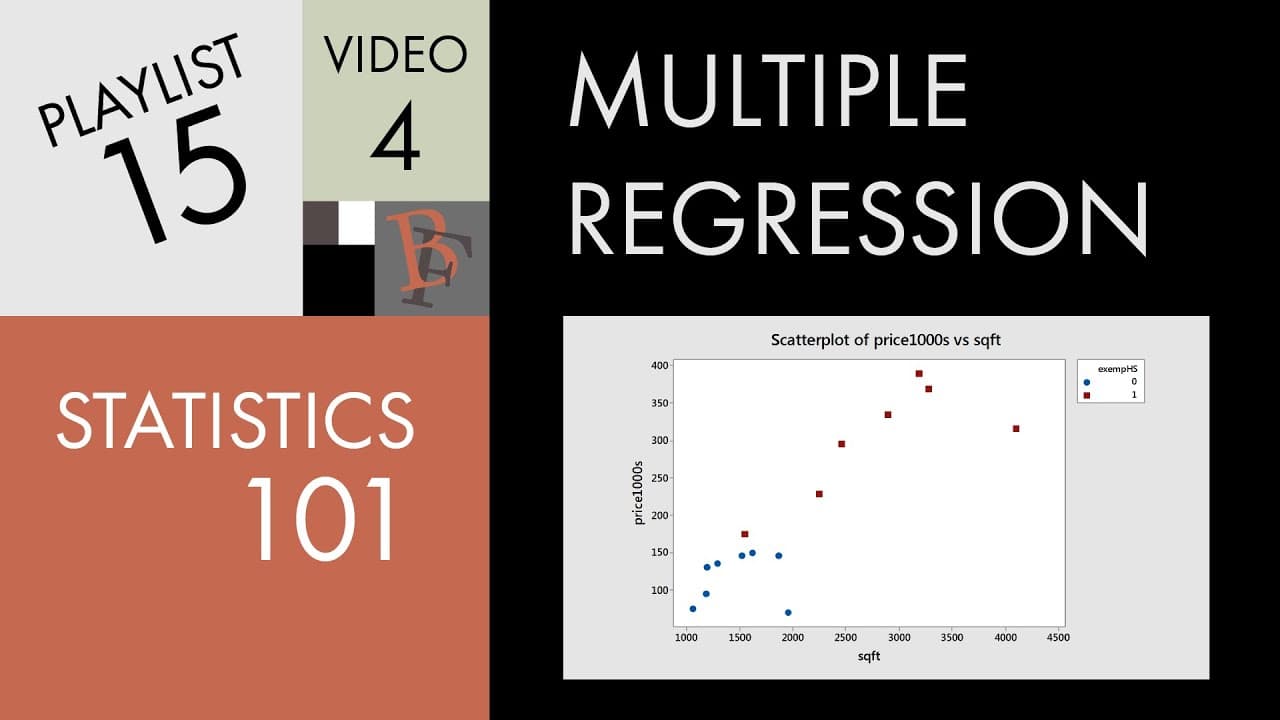
Dummy variables are essential for incorporating categorical data into regression analysis, allowing for the evaluation of relationships between categorical predictors and dependent variables. This video discusses how to code these variables and interpret the resulting coefficients using an example related to home prices and school ratings.
Transcript
- [Instructor] Hello and welcome to the next video in my series on basic statistics. If you are a first-time viewer, please stick around for the intro, It is worth the time. If you are a regular viewer, feel free to skip ahead using the annotation. So first a few things. I do these videos because I love to learn and help others learn. We are all go... Read More
Key Insights
- 🍵 Regression analysis can handle different data types, including interval and categorical variables.
- ❓ Dummy variables are a common technique for representing categorical data in regression analysis.
- ❓ Dummy variables are binary variables that take the value 1 or 0 to indicate the presence or absence of a specific category.
- ❓ The choice of reference category and the coding of dummy variables is arbitrary but should be consistent.
- ❓ Regression analysis with dummy variables can provide insights into the relationship between categorical variables and the dependent variable.
- ❓ The coefficients of dummy variables represent the average difference in the dependent variable associated with each category relative to the reference category.
- 💱 The slope of dummy variables represents the change in the dependent variable for a unit change in the independent variable.
Install to Summarize YouTube Videos and Get Transcripts
Explore YouTube Video Summarizer or Get YouTube Transcript Extractor
Questions & Answers
Q: What are dummy variables in regression analysis?
Dummy variables, also known as indicator variables, are used to represent categorical information in regression analysis. They are binary variables that take the value 1 or 0 to indicate the presence or absence of a specific category.
Q: How are dummy variables coded?
Dummy variables are coded by assigning a value of 1 to one category and a value of 0 to the other categories. The choice of which category gets assigned 1 is arbitrary and depends on the context of the analysis.
Q: How do you interpret the coefficients of dummy variables?
The coefficients of dummy variables represent the difference in the dependent variable associated with each category relative to a reference category. A positive coefficient indicates a higher value of the dependent variable for that category compared to the reference category.
Q: What is the purpose of using dummy variables in regression analysis?
Dummy variables allow us to include categorical information in regression models by capturing the effects of different categories on the dependent variable. They enable us to estimate the impact of qualitative factors on the outcome of interest.
Key Insights:
- Regression analysis can handle different data types, including interval and categorical variables.
- Dummy variables are a common technique for representing categorical data in regression analysis.
- Dummy variables are binary variables that take the value 1 or 0 to indicate the presence or absence of a specific category.
- The choice of reference category and the coding of dummy variables is arbitrary but should be consistent.
- Regression analysis with dummy variables can provide insights into the relationship between categorical variables and the dependent variable.
- The coefficients of dummy variables represent the average difference in the dependent variable associated with each category relative to the reference category.
- The slope of dummy variables represents the change in the dependent variable for a unit change in the independent variable.
- Interpretation of dummy variable coefficients requires comparing them to the reference category and considering their statistical significance.
Summary & Key Takeaways
-
The video explains how to use dummy variables to represent categorical information in regression analysis.
-
It provides an example of a problem where the goal is to determine how the rating of a high school is related to the price of homes in the neighborhood.
-
The video shows how to code dummy variables and interprets the coefficients derived from the regression analysis.
Read in Other Languages (beta)
Share This Summary 📚
Summarize YouTube Videos and Get Video Transcripts with 1-Click
Try YouTube Summary with ChatGPT & Claude or YouTube Transcript Generator
Explore More Summaries from Brandon Foltz 📚
Summarize YouTube Videos and Get Video Transcripts with 1-Click
Try YouTube Summary with ChatGPT & Claude or YouTube Transcript Generator