Genetics - Understanding Crosses - Lesson 6 | Don't Memorise
TL;DR
Learn about the three laws of genetics and exceptions to Mendelian inheritance in this comprehensive analysis of genetic principles.
Transcript
The three laws in genetics form the crux of this topic. These laws not only answered a few questions, but were even ahead of time! They were instrumental in proving a few important concepts which were discovered in the following years! But do all the organisms always follow these fundamental laws? When crossed, do all organisms always give offsprin... Read More
Key Insights
- 👮 The three laws of genetics, discovered by Gregor Mendel, are fundamental principles that explain inheritance patterns in organisms.
- 🥳 There are exceptions to Mendelian inheritance, where organisms do not follow the predicted ratios of allele combinations.
- 😵 Test crosses are used to determine the genotype of an organism by crossing it with a known recessive individual.
- 😵 Dihybrid crosses result in four different phenotypes and a genotypic ratio of 9:3:3:1.
- 💁 The law of independent assortment states that genes for different traits segregate independently during gamete formation.
- 😵 Trihybrid crosses involve three different traits and result in eight possible combinations of gametes.
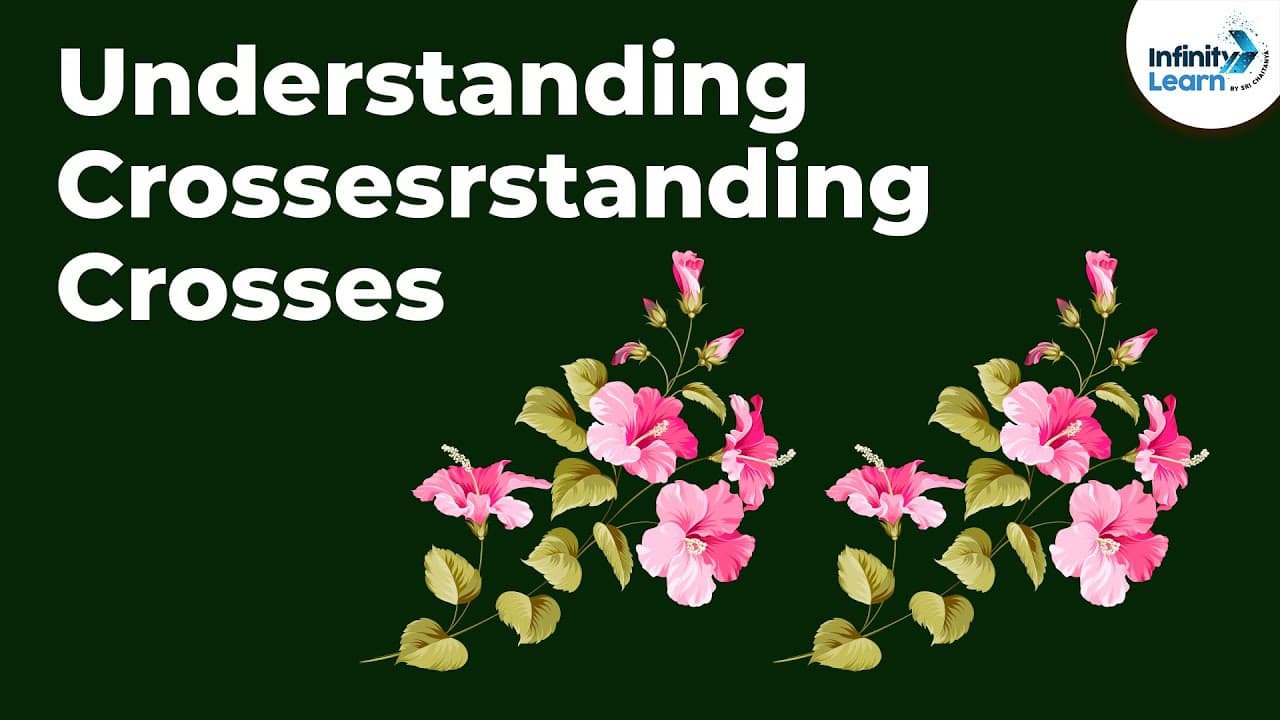
- 🩷 Some exceptional plants can exhibit intermediate traits, such as pink flowers, which deviate from Mendelian inheritance patterns.
Install to Summarize YouTube Videos and Get Transcripts
Explore YouTube Video Summarizer or Get YouTube Transcript Extractor
Questions & Answers
Q: How can the genotype of a plant with an unknown genotype be determined?
The genotype of a plant can be determined through a test cross, where it is crossed with a known recessive individual. By observing the phenotypic ratios of the offspring, the genotype of the unknown plant can be inferred.
Q: What is the phenotypic ratio observed in a dihybrid cross?
In a dihybrid cross, the phenotypic ratio is 9:3:3:1, which means that for every 16 offspring, 9 will exhibit both dominant traits, 3 will exhibit one dominant and one recessive trait, 3 will exhibit the other dominant and recessive trait, and 1 will exhibit both recessive traits.
Q: How many phenotypes are obtained in a dihybrid cross?
In a dihybrid cross, four different phenotypes can be observed. This is because there are four different combinations of traits that can be expressed in the offspring.
Q: Which cross or crosses explain the Law of Independent Assortment?
The law of independent assortment is best understood through dihybrid or higher crosses that involve multiple genes. In these crosses, the alleles for different genes assort independently of each other, resulting in multiple combinations of traits in the offspring.
Summary & Key Takeaways
-
The three laws of genetics are fundamental principles that explain inheritance patterns in organisms.
-
Not all organisms follow these laws, and there are exceptions to the ratios predicted by Mendel's experiments.
-
The genotype of an organism can be determined through a test cross, where it is crossed with a known recessive individual.
-
In a dihybrid cross, four different phenotypes and a genotypic ratio of 9:3:3:1 can be observed.
-
The law of independent assortment is best understood through dihybrid or higher crosses involving multiple genes.
-
In a trihybrid cross, eight possible combinations of gametes can be formed using the formula 2^n.
-
Certain exceptional plants can exhibit intermediate traits, such as pink flowers, which are exceptions to Mendelian inheritance.
Read in Other Languages (beta)
Share This Summary 📚
Summarize YouTube Videos and Get Video Transcripts with 1-Click
Try YouTube Summary with ChatGPT & Claude or YouTube Transcript Generator
Explore More Summaries from Infinity Learn NEET 📚
Summarize YouTube Videos and Get Video Transcripts with 1-Click
Try YouTube Summary with ChatGPT & Claude or YouTube Transcript Generator