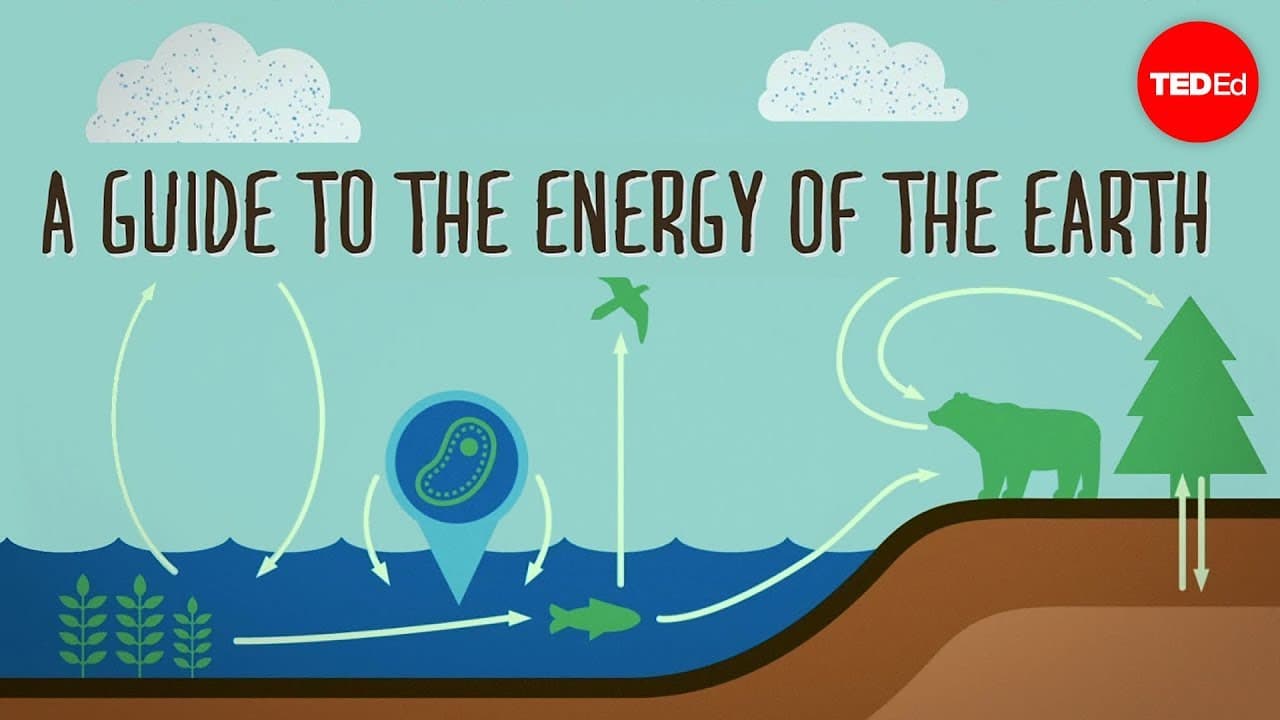
A guide to the energy of the Earth - Joshua M. Sneideman
TL;DR
Energy in various forms powers Earth's systems and human activities, with renewable sources crucial for sustainable growth.
Transcript
Energy is all around us, a physical quantity that follows precise natural laws. Our universe has a finite amount of it; it's neither created nor destroyed but can take different forms, such as kinetic or potential energy, with different properties and formulas to remember. For instance, an LED desk lamp's 6 Watt bulb transfers 6 Joules of light ene... Read More
Key Insights
- 🎭 Earth's systems operate on energy transfers, with losses occurring in the form of heat, light, or sound.
- 🛟 Internal (geothermal, rotational) and external (Solar) sources impact weather, climate, and life on Earth.
- ℹ️ Humans depend on diverse energy sources for daily activities, highlighting the importance of renewable options.
- 🌐 Sustainable growth necessitates improved energy efficiency to meet increasing global demands responsibly.
- ✊ Energy decisions affect health, education, political power, and socioeconomic status worldwide.
- 🚱 Renewable energy sources like wind, water, geothermal, and biofuels offer alternatives to non-renewable fossil fuels.
- ✊ Energy generation involves complex processes that power modern civilization and require continual advancements.
Install to Summarize YouTube Videos and Get Transcripts
Explore YouTube Video Summarizer or Get YouTube Transcript Extractor
Questions & Answers
Q: What are the different forms of energy mentioned in the content?
The content discusses kinetic energy (energy of motion) and potential energy (energy stored based on position or configuration), illustrating their role in Earth's systems and human activities.
Q: How do plants use sunlight to produce organic matter and impact the biosphere?
Plants, algae, and cyanobacteria use sunlight in photosynthesis to convert carbon dioxide and water into organic matter, initiating food chains and sustaining life in the biosphere.
Q: How do fossil fuels contribute to energy generation, and what are the implications?
Fossil fuels like coal, oil, and natural gas store energy from ancient sunlight, released when burned to generate electricity; however, their use raises concerns about environmental impact and limited resources.
Q: Why is improving energy efficiency crucial for sustainable development?
Enhancing energy efficiency allows responsible use of natural resources, reducing negative environmental impacts and improving quality of life for global populations.
Summary & Key Takeaways
-
Energy, a consistent quantity in different forms, follows natural laws and flows between Earth's systems, lost as heat, light, or sound during transfers.
-
Our planet's energy sources range from internal (geothermal, rotational) to external (Sun), impacting weather, climate, and life.
-
Humans utilize energy for various activities, with the need for sustainable, renewable sources becoming critical for global development.
Read in Other Languages (beta)
Share This Summary 📚
Summarize YouTube Videos and Get Video Transcripts with 1-Click
Try YouTube Summary with ChatGPT & Claude or YouTube Transcript Generator
Explore More Summaries from TED-Ed 📚





Summarize YouTube Videos and Get Video Transcripts with 1-Click
Try YouTube Summary with ChatGPT & Claude or YouTube Transcript Generator