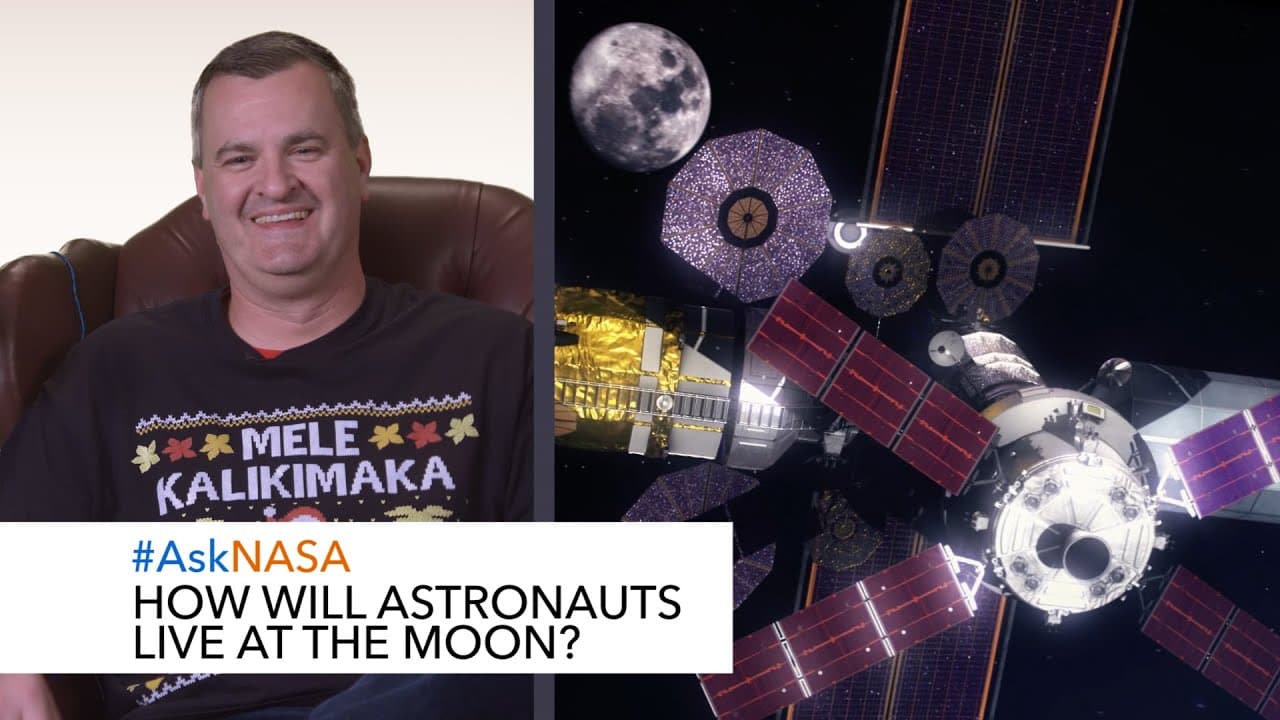
#AskNASA┃ How Will Astronauts Live at the Moon?
TL;DR
NASA's Gateway Program aims to enable sustainable exploration of the Moon through a reusable command and service module called Gateway, allowing access to the entire Moon.
Transcript
[MUSIC] Ho, Ho, Ho Hi. Im Mark Wiese and I’m the Logistics Element Manager for NASA's Gateway Program and this is #AskNASA. We’re here to answer your questions about Gateway. Alright lets get to the questions. First one we got in the mailbag. Why can't we just land on the Moon? We can. We did that already. Gateway is not about just landing on the M... Read More
Key Insights
- ♿ The Gateway Program focuses on sustainable exploration and comprehensive access to the Moon.
- 😫 The Power Propulsion Element is the first module of Gateway and is set to launch by the end of 2022.
- 👻 Cameras on Gateway will allow people to watch live action and share the experience.
- 🛩️ Gateway is smaller and more difficult to spot compared to the International Space Station.
- 👨🔬 Scientific research will be conducted on Gateway, taking advantage of the Moon's environment.
- 👾 Establishing a commercial supply chain in deep space is crucial for water, air, and other supplies on Gateway.
- 👨🎨 Inter-vehicle robotics will perform tasks on Gateway without the constant presence of astronauts.
Install to Summarize YouTube Videos and Get Transcripts
Explore YouTube Video Summarizer or Get YouTube Transcript Extractor
Questions & Answers
Q: Why can't we just land on the Moon?
While we have already landed on the Moon, the Gateway Program aims to give us comprehensive access to the Moon and explore it sustainably, using Gateway as a command and service module.
Q: When will the first module be ready?
The first module, the Power Propulsion Element, is scheduled to launch by the end of 2022, preparing for Moon missions by 2024.
Q: Will the Gateway have cameras for live action?
Yes, the Gateway will have cameras to share the experience of going to the Moon, allowing scientists and the public to witness and be part of the mission.
Q: If the Moon was made of cheese, could you smell it from Gateway?
No, as smells can't travel in space. The distance of Gateway from the Moon would prevent any smell from reaching it.
Q: How far is Gateway from Earth?
Gateway is located in deep space and is approximately a quarter of a million miles away from the Moon. It is much smaller than the International Space Station and harder to spot.
Q: Will science research be conducted on Gateway?
Absolutely, the goal is to take advantage of the environment near the Moon with fewer interferences from Earth, allowing for the study of planets beyond.
Q: How will air and water be supplied on Gateway?
Water and air will not be supplied in traditional bottles. NASA needs to establish a commercial supply chain in deep space to ensure the crew has all necessary supplies, science equipment, and breathable air.
Q: How many astronauts does it take to change a light bulb on Gateway?
No astronauts live on Gateway full-time, so inter-vehicle robotics are being developed to enable tasks like light bulb changes without the presence of astronauts.
Summary & Key Takeaways
-
The Gateway Program is not solely about landing on the Moon but about gaining access to and exploring the entire Moon in a reusable and sustainable manner.
-
The first module of the Gateway, the Power Propulsion Element, is scheduled to launch by the end of 2022, enabling the assembly of Gateway and preparing for Moon missions by 2024.
-
The Gateway will have cameras to allow people to watch live action, sharing the experience of going to the Moon and living aboard Gateway.
Read in Other Languages (beta)
Share This Summary 📚
Summarize YouTube Videos and Get Video Transcripts with 1-Click
Try YouTube Summary with ChatGPT & Claude or YouTube Transcript Generator
Explore More Summaries from NASA 📚

Summarize YouTube Videos and Get Video Transcripts with 1-Click
Try YouTube Summary with ChatGPT & Claude or YouTube Transcript Generator