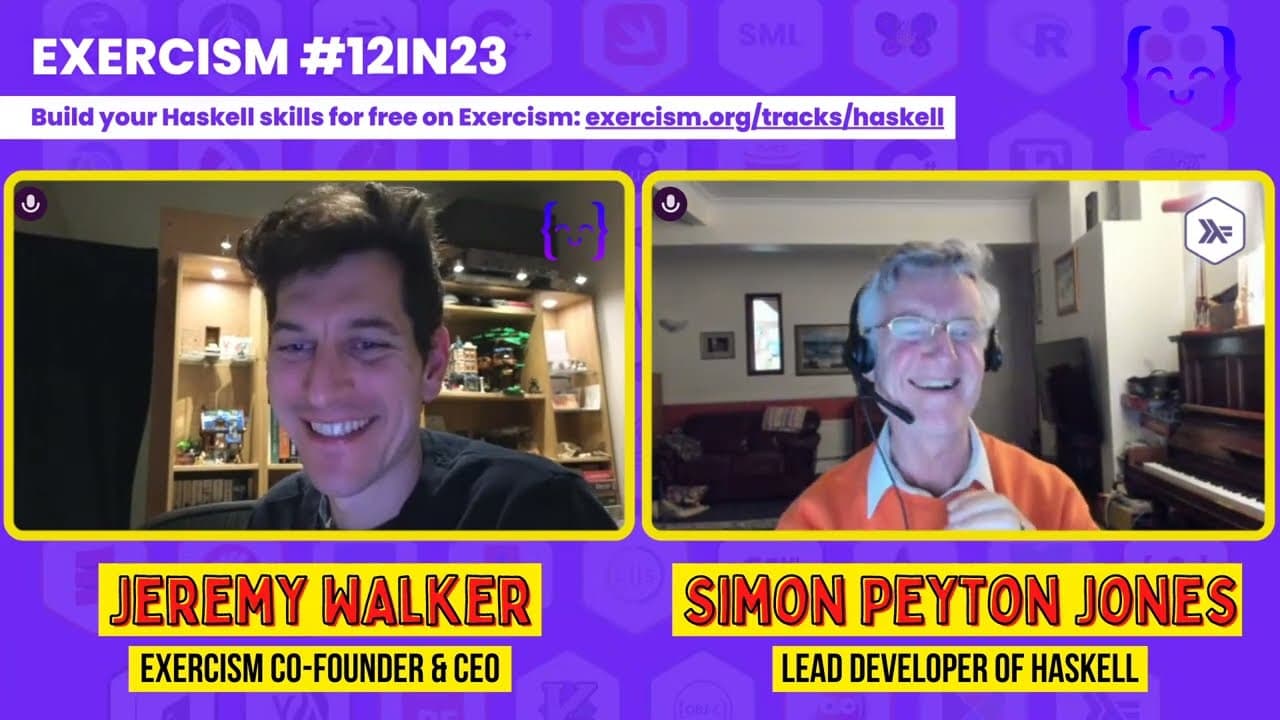
Interview and AMA with Simon Peyton Jones, lead developer of Haskell
TL;DR
Simon Peyton Jones discusses his work with Haskell, lazy functional languages, and the future of programming languages in a comprehensive interview.
Transcript
thank you thank you thank you thank you foreign foreign thank you thank you hello everyone thank you for joining us um today to be joined by Simon Payton James freshly Obe one of the key figures behind Haskell C minus minus and most recently uh verse uh Simon and I are going to be chatting about lazy functional uh languages and functional languages... Read More
Key Insights
- 👨🔬 Functional programming has gained traction over the years and is no longer limited to academic research.
- 👻 Haskell's gradual growth and slow adoption allowed for continuous innovation and exploration of new features.
- 🅰️ The adoption of type classes and higher-kinded types greatly expanded the expressiveness and usability of Haskell.
- 🖐️ The development of C-- as a compiler target language for Haskell laid the foundation for future backend options like LLVM and WebAssembly.
- ❓ Excel, being a widely-used programming language, provided an opportunity to introduce functional programming concepts and improve the language's capabilities.
- 😘 Vers, a programming language developed by Tim Sweeney, founder of Epic Games, aims to fill the gap between visual programming languages and lower-level languages like C++.
Install to Summarize YouTube Videos and Get Transcripts
Explore YouTube Video Summarizer or Get YouTube Transcript Extractor
Questions & Answers
Q: What is an OBE and how is it related to Simon's work?
An OBE stands for Order of the British Empire and is a British honor recognizing contributions to society. Simon Peyton Jones received an OBE in recognition of his work in functional programming.
Q: How did Simon get into programming and what role did Cambridge play in his journey?
Simon was always interested in computing and was drawn to the first consumer microprocessors while he was still in school. He studied math and electrical sciences at Cambridge University before pursuing postgraduate education in computing.
Q: How did Haskell evolve over the years and what key features were added?
Haskell started as an effort to unify syntax among various lazy functional programming languages. The addition of type classes, higher-kinded types, and other features significantly shaped Haskell's evolution into a powerful and widely-used functional programming language.
Q: How is GHC involved in the development of Haskell and what backends does it support?
GHC, or Glasgow Haskell Compiler, played a crucial role in the development of Haskell. It supports various backends, including C-, LLVM, and WebAssembly, providing developers with options for code generation and execution.
Key Insights:
- Functional programming has gained traction over the years and is no longer limited to academic research.
- Haskell's gradual growth and slow adoption allowed for continuous innovation and exploration of new features.
- The adoption of type classes and higher-kinded types greatly expanded the expressiveness and usability of Haskell.
- The development of C-- as a compiler target language for Haskell laid the foundation for future backend options like LLVM and WebAssembly.
- Excel, being a widely-used programming language, provided an opportunity to introduce functional programming concepts and improve the language's capabilities.
- Vers, a programming language developed by Tim Sweeney, founder of Epic Games, aims to fill the gap between visual programming languages and lower-level languages like C++.
- Vers incorporates functional logic programming concepts and prioritizes coordination and communication between different components in large-scale systems.
Summary & Key Takeaways
-
Simon Peyton Jones talks about receiving an OBE and the honor system in recognition of his contributions to society and functional programming.
-
He explains his journey into programming, starting with his fascination with early microprocessors and his introduction to functional programming at Cambridge University.
-
Simon discusses the development of Haskell, including the creation of the Glasgow Haskell Compiler (GHC) and the inclusion of type classes, higher-kinded types, and other key features.
Read in Other Languages (beta)
Share This Summary 📚
Summarize YouTube Videos and Get Video Transcripts with 1-Click
Try YouTube Summary with ChatGPT & Claude or YouTube Transcript Generator