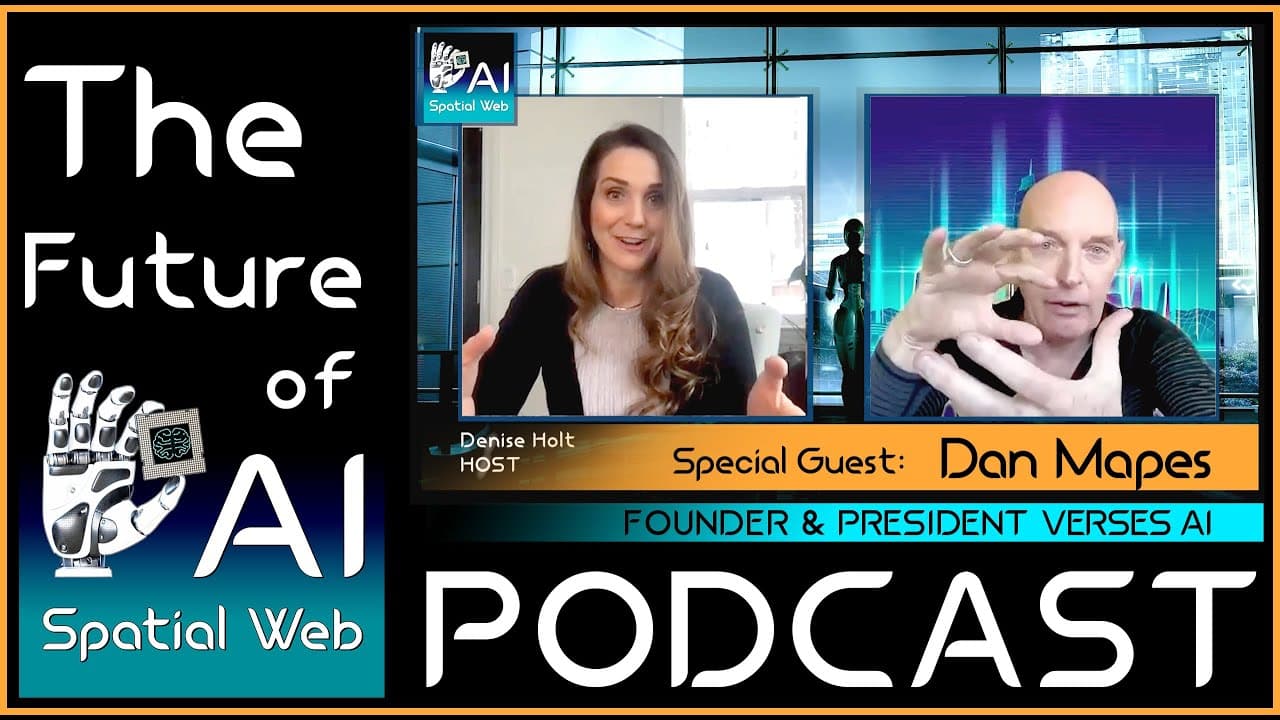
Special Guest Dan Mapes – Founder, VERSES AI | The Spatial Web, KOSM, & Active Inference AI
TL;DR
The Spatial Web, a new paradigm for the internet, is poised to revolutionize AI by offering a decentralized network of intelligent agents that can connect, learn, and assist individuals. This comprehensive analysis explores the architecture, potential applications, and benefits of the Spatial Web, while addressing concerns about security and alignment.
Transcript
foreign I have a very special guest on our show today and I'd love to welcome Dan Mapes president and co-founder of versus Ai and the founder and director of the spatial web Foundation Dan thank you so much for being here with us today and Welcome to our show great great to be here Denise great to see you again nice to see you so Dan um you guys ar... Read More
Key Insights
- ❓ The Spatial Web combines AI, 3D modeling, and the internet to create a network of intelligent agents that assist individuals in various domains.
- 💯 The architecture of the Spatial Web is built on three layers: interface, logic, and data, with AI acting as the core engine that connects and powers the network.
- 🤳 By leveraging self-sovereign identity, zero-knowledge proofs, and blockchain technology, the Spatial Web addresses security, privacy, and trust issues commonly associated with AI.
- 🕸️ The Spatial Web democratizes AI development, enabling anyone to build their own intelligent agents and contribute to the collective intelligence of the network.
- 😥 The distributed nature of the Spatial Web prevents single points of failure and ensures accountability, reducing the risk of malicious or uncontrollable AI behavior.
Install to Summarize YouTube Videos and Get Transcripts
Explore YouTube Video Summarizer or Get YouTube Transcript Extractor
Questions & Answers
Q: How does the Spatial Web address concerns about security and privacy in AI?
The Spatial Web incorporates self-sovereign identity and zero-knowledge proofs, allowing individuals to own and control their data. With blockchain technology, users can selectively share their information, ensuring privacy and mitigating surveillance risks.
Q: How does the Spatial Web enhance the capabilities of AI?
The Spatial Web provides a collaborative platform where millions of individuals can build and maintain their own AI applications. By connecting these intelligent agents, the collective wisdom of humanity can be leveraged to continuously improve AI capabilities and solve complex problems.
Q: Can AI assistants built on the Spatial Web become malicious or uncontrollable?
The decentralized nature of the Spatial Web eliminates the risk of a single AI becoming malicious or uncontrollable. Each AI assistant is maintained by its creator and can be monitored and corrected by the larger network. This distributed approach ensures accountability and prevents rogue AI behavior.
Q: What is the timeline for achieving AGI and superintelligence within the Spatial Web?
The timeline presented in the white paper outlines the steps towards AGI and superintelligence. While specific dates may vary, the focus is on the architecture and principles necessary for AGI development, fostering collective intelligence, and ensuring alignment with human values.
Key Insights:
- The Spatial Web combines AI, 3D modeling, and the internet to create a network of intelligent agents that assist individuals in various domains.
- The architecture of the Spatial Web is built on three layers: interface, logic, and data, with AI acting as the core engine that connects and powers the network.
- By leveraging self-sovereign identity, zero-knowledge proofs, and blockchain technology, the Spatial Web addresses security, privacy, and trust issues commonly associated with AI.
- The Spatial Web democratizes AI development, enabling anyone to build their own intelligent agents and contribute to the collective intelligence of the network.
- The distributed nature of the Spatial Web prevents single points of failure and ensures accountability, reducing the risk of malicious or uncontrollable AI behavior.
- The timeline for achieving AGI and superintelligence within the Spatial Web is a gradual process, focusing on continuous improvement, human-AI collaboration, and alignment with human values.
Summary & Key Takeaways
-
The Spatial Web combines AI and the internet to create a network of intelligent agents that can assist individuals in various applications, from healthcare to e-commerce.
-
By leveraging AI and 3D modeling technologies, the Spatial Web enables immersive experiences and enhances the way we interact with information, products, and services.
-
The architecture of the Spatial Web is based on three layers: interface, logic, and data, with AI acting as the core engine that powers the network and connects all the elements.
Read in Other Languages (beta)
Share This Summary 📚
Summarize YouTube Videos and Get Video Transcripts with 1-Click
Try YouTube Summary with ChatGPT & Claude or YouTube Transcript Generator