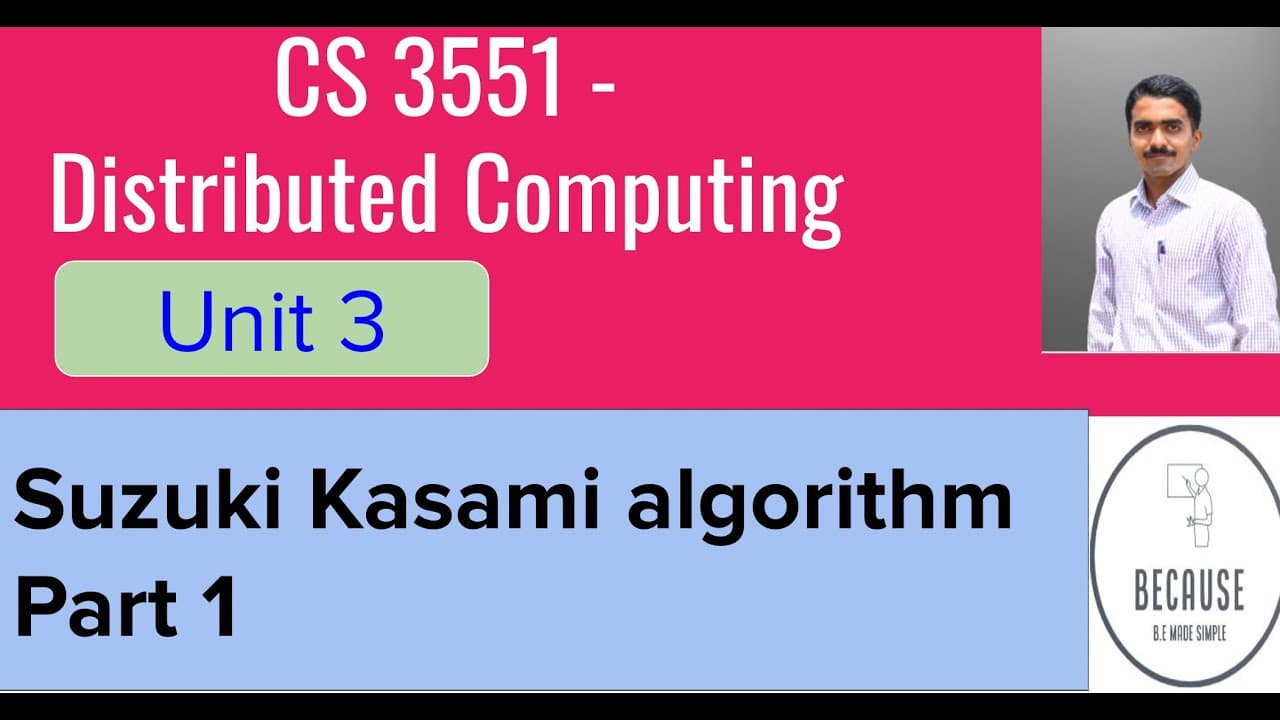
3.7 Suzuki Kasami Algorithm Part 1 in Tamil
TL;DR
Token-based mutual exclusion allows a site to enter the critical section if it possesses the token, which can be passed between sites.
Transcript
hi friends welcome back to in the video distributed computing token Bas the set of process Tok shared among the sites s is allowed to enter the critical section if it possesses the token a site holding the token can enter its critical section repeatedly until it sends the token to some other so site increments its sequence number every time it make... Read More
Key Insights
- 👻 Token-based mutual exclusion allows sites to access a critical section in a distributed system.
- ❓ The possession of the token determines which site can enter the critical section.
- 🧭 Sequence numbers are used to maintain the order of requesting and passing the token.
- 🥹 Mutual exclusion is guaranteed as only the site holding the token can enter the critical section.
- 👻 The token can be passed between sites, allowing multiple sites to access the critical section.
- #️⃣ Sequence numbers help prevent outdated messages and ensure the correct execution of the algorithm.
- ⚾ Token-based mutual exclusion ensures fairness by giving each site an equal chance to access the critical section.
Install to Summarize YouTube Videos and Get Transcripts
Explore YouTube Video Summarizer or Get YouTube Transcript Extractor
Questions & Answers
Q: What is token-based mutual exclusion in distributed computing?
Token-based mutual exclusion is a mechanism that allows a distributed system to ensure that only one site can access a critical section at a time. A site can enter the critical section if it possesses the token, which is passed between sites.
Q: How does a site obtain the token in token-based mutual exclusion?
A site can obtain the token by sending a request message with its sequence number. Once it receives the token, it can enter the critical section. The site can hold the token and enter the critical section repeatedly until it sends the token to another site.
Q: What is the purpose of sequence numbers in token-based mutual exclusion?
Sequence numbers are used to ensure the correct order of requesting and passing the token. Each site increments its sequence number every time it requests the token. This helps to prevent outdated messages and ensures the consistency of the token-based mutual exclusion algorithm.
Q: How does token-based mutual exclusion guarantee mutual exclusion?
Token-based mutual exclusion guarantees mutual exclusion because at any point in time, only the site holding the token can enter the critical section. Other sites have to wait until they receive the token to access the critical section. This ensures that only one site is executing the critical section at a time.
Key Insights:
- Token-based mutual exclusion allows sites to access a critical section in a distributed system.
- The possession of the token determines which site can enter the critical section.
- Sequence numbers are used to maintain the order of requesting and passing the token.
- Mutual exclusion is guaranteed as only the site holding the token can enter the critical section.
- The token can be passed between sites, allowing multiple sites to access the critical section.
- Sequence numbers help prevent outdated messages and ensure the correct execution of the algorithm.
- Token-based mutual exclusion ensures fairness by giving each site an equal chance to access the critical section.
- The algorithm can handle duplicate or outdated messages by ignoring them and relying on the latest sequence numbers.
Summary & Key Takeaways
-
Token-based mutual exclusion allows a site to enter the critical section if it possesses the token.
-
A site can enter its critical section repeatedly until it sends the token to another site.
-
Each site increments its sequence number every time it requests the token.
Read in Other Languages (beta)
Share This Summary 📚
Summarize YouTube Videos and Get Video Transcripts with 1-Click
Try YouTube Summary with ChatGPT & Claude or YouTube Transcript Generator
Explore More Summaries from BECAUSE 📚
Summarize YouTube Videos and Get Video Transcripts with 1-Click
Try YouTube Summary with ChatGPT & Claude or YouTube Transcript Generator