Demultiplexer - Digital Logic and Logic Families - Industrial Electronics
TL;DR
Demultiplexers are the reverse operation of multiplexers and distribute one input to multiple outputs based on select lines.
Transcript
Click the bell icon to get latest videos from Ekeeda Hello friends in this video we are going to see Demultiplexer demultiplexer is a reverse operation of a multiplexer where multiplexer we choose many to one in B multiplexer we choose from one to many that means data input will be one and that input will be connected to one of the output present s... Read More
Key Insights
- 👻 A demultiplexer is the reverse operation of a multiplexer, allowing one input to be distributed to multiple outputs.
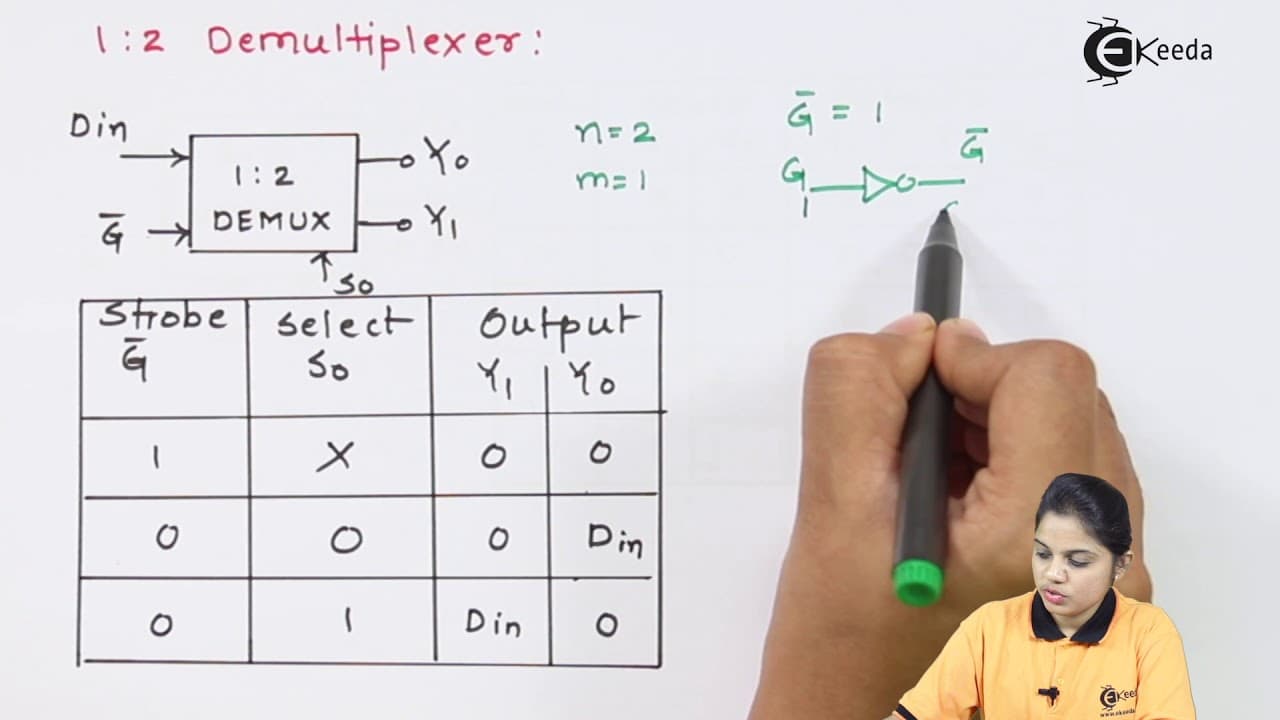
- 🫥 The number of output lines and select lines in a demultiplexer is determined by the equation n = 2^M, where n is the number of output lines and M is the number of select lines.
- 🫥 The strobe line, indicated by G bar, should be low (0) for the demultiplexer to produce an output based on the select lines.
- 🫥 Different types of demultiplexers, such as 1:2, 1:4, 1:8, and 1:16, can be designed and utilized based on the desired number of output lines.
- 🖐️ Demultiplexers play a crucial role in various electronic applications, including data routing and signal distribution.
- 🫥 Select lines in a demultiplexer represent different binary combinations that determine the output line to which the data input is connected.
- 🫥 The output lines in a demultiplexer remain at a low state (0) when the strobe line is high (1).
Install to Summarize YouTube Videos and Get Transcripts
Explore YouTube Video Summarizer or Get YouTube Transcript Extractor
Questions & Answers
Q: What is the purpose of a demultiplexer?
A demultiplexer is used to distribute one input to multiple outputs based on select lines. It performs the reverse operation of a multiplexer.
Q: How are the number of output lines and select lines determined in a demultiplexer?
The number of output lines in a demultiplexer is determined by the desired application, while the number of select lines is calculated using the equation n = 2^M, where n represents the number of output lines and M represents the number of select lines.
Q: What is the function of the strobe line in a demultiplexer?
The strobe line, indicated by G bar, determines the active state of the demultiplexer. It should be low (0) for the demultiplexer to produce an output according to the select lines.
Q: How does a 1:4 demultiplexer work?
In a 1:4 demultiplexer, also known as a 1-input and 4-output demultiplexer, the data input is directed to one of the four output lines based on the select lines. The select lines represent different binary combinations that determine the output line to which the data input is connected.
Summary & Key Takeaways
-
Demultiplexers, also known as decoders, distribute one input to multiple outputs based on select lines.
-
The number of output lines and select lines in a demultiplexer are determined by the equation n = 2^M.
-
Demultiplexers can be designed and used for various applications based on the desired number of output lines.
Read in Other Languages (beta)
Share This Summary 📚
Summarize YouTube Videos and Get Video Transcripts with 1-Click
Try YouTube Summary with ChatGPT & Claude or YouTube Transcript Generator
Explore More Summaries from Ekeeda 📚






Summarize YouTube Videos and Get Video Transcripts with 1-Click
Try YouTube Summary with ChatGPT & Claude or YouTube Transcript Generator