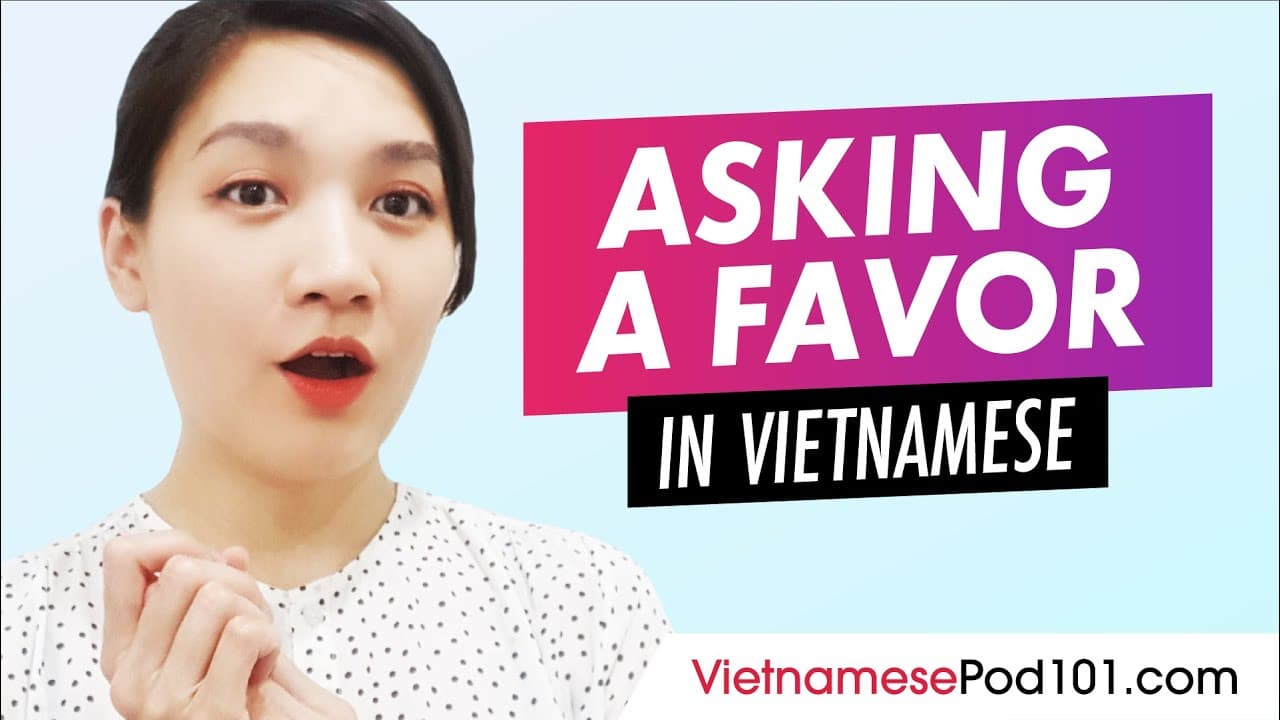
Asking for a Favor in Vietnamese | Vietnamese Grammar
TL;DR
Learn how to ask for favors in Vietnamese effectively.
Transcript
want to speak real Vietnamese from your first lesson sign up for your free lifetime account at vietnamesepod101.com how to ask someone for a favor in Vietnamese there are many ways to do so expressing invitations suggestions or requests or even asking someone not to do something so in this video today I'm going to introduce to you all of them so th... Read More
Key Insights
- The video introduces various methods to ask for favors in Vietnamese, focusing on different phrases and their usage.
- Using 'hi' and 'go' in sentences can help make requests more polite and convincing in Vietnamese.
- 'D' can be added at the end of sentences to emphasize requests, making them more compelling.
- The video explains that 'my' is used for invitations or offering help, and it can be replaced with 'S' for a more formal tone.
- For asking someone not to do something, 'd' is used, and adding the subject at the beginning makes the request more serious.
- The content emphasizes the importance of context in choosing the right word for making requests or invitations.
- The host provides examples to demonstrate the correct pronunciation and usage of each phrase in real-life scenarios.
- The video is designed for beginners and aims to improve listening comprehension and conversational skills in Vietnamese.
Install to Summarize YouTube Videos and Get Transcripts
Explore YouTube Video Summarizer or Get YouTube Transcript Extractor
Questions & Answers
Q: What is the main focus of the video?
The main focus of the video is to teach viewers how to ask for favors in Vietnamese. It covers various phrases and their appropriate usage, providing examples and pronunciation tips to help learners effectively communicate requests in different contexts.
Q: How does the video suggest making requests more convincing?
The video suggests making requests more convincing by adding 'D' at the end of sentences. This addition emphasizes the request and makes it more compelling, helping to ensure that the listener understands the importance or urgency of the favor being asked.
Q: What is the difference between 'hi' and 'go' in Vietnamese?
'Hi' and 'go' in Vietnamese both mean 'please' and are used to make polite requests. They are interchangeable in most contexts, and the choice between them depends on personal preference or regional dialects. The video provides examples to illustrate their usage in sentences.
Q: When should 'my' be used in Vietnamese requests?
'My' should be used in Vietnamese when inviting someone to do something or offering help. It is suitable for casual invitations, and the video also mentions that 'S' can be used as a more formal alternative, particularly in professional or formal settings.
Q: How does the video address asking someone not to do something?
The video addresses asking someone not to do something by using the word 'd,' which means 'don't.' This phrase can be strengthened by adding the subject at the beginning of the sentence, making the request more serious and emphasizing the importance of not performing the action.
Q: What is the target audience of the video?
The target audience of the video is absolute beginners learning Vietnamese. The content is designed to improve listening comprehension and conversational skills by teaching basic phrases and providing examples in simple Vietnamese and English, making it accessible to new learners.
Q: What resources does the video promote for learning Vietnamese?
The video promotes VietnamesePod101.com as a resource for learning Vietnamese. It encourages viewers to sign up for a free lifetime account to access lessons and materials designed to help learners quickly become conversational in Vietnamese, emphasizing the platform's effectiveness and ease of use.
Q: How does the video enhance listening comprehension skills?
The video enhances listening comprehension skills by providing examples of how to use various phrases in real-life scenarios. The host speaks in both Vietnamese and English, allowing viewers to hear the correct pronunciation and understand the context, thereby improving their ability to comprehend spoken Vietnamese.
Summary & Key Takeaways
-
The video provides an overview of how to ask for favors in Vietnamese, using various phrases such as 'hi,' 'go,' and 'd.' It offers examples and tips for making requests more effectively.
-
Different contexts require different words for making requests. 'My' is used for invitations, while 'd' is used to ask someone not to do something, with examples provided for clarity.
-
Designed for beginners, the video aims to improve listening and speaking skills in Vietnamese, with the host explaining the nuances of each phrase in simple terms.
Read in Other Languages (beta)
Share This Summary 📚
Summarize YouTube Videos and Get Video Transcripts with 1-Click
Try YouTube Summary with ChatGPT & Claude or YouTube Transcript Generator
Explore More Summaries from Learn Vietnamese with VietnamesePod101.com 📚




Summarize YouTube Videos and Get Video Transcripts with 1-Click
Try YouTube Summary with ChatGPT & Claude or YouTube Transcript Generator