AutoML with Hyperband
TL;DR
Hyper Band optimizes hyperparameter tuning for machine learning efficiently.
Transcript
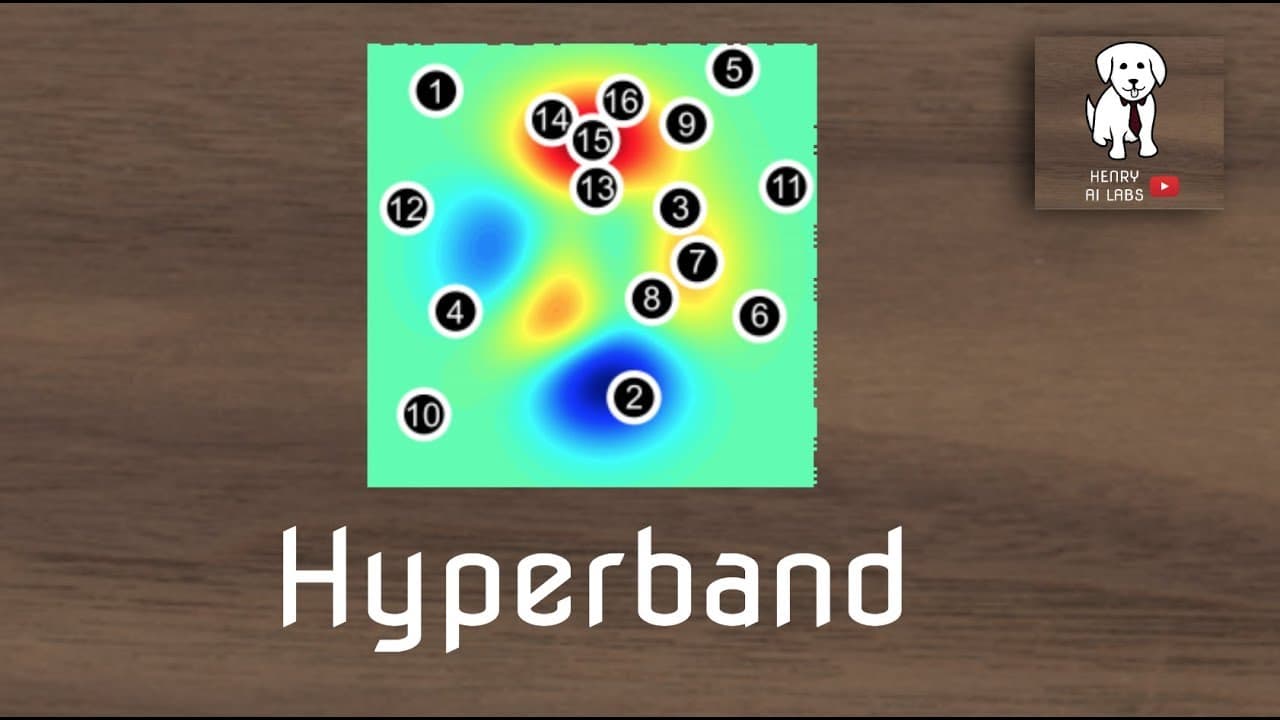
this video will explain the hyper band algorithm for auto ml auto ml refers to the general practice of hyper parameter optimization in machine learning in this case this algorithm is going to show a way to speed up the evaluations of different hyper parameter configurations so hyper parameter optimization can be defined as a discrete search space o... Read More
Key Insights
- 🎰 Hyperparameter optimization is essential for improving machine learning models but can be computationally expensive with numerous configurations.
- ⌛ Hyper Band leverages resource allocation strategies to reduce the time spent on configurations unlikely to perform well from the outset.
- ✳️ Early stopping can be beneficial but carries risks of prematurely dismissing configurations that might yield better results with further training.
- 👻 The algorithm's random resource allocation allows better explorations of various hyperparameter behaviors, increasing the likelihood of discovering optimal solutions.
- 👨🔬 Comparing Hyper Band with traditional methods, like grid search or random search, highlights its efficient handling of resource distribution and evaluation depth.
- 🥋 Successive halving, although effective, can suffer from a uniform approach that might not explore configurations' varied convergence behaviors effectively.
- 🦔 Hyper Band's adaptability regarding convergence behavior enables it to maintain a competitive edge in the evolving landscape of deep learning optimization.
Install to Summarize YouTube Videos and Get Transcripts
Explore YouTube Video Summarizer or Get YouTube Transcript Extractor
Questions & Answers
Q: What is the main purpose of Hyper Band in machine learning?
Hyper Band aims to optimize hyperparameter tuning processes in machine learning by speeding up the evaluations of various configurations. Given the typically long training times required for deep neural networks to converge, Hyper Band efficiently allocates resources to configurations, allowing quicker identification of the most promising setups without exhaustive training for each one.
Q: How does early stopping factor into the Hyper Band algorithm?
Early stopping plays a crucial role in Hyper Band by allowing configurations that show suboptimal performance to be terminated early, thus saving computational resources. However, it can be problematic, as early stopping can misjudge a configuration's potential based on its early performance. Hyper Band uses this mechanism cautiously, often adapting based on convergence behaviors to ensure more accurate evaluations.
Q: What are some strategies used in Hyper Band to optimize resource allocation?
Hyper Band employs strategies like dividing the total training budget into chunks and randomly distributing resources across configurations. This contrasts with uniform allocation, allowing exploration of different behaviors among configurations. The algorithm iteratively narrows down the configurations, focusing resources on those showing the most promise to find the best-performing hyperparameters quickly.
Q: Can you explain the concept of stochastic vs. non-stochastic bandit algorithms in the context of Hyper Band?
Stochastic bandit algorithms, such as those used in Hyper Band, assume that outcomes can vary due to inherent randomness in model training, like different initial weights or data presentation. Conversely, non-stochastic assumptions imply fixed performance based solely on the hyperparameters. Hyper Band recognizes the stochastic nature of hyperparameter optimization, as results can significantly differ even with the same settings when considering random factors like initialization and data order.
Summary & Key Takeaways
-
The Hyper Band algorithm enhances the efficiency of hyperparameter optimization by speeding up the evaluation of configurations, which can become extensive due to the vast number of combinations in deep learning architectures.
-
It utilizes three main strategies: early stopping, training on subsets of data, and resource allocation to evaluate different configurations quickly without the need for full convergence on each one.
-
The algorithm primarily leverages a stochastic approach to resource distribution rather than uniform allocation, allowing better exploration of various hyperparameter behaviors and improving the chances of finding optimal configurations.
Read in Other Languages (beta)
Share This Summary 📚
Summarize YouTube Videos and Get Video Transcripts with 1-Click
Try YouTube Summary with ChatGPT & Claude or YouTube Transcript Generator
Explore More Summaries from Connor Shorten 📚
Summarize YouTube Videos and Get Video Transcripts with 1-Click
Try YouTube Summary with ChatGPT & Claude or YouTube Transcript Generator