Summer School 2025 Day 05
TL;DR
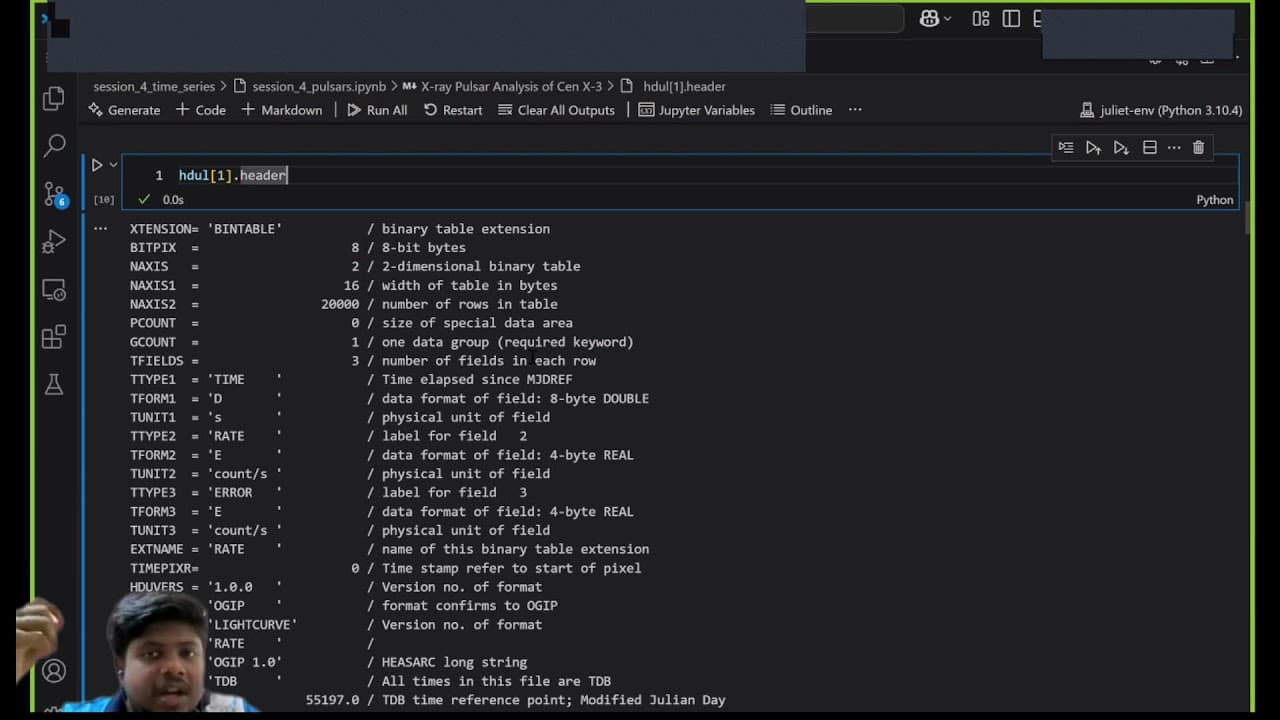
Exploring time series data analysis for pulsars in X-ray astronomy.
Transcript
so good morning everyone hello everyone i hope you are doing good today is a Monday so I hope you all are fresh as well today we will be having a session on how to analyze some of the time series data in astronomy now as previously mentioned we saw how what kind of data astronomy provides some are time series some are spectrum some are just image t... Read More
Key Insights
- Time series data in astronomy involves recording photon emissions over time, crucial for studying variable sky objects.
- X-ray astronomy differs from optical astronomy by focusing on X-ray photon detection, used for analyzing objects like X-ray pulsars.
- Centaurus X3, an X-ray pulsar, is a neutron star with periodic brightening and dimming due to its rotation and magnetic field emissions.
- Binning in time series analysis helps clarify data trends by grouping photon counts over specific time intervals, enhancing signal clarity.
- Fourier transform in time series converts data from time to frequency domain, aiding in identifying periodic signals like pulsar emissions.
- Folding light curves by known periods enhances periodic signals, making pulsar brightening phases visually apparent.
- Time series analysis techniques are applicable in exoplanet studies, detecting periodic dimming as planets transit stars.
- Astronomical software packages like Stingray and libraries in Python streamline time series analysis, saving time for scientific exploration.
Install to Summarize YouTube Videos and Get Transcripts
Explore YouTube Video Summarizer or Get YouTube Transcript Extractor
Questions & Answers
Q: What is the significance of time series data in astronomy?
Time series data in astronomy is crucial for studying variable celestial objects by capturing photon emissions over time. This data helps astronomers analyze changes in brightness or emissions, essential for understanding phenomena like pulsars, exoplanet transits, and other astrophysical events. The data provides insights into the temporal behavior of these objects, enabling detailed scientific analysis.
Q: How does X-ray astronomy differ from optical astronomy?
X-ray astronomy focuses on detecting X-ray photons emitted by celestial objects, unlike optical astronomy, which observes visible light. X-ray telescopes capture high-energy emissions, often from extreme environments like neutron stars or black holes, providing insights into phenomena not visible in optical wavelengths. This field is essential for studying objects like X-ray pulsars, which emit primarily in the X-ray spectrum.
Q: What is Centaurus X3 and why is it significant?
Centaurus X3 is an X-ray pulsar, a type of neutron star that exhibits periodic brightening and dimming due to its rotation and magnetic field emissions. It is significant because it provides a clear example of how time series data can reveal periodic signals. Studying such objects helps astronomers understand the life cycle of massive stars and the behavior of neutron stars, contributing to our knowledge of stellar evolution.
Q: What role does binning play in time series analysis?
Binning is a technique used in time series analysis to group photon counts over specific time intervals, enhancing signal clarity. By reducing the time resolution, binning helps highlight trends and periodic signals that might be obscured by noise in high-resolution data. This method is particularly useful in astronomy for clarifying light curves and identifying phenomena like pulsar emissions or exoplanet transits.
Q: How does Fourier transform aid in analyzing time series data?
Fourier transform converts time series data from the time domain to the frequency domain, aiding in identifying periodic signals. In astronomy, this technique helps detect periodic emissions from objects like pulsars by highlighting frequencies with significant power. The process reveals hidden periodicities in the data, essential for understanding the rotational behavior of neutron stars or the orbital periods of exoplanets.
Q: What is the concept of folding in light curve analysis?
Folding in light curve analysis involves stacking light curve segments based on known periods, enhancing periodic signals. This technique is used to make pulsar brightening phases visually apparent by aligning and averaging data over multiple cycles. Folding reduces noise and emphasizes the periodic nature of the signal, providing a clearer view of the object's behavior over time.
Q: How is time series analysis used in exoplanet studies?
In exoplanet studies, time series analysis detects periodic dimming in a star's light curve, indicating potential planetary transits. As a planet crosses in front of its host star, it causes a temporary decrease in brightness, creating a characteristic dip in the light curve. Analyzing these patterns helps astronomers identify and study exoplanets, providing insights into their orbits and characteristics.
Q: What tools or software are used for time series analysis in astronomy?
Astronomers use various tools and software for time series analysis, such as the Stingray package for X-ray astronomy, which includes functions for Fourier transform and light curve folding. Python libraries like NumPy and Matplotlib facilitate data processing and visualization. These tools streamline the analysis process, allowing astronomers to focus on scientific exploration rather than coding from scratch.
Summary & Key Takeaways
-
Time series data in astronomy captures photon emissions over time, essential for analyzing variable celestial objects. This session focuses on X-ray astronomy, particularly studying X-ray pulsars like Centaurus X3, a neutron star. The session demonstrates techniques like binning and Fourier transform to analyze time series data.
-
Centaurus X3, an X-ray pulsar, exhibits periodic brightening and dimming due to its rotation and magnetic field emissions. Binning helps clarify this data by grouping photon counts over time intervals. Fourier transform converts time series data to frequency domain, identifying periodic signals like pulsar emissions.
-
Folding light curves using known periods enhances periodic signals, making pulsar brightening phases more apparent. The session also highlights the applicability of time series analysis in exoplanet studies, where periodic dimming indicates planetary transits. Astronomical software packages streamline these analyses, aiding scientific exploration.
Read in Other Languages (beta)
Share This Summary 📚
Summarize YouTube Videos and Get Video Transcripts with 1-Click
Try YouTube Summary with ChatGPT & Claude or YouTube Transcript Generator
Explore More Summaries from India Space Academy 📚
Summarize YouTube Videos and Get Video Transcripts with 1-Click
Try YouTube Summary with ChatGPT & Claude or YouTube Transcript Generator