How Does Ethereum's Layer 2 Enhance Scalability?
TL;DR
Ethereum's evolution into a 'world computer' is marked by its transition from proof of work to proof of stake and the introduction of layer 2 solutions. These changes enhance scalability and security, allowing Ethereum to support a diverse range of decentralized applications. The ecosystem's focus is shifting towards application development, leveraging improved decentralization and client diversity.
Transcript
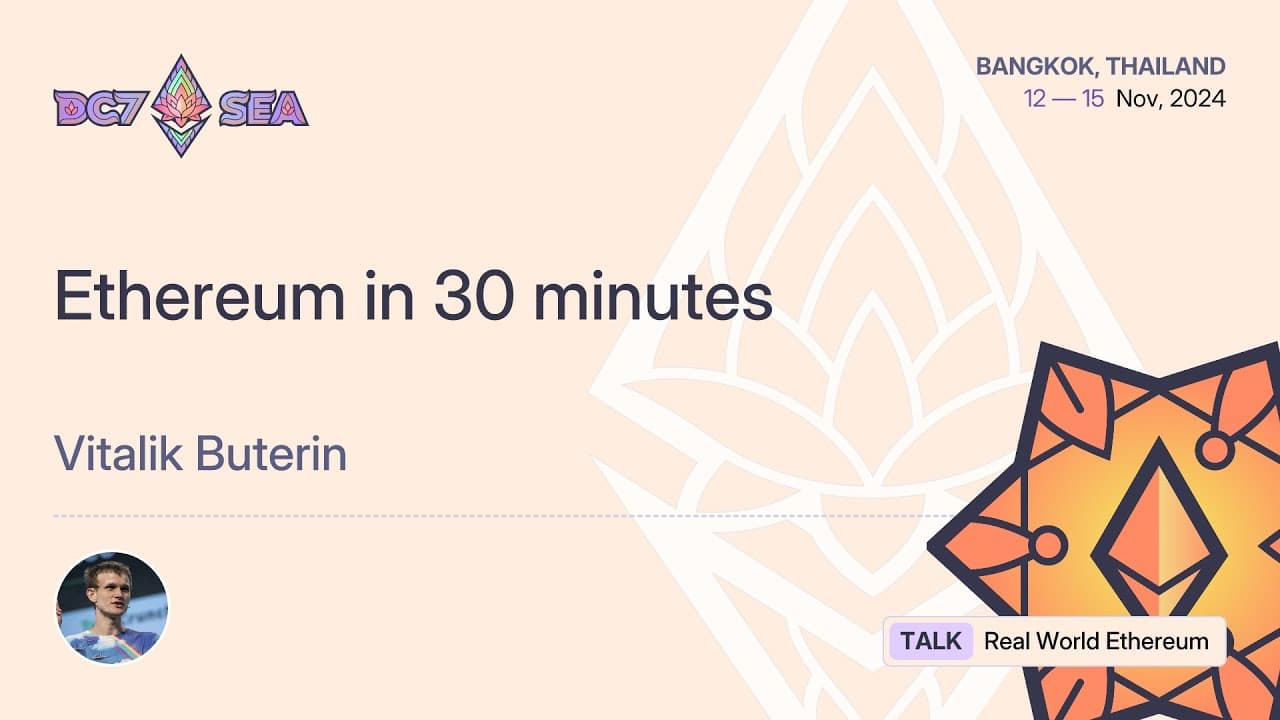
great so ethereum in uh 30 minutes so this is a a presentation that I've given at I think basically every single Devcon since launch though I think what's interesting is how as uh ethereum the ecosystem uh changes and as ethereum the protocol changes as the times change uh the contents also end up changing quite a bit right so if yo... Read More
Key Insights
- Ethereum is evolving from a basic infrastructure to a robust application platform.
- Layer 1 is the foundation, ensuring decentralization and security.
- Layer 2 solutions enhance scalability, reducing transaction fees significantly.
- Ethereum's transition to proof of stake has increased decentralization.
- Client diversity in Ethereum mitigates risks associated with single points of failure.
- Ethereum's roadmap includes further decentralization and quantum resistance upgrades.
- Developers are encouraged to build mixed financial and non-financial applications.
- Ethereum's ecosystem is poised for innovation with its improved technological base.
Install to Summarize YouTube Videos and Get Transcripts
Explore YouTube Video Summarizer or Get YouTube Transcript Extractor
Questions & Answers
Q: How does Ethereum's layer 2 improve scalability?
Ethereum's layer 2 solutions improve scalability by significantly reducing transaction fees and increasing transaction speed. Layer 2 acts as an extension of the core Ethereum blockchain (layer 1), handling more transactions off-chain while ensuring security through optimistic and zero-knowledge proofs. This allows Ethereum to support a larger number of applications and users without compromising on security or decentralization.
Q: What is the role of layer 1 in Ethereum?
Layer 1 in Ethereum serves as the foundational blockchain, providing security, decentralization, and robustness. It acts as an anchor for the ecosystem, ensuring that all transactions and smart contracts are executed according to the network's consensus rules. While not designed for high-speed transactions, layer 1 is crucial for maintaining the integrity and trustworthiness of the Ethereum network.
Q: Why is client diversity important for Ethereum?
Client diversity is crucial for Ethereum as it prevents single points of failure and enhances the network's resilience. By having multiple clients, Ethereum can mitigate the risks associated with bugs or vulnerabilities in any one client. This diversity ensures that the network remains secure and operational even if a bug affects a particular client, as users can switch to alternative clients to continue operations.
Q: How has Ethereum's transition to proof of stake improved decentralization?
Ethereum's transition to proof of stake has improved decentralization by allowing a more diverse set of validators to participate in securing the network. Unlike proof of work, which relies on energy-intensive mining, proof of stake requires validators to hold and lock up a certain amount of ether. This reduces the centralization of mining power and makes it easier for more participants to contribute to the network's security.
Q: What are the future upgrades planned for Ethereum?
Future upgrades for Ethereum focus on enhancing decentralization, censorship resistance, and quantum resistance. These upgrades aim to improve the network's scalability and efficiency, particularly through data availability sampling and increased use of stateless clients. The roadmap includes continued development of layer 2 solutions and efforts to make staking more accessible, ensuring Ethereum's long-term sustainability and security.
Q: What types of applications can Ethereum support with its current infrastructure?
With its current infrastructure, Ethereum can support a wide range of applications, including decentralized finance (DeFi), non-fungible tokens (NFTs), decentralized autonomous organizations (DAOs), and more. The introduction of layer 2 solutions has made it feasible to run high-value applications on Ethereum, offering low transaction fees and fast processing times, which are crucial for user adoption and application viability.
Q: How does Ethereum maintain security with layer 2 solutions?
Ethereum maintains security with layer 2 solutions by using optimistic and zero-knowledge proofs to verify off-chain transactions. Layer 2 solutions are connected to the layer 1 blockchain, which acts as a secure base. This architecture ensures that even if a layer 2 solution fails or is attacked, users can revert to layer 1 to secure their assets and continue operations, maintaining the overall security and integrity of the network.
Q: Why is Ethereum considered a 'world computer'?
Ethereum is considered a 'world computer' because it provides a decentralized platform for executing smart contracts and decentralized applications (dApps) across a global network. This allows developers to build and deploy applications that run exactly as programmed without downtime, fraud, or third-party interference. The term reflects Ethereum's capability to serve as a universal platform for decentralized computing.
Summary & Key Takeaways
-
Ethereum has transitioned from proof of work to proof of stake, improving its decentralization and scalability. This evolution is supported by layer 2 solutions, which significantly reduce transaction costs and enhance speed. As a result, Ethereum is now a robust platform for decentralized applications.
-
Layer 1 serves as Ethereum's secure and decentralized core, while layer 2 provides scalability and speed. This dual-layer approach allows for a wide variety of applications, ensuring Ethereum's continued growth and relevance in the blockchain space.
-
Vitalik Buterin highlights Ethereum's progress and future potential, emphasizing the importance of client diversity and the ecosystem's ability to adapt and improve. Developers are encouraged to innovate using Ethereum's evolving infrastructure, focusing on applications beyond mere financial transactions.
Read in Other Languages (beta)
Share This Summary 📚
Summarize YouTube Videos and Get Video Transcripts with 1-Click
Try YouTube Summary with ChatGPT & Claude or YouTube Transcript Generator
Explore More Summaries from Ethereum Foundation 📚





Summarize YouTube Videos and Get Video Transcripts with 1-Click
Try YouTube Summary with ChatGPT & Claude or YouTube Transcript Generator