Momentum (16 of 16) Elastic Collisions, Example 6
TL;DR
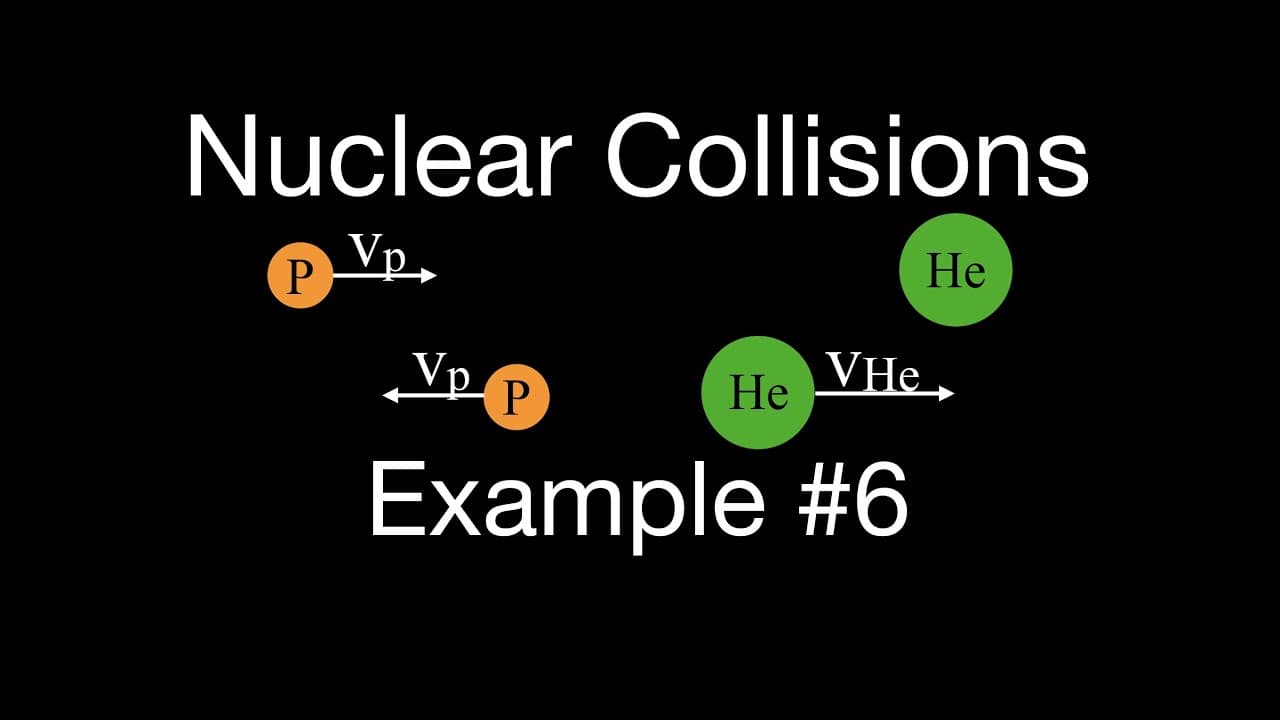
Proton collides elastically with helium nucleus, resulting in opposite directions of motion.
Transcript
okay in - I thought go over one more problem involving elastic collision and this is gonna be nuclear elastic listen this what might occur in a particle accelerator so we're gonna be using the nuclear particles but it's really the same thing masses and velocities so in this case we have a proton there's a mass of 1.0 one atomic mass units is travel... Read More
Key Insights
- 💥 Conservation of momentum plays a crucial role in determining the final velocities of particles in an elastic collision.
- 💥 The mass and initial velocities of the colliding particles dictate their resulting velocities after the collision.
- 💥 Elastic collisions between nuclear particles exhibit similar principles to other particle collisions.
- 💥 Kinetic energy and momentum can be used to verify the calculated final velocities in an elastic collision scenario.
Install to Summarize YouTube Videos and Get Transcripts
Explore YouTube Video Summarizer or Get YouTube Transcript Extractor
Questions & Answers
Q: What are the initial and final velocities of the proton and helium nucleus in the elastic collision scenario described?
The initial velocity of the proton is 4.50 x 10^6 m/s, and post-collision, it bounces back with a negative velocity. The helium nucleus, initially at rest, moves off with a velocity of 1.81 x 10^6 m/s.
Q: How does the mass and initial velocity of the helium nucleus impact its final velocity after the elastic collision?
The mass of the helium nucleus being greater and its initial velocity being zero results in a final velocity of 1.81 x 10^6 m/s, moving in the opposite direction as the proton.
Q: Why is the final velocity of the proton negative in the given elastic collision problem?
The negative final velocity of the proton indicates that it bounces back in the opposite direction after colliding with the helium nucleus due to the conservation of momentum in the system.
Q: How can one verify the calculated final velocities of the particles in the elastic collision scenario?
By checking the conservation of momentum and kinetic energy in the system, one can verify the calculated final velocities of the proton and helium nucleus post-collision.
Summary & Key Takeaways
-
A proton with a mass of 1.0 atomic mass units and velocity of 4.50 x 10^6 m/s collides elastically with a helium nucleus at rest, leading to opposite velocities post-collision.
-
The final velocity of the proton is negative, bouncing back in the opposite direction, while the helium nucleus moves off with a velocity of 1.81 x 10^6 m/s.
-
Conservation of momentum and kinetic energy can be checked to verify the calculated final velocities for the particles.
Read in Other Languages (beta)
Share This Summary 📚
Summarize YouTube Videos and Get Video Transcripts with 1-Click
Try YouTube Summary with ChatGPT & Claude or YouTube Transcript Generator
Explore More Summaries from Step by Step Science 📚

Summarize YouTube Videos and Get Video Transcripts with 1-Click
Try YouTube Summary with ChatGPT & Claude or YouTube Transcript Generator